How exactly should Alocasia amazonica be grown to get it right?
Alocasia amazonica belongs to the terrestrial ferns, with plants reaching up to 90cm tall. The rhizome is horizontal or slanting, thick and short, with brown short glandular hairs at the top. Leaves are clustered; the petiole is 25-50cm long, with a longitudinal groove on the ventral side, densely covered with brown short glandular hairs when young, gradually falling off later; both the rachis and pinnate rachis are sparsely covered with brown glandular hairs, and the rachis often bears an ovate bud, brownish green; the blade is membranous, narrowly ovate or triangular-elliptic, 30-45cm long, 18-36cm wide, four times pinnately finely divided; the primary pinnae are 10-15 pairs, nearly opposite, stalked, narrowly ovate, the first pair of pinnae the largest, 14-24cm long, 8-12cm wide; the secondary pinnae are about 15 pairs, alternate, short-stalked, narrowly ovate to lanceolate, 4-7cm long, 1.2-2cm wide; the tertiary pinnae are 8-10 pairs, alternate, short-stalked, obliquely oblong, 6-8mm long, 5-6mm wide, each side with 1-2 pointed lobes; leaf veins pinnate, lateral veins forked within the lobes. Sori small, round, borne near the apex of the veinlets on the back of the leaf, without indusium.
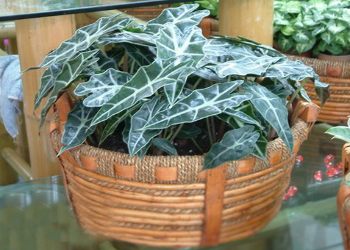
Character identification: rhizome cylindrical, thick and short. Surface brown, cross-section shows yellow-white vascular bundles. Petiole 25-40cm long, about 3.5mm in diameter, straw-colored, herbaceous, densely covered with rusty glandular hairs; blade triangular-oblong, 25-40cm long, 18-30cm wide, four times pinnately finely divided, membranous, brownish green; rachis and pinnate rachis have rusty glandular hairs, and the rachis often bears 1-3 bulbils axillary at the base of the pinnae above the middle. Sori round and small, borne near the apex on the veinlets. Slight odor, slightly astringent taste.
Alocasia amazonica is a high-grade, uniquely styled indoor foliage plant. At present, Alocasia amazonica is very popular in the international foliage plant market, and it is widely used in high-end indoor garden design and waterscape design. To date, Israel's Carmel company is world-renowned for producing Alocasia amazonica.
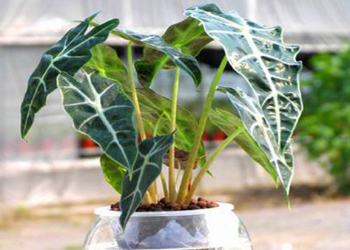
Environmental benefits: it has a slight effect on absorbing indoor toxic gases, absorbs dust, sterilizes, purifies the air, filters turbid air, and can slightly increase indoor humidity. Application: Alocasia amazonica has a compact, upright plant form, with broad, thick leaves that have a special metallic luster; the leaf veins are clear as a painting, full of poetic charm, making it a uniquely styled foliage plant and one of the foliage plants popular at home and abroad in recent years. Alocasia amazonica is widely used. It can be planted in small and medium pots to decorate studies, living rooms, bedrooms and offices, appearing noble and elegant.
Temperature: its ecological habit is to prefer a warm, humid, semi-shaded growing environment, with an optimum growing temperature of 20-30°C and an overwintering temperature of 15°C.
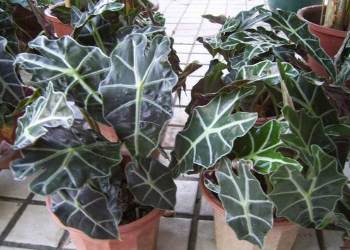
Propagation: Alocasia amazonica is commonly propagated by division. Generally, when temperatures are higher in spring and summer each year, divide the plants whose underground tubers have tillered and grown densely along the separation points of the tubers, so that each part has 2-3 plants, then pot them separately. When dividing, damage the roots as little as possible, and after potting, place them in a shaded, humid environment, keep the potting soil often moist, and pay attention to misting the leaves to help the new plants recover growth. You can also dig out the underground tubers before new buds sprout in spring, cut the tubers into sections, disinfect and preserve the wounds with plant ash or sulfur powder, let them dry slightly, then wrap them in sphagnum moss, or place them in loose, well-aerated and well-drained soil, so that they grow adventitious roots and sprout new buds. During this period, never let the substrate be too wet, to avoid tuber rot. This plant can also be propagated by sowing, but seeds are not easy to obtain.
Soil: for potted Alocasia amazonica, use loose, well-drained and well-aerated soil rich in humus; generally, equal parts of leaf mold, garden soil and river sand mixed together can be used as the substrate.
Watering: April-September is its vigorous growth period, when the soil should be moist and the air humidity relatively high, and sufficient water should be given; especially in the high-temperature summer period, the leaves evaporate a lot of water and need more water. If short of water, the leaves easily wilt, so the leaves must be misted frequently while keeping the environment humid, but water accumulation in the pot must be avoided, otherwise it will cause root rot. In autumn, when the temperature is below 15°C, the growth of Alocasia amazonica stagnates and it enters a dormant state, and the aboveground leaves gradually begin to wither; at this time, reduce watering as much as possible, place it in a warm, windless, dry place, and keep the potting soil appropriately dry (only slightly moist) to help it overwinter safely; if the humidity is high and the temperature low, the tubers rot very easily.
Light: Alocasia amazonica prefers semi-shade and must never be exposed to strong sunlight. In a semi-shaded environment, the leaf color is fresh and tender with luster, the leaf veins are clear, and the leaf color is dark green. If the light is too strong, the leaf color easily becomes dull, even causing sunscald, with rough leaf surface, grayish-white leaf color, blurred leaf veins, and sometimes scorch spots on the leaf surface; but too weak light also easily causes leggy growth, with the plant growing thin and tending to lodge. During the vigorous growth period, apply 1-2 times a month of dilute liquid fertilizer according to the plant's growth, and additionally apply phosphorus and potassium fertilizer, to help the stems stand upright and grow robustly, and at the same time to help the underground tubers grow plump and resist cold for overwintering.
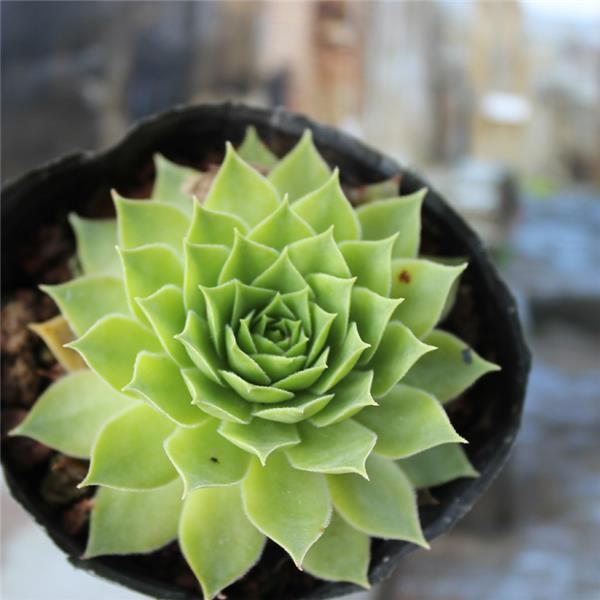
Alocasia amazonica is said to be able to purify the air and absorb dust and so on, but this is actually an exaggeration. The succulent type of Alocasia amazonica only has a slight effect of absorbing toxic gases and slightly increasing humidity. In fact, the main effect of Alocasia amazonica is to treat typhoid diarrhea, rheumatism, rhinitis and various skin diseases.
The whole plant of Alocasia amazonica is toxic, with the greatest toxicity in the stem. If the skin comes into contact with the sap, it causes itching; if it accidentally gets into the eyes, it can lead to blindness; if accidentally swallowed, the throat and tongue become itchy, swollen and painful, with nausea and vomiting, and in the most severe cases, it can cause cardiac paralysis and then death. So be extra careful when growing it.
The plant grows thin and tends to lodge. During the vigorous growth period, apply 1-2 times a month of dilute liquid fertilizer according to the plant's growth, and additionally apply phosphorus and potassium fertilizer, to help the stems stand upright and grow robustly, and at the same time to help the underground tubers grow plump and resist cold for overwintering.
Alocasia amazonica is said to be able to purify the air and absorb dust and so on, but this is actually an exaggeration. The succulent type of Alocasia amazonica only has a slight effect of absorbing toxic gases and slightly increasing humidity. In fact, the main effect of Alocasia amazonica is to treat typhoid diarrhea, rheumatism, rhinitis and various skin diseases.
The whole plant of Alocasia amazonica is toxic, with the greatest toxicity in the stem. If the skin comes into contact with the sap, it causes itching; if it accidentally gets into the eyes, it can lead to blindness; if accidentally swallowed, the throat and tongue become itchy, swollen and painful, with nausea and vomiting, and in the most severe cases, it can cause cardiac paralysis and then death. So be extra careful when growing it.