What are the causes of yellowing pothos leaves and how to fix them
What to do when the leaves of the pothos you keep at home turn yellow. If you are still troubled by the leaves of your home pothos turning yellow, here is a detailed explanation of how to handle this situation.
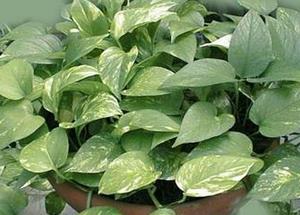
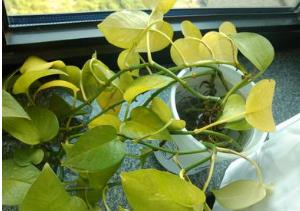
Overall, when pothos leaves turn yellow, if it is grown in water, it is mostly because there are bacteria in the water; if it is grown in soil, it may be that the roots are rotting. Relatively speaking, water-grown pothos is more likely to develop yellow leaves than soil-grown pothos.
1. Causes of yellowing pothos leaves
The main causes of yellowing pothos leaves are: 1. too much watering 2. lack of sunlight 3. lack of fertilizer
First, pothos itself is not tolerant of low temperatures. Prolonged low temperatures combined with excessive water will lead to root rot, resulting in an insufficient water supply from the roots, and eventually the leaves at the base begin to turn yellow, while the leaves at the top lose their luster and feel soft and mushy when touched. Try drenching the roots with root rot remedy; if it does not work, the only option is to cut off the vines that do not have yellow leaves and re-cutt them. In winter, keep the pot soil slightly on the dry side, and do not water unless it is dry.
Second, there is another situation: if the root system is fine, then it is a lack of fertilizer. Long-term lack of nitrogen fertilizer will also cause the leaves at the base to turn yellow. In this case, the leaves at the top still feel firm.
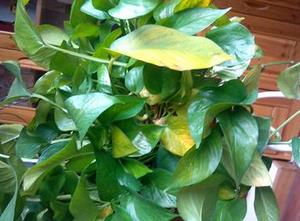
1. Light: the original growing conditions of pothos are in forests shaded by towering trees, so it is not strongly heliotropic. But in the north in autumn and winter, in order to make up for the lack of temperature and photosynthesis, its light exposure should be increased. The method is to place the pothos in the spot with the best indoor light, or move it to a sealed balcony at noon to sunbathe. At the same time, when the temperature is low, open windows as little as possible, because in a very short time the leaves may be frostbitten.
2. Temperature: in the north, with an indoor temperature above 10 degrees, pothos can safely overwinter, and with an indoor temperature above 20 degrees, pothos can grow normally. Generally, households have no problem reaching this temperature. What needs attention is avoiding excessive temperature differences, and also making sure the leaves do not get close to heating equipment.
3. Humidity: this refers to the moisture content of the air in the plant's growing environment. Under the condition of ensuring normal temperature, increasing humidity is extremely beneficial to plant growth. The following methods can be used to increase humidity. Place the plant near a humidifier, with the humidifier running for more than 5 hours a day, so the plant can enjoy the mist sprayed out by the humidifier; use a sprayer adjusted to the mist setting to spray water on the plant's leaves, stems and aerial roots, several times a day; keep an appropriate amount of water in the saucer under the pot, and increase the plant's local humidity through its evaporation; gently wipe the leaf surface with a cold wet towel or toilet paper, or lightly apply it to the leaf surface for a short time (1-2 hours per day); cover the plant with a transparent plastic film to create a small greenhouse effect, supplementing the plant's moisture through evaporation of water vapor from the soil, for no more than 2 hours a day, as too long will affect the plant's ventilation and photosynthesis.
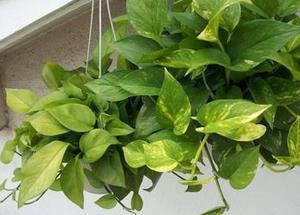
Fertilizer: in the autumn and winter seasons in the north, plants mostly grow slowly or even stop growing, so fertilization should be reduced. Before the beginning of winter, mainly apply liquid inorganic fertilizer by watering and spraying, about once every 15 days. After the beginning of winter, fertilization should mainly be foliar spraying, applied mainly through the stomata on the leaf surface, so that the fertilizer effect can act directly on the leaf surface. Special fertilizer should be used for foliar fertilizer; ordinary inorganic fertilizer is not easily absorbed by the leaf surface.
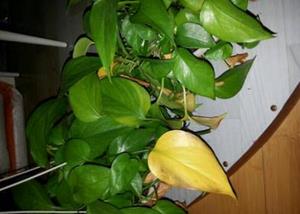
Since pothos can be propagated by cuttings, each node of its stems has a leaf bud, and taking just one node for planting can allow it to grow.
Therefore, when the leaves of the pothos being grown turn yellow severely, the rotten roots can be removed, and the yellow leaves picked off before re-cutt and planting. Note that when growing in water, it should be changed to fresh water.
You can also cut off the vines whose leaves have not yet turned yellow and re-cutt and plant them. During the cutting and planting process, two to three nodes should be buried; for water culture it is likewise two to three nodes, and the water should be changed once every three or four days, preferably using cold boiled water.
Just after cutting and planting, it must not be exposed to direct strong light. It can be placed in a position with weaker light. In about 20 days, the newly planted pothos will take root and grow.
1. The main causes are: the first is too much watering. The second is that there may be mold;
2. How to handle it:
1. How to handle pothos that has been watered too much
For soil-grown pothos, pay attention to controlling water, otherwise there will be a lack of oxygen. Pothos grows slowly, so watering should be strictly controlled
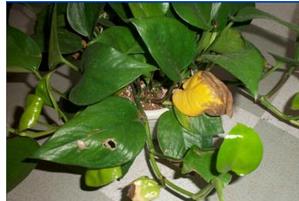
Pothos is said to be very easy to grow, but it is also prone to root mold. For some pothos that have been grown for a relatively long time, I always cut them off and re-cutt them. When the original soil is turned out, you will see a lot of moldy roots, and it must be exposed to the sun for a long time before being used again.
and pick off the yellow leaves before re-cutt and planting. Note that when growing in water, it should be changed to fresh water.
You can also cut off the vines whose leaves have not yet turned yellow and re-cutt and plant them. During the cutting and planting process, two to three nodes should be buried; for water culture it is likewise two to three nodes, and the water should be changed once every three or four days, preferably using cold boiled water.
Just after cutting and planting, it must not be exposed to direct strong light. It can be placed in a position with weaker light. In about 20 days, the newly planted pothos will take root and grow.
1. The main causes are: the first is too much watering. The second is that there may be mold;
2. How to handle it:
1. How to handle pothos that has been watered too much
For soil-grown pothos, pay attention to controlling water, otherwise there will be a lack of oxygen. Pothos grows slowly, so watering should be strictly controlled
Pothos is said to be very easy to grow, but it is also prone to root mold. For some pothos that have been grown for a relatively long time, I always cut them off and re-cutt them. When the original soil is turned out, you will see a lot of moldy roots, and it must be exposed to the sun for a long time before being used again.