How to Grow Asparagus Fern (Asparagus plumosus)? Detailed Guide to Asparagus Fern Cultivation Methods
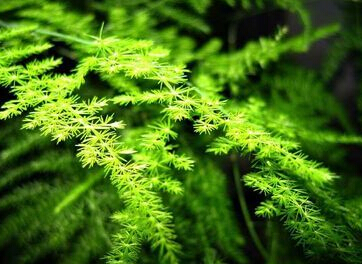
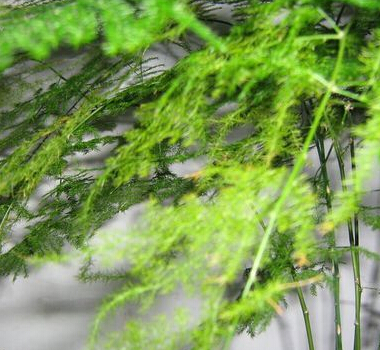
Asparagus fern, also known as cloud-pine, spiny asparagus, or cloud bamboo, is a perennial evergreen climbing foliage plant and a well-known ornamental plant. It belongs to the genus Asparagus in the family Liliaceae (Asparagus plumosus), and is grown mainly as a potted foliage plant; it is also an important material for cut foliage. Asparagus fern can not only enhance cultural refinement, but also has a certain regulating effect on people with liver disease, depression, or low mood. At night, besides absorbing harmful gases such as sulfur dioxide, nitrogen dioxide, and chlorine, asparagus fern can also secrete gases that kill bacteria, reducing the incidence of infectious diseases such as colds, typhoid, and laryngitis, which is greatly beneficial to human health.
Steps
1. Asparagus fern is suited to growing in warm, humid soil rich in decayed leaf matter with good drainage. It is sensitive to smoke and dust; if exposed to toxic gases, its branches and leaves tend to turn yellow. For this reason, keep it in a clean environment during care. Asparagus fern prefers fertile soil; if the soil is not changed and fertilizer is not added for a long time, nutrients will be in short supply and the branches and leaves will turn yellow. At this point, apply a dilute decomposed liquid fertilizer or compound fertilizer once a week, and water and loosen the soil promptly; before long the plant will turn from yellow back to green. If fertilizer is applied too heavily or un-decomposed fertilizer is used, it can easily cause root burn, leading to dry, falling leaves. In this case, take the plant out of the pot to remove the fertilizer, rinse the root ball with clean water, and then repot it in fresh growing medium.
2. If a potted asparagus fern is overwatered, or the soil is too sticky and heavy with poor drainage, the leaves will turn scorched yellow and drop, affecting the plant's lifespan. Generally, water only when the potting soil has dried out; in spring and autumn, reduce watering, following the principle of not watering until dry, and control watering in winter. Overwatering and soggy potting soil can easily cause root rot and yellow, dropping leaves. When watering, make sure the water temperature is as close as possible to the surrounding temperature, to reduce the shock to the root system from unsuitable water temperature. In hot, dry weather, spray the leaf surface with water.
3. Although asparagus fern is not a heavy feeder, it still cannot do without fertilizer. Potted asparagus fern is limited by its potting soil, so nutrients must be replenished in time to meet its growth requirements. Fertilize asparagus fern lightly and frequently; never apply heavy fertilizer, or the branches and leaves will easily turn yellow. During the spring and summer growing season, use mainly nitrogen fertilizer. Apply a dilute decomposed liquid fertilizer once a month. Once the plant's form is established, appropriately control fertilization to avoid leggy growth that spoils the plant's appearance.
Precautions
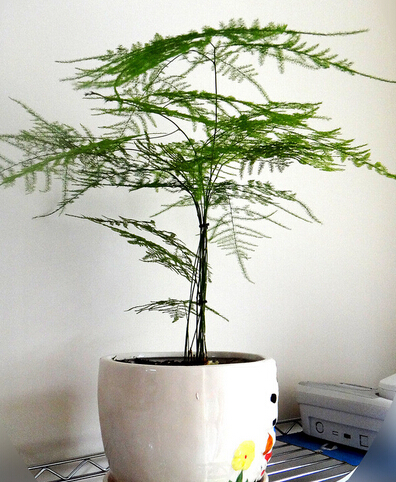
a) Light too strong. Asparagus fern likes partial shade and dislikes strong light; in summer, if placed in direct sunlight, its branches and leaves will wither and turn yellow. Once this happens, move the pot to a shaded spot and frequently spray the branches and leaves with water to increase relative humidity; most plants with mild damage can recover.
b) Improper watering. Although asparagus fern likes humidity, it is very afraid of waterlogged pots; too much water easily causes root rot, while too little makes leaf tips dry out. If root rot occurs, control watering and loosen the soil frequently. For plants with dry leaf tips, water lightly at first and gradually increase the amount, while also spraying water on the branches and leaves.
Shaping Methods
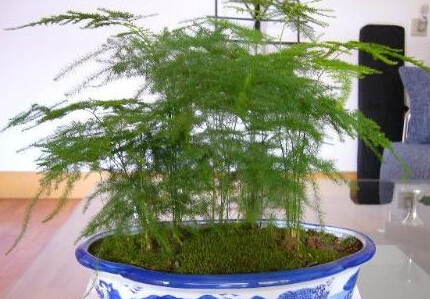
1. Pot control method: The size ratio of pot to plant should be 1:3; this restricts root growth and keeps the plant's size unchanged.
2. Pinching out growing points: When new shoots grow to 2-3 cm, pinch out the growing points; this promotes new branches and leaves on the stems of the asparagus fern, controls vine growth, makes the branches and leaves spread out horizontally, and keeps the plant's form constantly full.
3. Using the phototropism of asparagus fern: Turn the pot's direction at the right time to correct the shape of branch and leaf growth and keep the plant's form unchanged.
4. Physical shading method: Use a piece of stiff paper to press down the branches and leaves or block the sunlight, so that as the branches and leaves grow, they bend or turn when meeting the obstruction, thereby achieving the desired shape.
5. Combined use of several shaping methods:
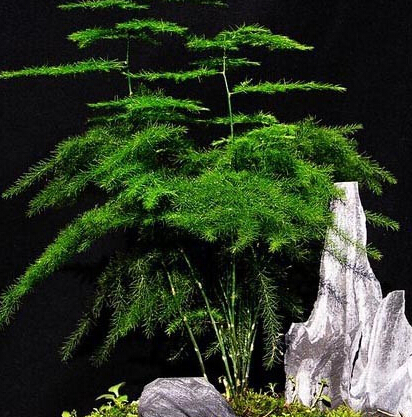
(1) Tower style: Choose 2-3 tall, upright, elegant stems as the main peak, pinch out all the growing points on these stems, and set the plant height at 30-35 cm. The remaining branches and new stems should not be taller than the main peak. For new shoots, decide whether to pinch out the growing points based on the thickness of the stem. If the stem is thicker than the main peak's stem, pinch it out; if it is thinner than the main peak's, do not pinch it and let it grow. At the same time, use the physical shading method and the plant's own phototropism to constantly adjust the plant's form.
(2) Double-clump style: Plant two asparagus ferns in the pot, one tall and one short, with the tall one about 30 cm and the short one about 18 cm; during the growing period, shape them as for the tower style.
(3) Natural style: Mainly follow the asparagus fern's natural growth form, still using basic methods such as pinching out growing points, physical shading, and making use of its phototropism, so that the branches and leaves spread out and give a natural sense of beauty.
Note that shaping asparagus fern must be combined with controlling fertilizer and water. That is, at a room temperature of 15-18°C, water thoroughly once a week to keep the potting soil moist (it should be soft enough to press down with a finger). Do not fertilize, or fertilize only lightly.
Asparagus fern should be repotted once a year, with the pot size increased year by year. If you do not move it to a larger pot, you can turn it out of the pot, remove part of the small root tubers, replace with fresh soil, and replant it in the original pot. Usually pay attention to renewing the stems and branches, and remove aged, diseased, and damaged stems and branches at any time.
Pest and Disease Control
When humidity is too high and ventilation is poor, leaf blight is likely to occur; appropriately reduce air humidity and pay attention to ventilation and light transmission. After the disease occurs, spray 200-times Bordeaux mixture, or 50% carbendazim wettable powder at 500-600 times dilution, or 50% thiophanate wettable powder at 1000 times dilution for control. In summer, pests such as scale insects and aphids are likely to occur; spray 40% omethoate at 1000 times dilution to kill them.
Note that shaping asparagus fern must be combined with controlling fertilizer and water. That is, at a room temperature of 15-18°C, water thoroughly once a week to keep the potting soil moist (it should be soft enough to press down with a finger). Do not fertilize, or fertilize only lightly.
Asparagus fern should be repotted once a year, with the pot size increased year by year. If you do not move it to a larger pot, you can turn it out of the pot, remove part of the small root tubers, replace with fresh soil, and replant it in the original pot. Usually pay attention to renewing the stems and branches, and remove aged, diseased, and damaged stems and branches at any time.
Pest and Disease Control
When humidity is too high and ventilation is poor, leaf blight is likely to occur; appropriately reduce air humidity and pay attention to ventilation and light transmission. After the disease occurs, spray 200-times Bordeaux mixture, or 50% carbendazim wettable powder at 500-600 times dilution, or 50% thiophanate wettable powder at 1000 times dilution for control. In summer, pests such as scale insects and aphids are likely to occur; spray 40% omethoate at 1000 times dilution to kill them.