Reasons for Yellowing and Drying Orchid Leaves and How to Fix Them
First, what to do when orchid leaves turn yellow
2. Drought yellowness. Caused by lack of water and drought; its characteristic is that the old leaves at the bottom turn yellow first, and if the water shortage lasts a little longer, the whole plant's leaves will turn yellow, or it may even die. Water promptly.
3. Fertilizer yellowness. Caused by fertilizing too frequently or with too high a concentration; its characteristic is that the young leaves are thick, glossy, and uneven. Fertilizing should be reduced, and the soil should be cultivated and watered.
4. Starvation yellowness. Caused by insufficient fertilizer, too low a fertilizer concentration, and too long an interval between fertilizing; its characteristic is that the young leaves and tender stems turn yellow first. If this phenomenon is seen and fertilizer is not applied in time, it can also cause the whole plant's leaves to turn yellow or even die. For flowers lacking fertilizer, never apply a large amount of strong fertilizer at one time, to avoid burning the roots.
6. Nutrient-deficiency chlorosis. If the potting soil lacks iron, the leaf tips turn yellow first. If it lacks nitrogen, the new leaves appear yellow-white.
7. Sunscald. Direct strong sunlight, especially after summer, causes yellow spots on the leaves, known as sunscald. When it is dry and the high temperature is above 30 degrees, the leaves also tend to wither and turn yellow.
8. Pollution. Orchid leaves should be kept clean; if dirty matter splashes on them, the contaminated spots may turn yellow.
9. Freeze damage. Orchids suffer freeze damage below 0 degrees, and the symptom is still yellow leaves.
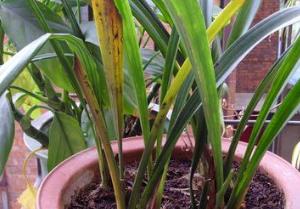
11. Leaf spot disease. It is caused by bacterial infection; the main causes are changing to unrotted raw soil, applying fertilizer that has not been well fermented, not changing the potting soil for a long time, and applying fertilizer with an imbalance of nitrogen, phosphorus, and potassium or in excessive amounts. In the early stage, small yellow-brown spots appear on the leaf surface, then the spot color gradually deepens, the spot area keeps expanding, and decay develops, until the whole plant rots away.
Solution: The flowers should be placed in a ventilated spot and protected from direct sunlight. Orchids often develop dry leaf tips, or even whole leaves withering, and first-time orchid growers do not know what to do. Orchid leaf tip drying is mainly caused by orchid anthracnose and round spot disease. When orchids suffer freeze damage or late frost damage, dry or discolored leaf tips also easily form. Below are the specific solutions.
Caused by orchid anthracnose and round spot disease. This disease occurs in large numbers during the plum rain season or at the turn of summer and autumn when temperatures are high and rain is frequent. The solution is to spray a 50 percent carbendazim 1000-times solution or a 50 percent captan 500-times solution during the susceptible period, once every 10 days, for 3 to 4 consecutive sprays.
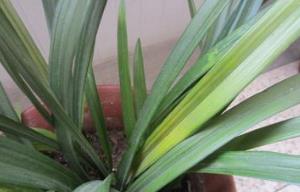
1. The pot is too dry, or the air humidity is too low and the pot surface is too dry. In this case, the orchid leaves generally cannot show tip withdrawal immediately; the first sign is that the orchid leaves appear dehydrated. After watering restores them, the decline tends to start from the old growth, and the orchid leaves turn yellow from the top downward. If there is water damage in the pot, the orchid leaves turn yellow from the bottom upward, and the decline is slower.
2. Fungal damage to orchid roots or waterlogging of the orchid root crystal heads should be the same in principle: waterlogging is the process, crystal head rot is the result, and scorched leaf tips are the surface phenomenon. For this kind of scorched tip, as Feixiang said, the leaf tip turns black, and after the pot is treated, the scorched tip generally no longer extends downward.
3. Scorched tips caused by fertilizer damage are brown or black. The boundary with the parts of the orchid leaf not affected by fertilizer damage is very clear, and spots from fertilizer damage also easily appear on the normal tissue of orchid leaves. Such irregular round spots have a brown center, and where they contact normal tissue there is a ring of black spots of uneven thickness, with a very clear boundary as well.
Solution: When orchids suffer freeze damage or late frost damage, dry or discolored leaf tips also easily form. Therefore, in areas where the winter temperature is below 0°C, orchids should be moved indoors before winter to a ventilated, sunny place for care. When moving them outdoors in spring, be careful to avoid late frost damage. The traditional saying of no wind in spring, no sun in summer, no dryness in autumn, and no dampness in winter is very helpful for preventing orchid leaf drying.
For orchid leaves whose tips have already dried up, if the situation is not too serious, manual pruning can be used: use scissors, preferably disinfected with alcohol. Cut about 10 mm below the dried part, and the pot can still remain full of green. If a fungicide is sprayed after pruning, so much the better.
The boundary is also very clear.
Solution: When orchids suffer freeze damage or late frost damage, dry or discolored leaf tips also easily form. Therefore, in areas where the winter temperature is below 0°C, orchids should be moved indoors before winter to a ventilated, sunny place for care. When moving them outdoors in spring, be careful to avoid late frost damage. The traditional saying of no wind in spring, no sun in summer, no dryness in autumn, and no dampness in winter is very helpful for preventing orchid leaf drying.
For orchid leaves whose tips have already dried up, if the situation is not too serious, manual pruning can be used: use scissors, preferably disinfected with alcohol. Cut about 10 mm below the dried part, and the pot can still remain full of green. If a fungicide is sprayed after pruning, so much the better.