Rubber Plant Pictures and an Introduction to Its Uses
The rubber plant, also known as the rubber tree or Brazilian rubber, is a large tree species in the genus Ficus of the family Euphorbiaceae. Its leaves are large and glossy, evergreen all year round, making it a large shade-tolerant foliage plant. The rubber plant is a well-known foliage plant; its leaves are thick and beautiful, broad and attractive with a glossy sheen, the red growing tip resembles a crouching cloud, and when the stipules split open they hang down just like a red tassel, full of charm. Below, let us take a look at rubber plant pictures and what its uses are.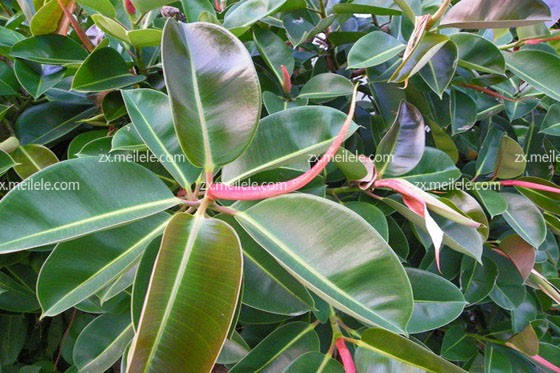
Rubber plant picture one
The rubber plant is a large tree in the genus Ficus of the family Euphorbiaceae. Its trunk is fairly obvious, with few branches, and it grows aerial roots. The leaves of the rubber plant are simple and alternate, the leaf blades are oblong, thick and leathery, bright green, with many parallel lateral veins; the young leaves are red, and the petioles are thick and strong. The rubber plant has high ornamental value and is quite suitable for keeping indoors, while small and medium-sized rubber plants are often used to beautify the living room or study.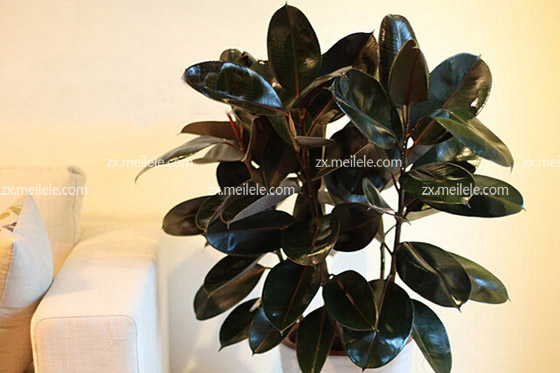
Rubber plant picture two
The rubber plant is a plant that likes a hot, humid environment with plenty of sunlight. Its optimum growth temperature is 20-25°C, and it cannot be exposed to direct sunlight. However, the rubber plant is also a fairly shade-tolerant plant and is not cold-tolerant. If you want it to survive the winter safely, then its wintering temperature must be above 5°C. The rubber plant is drought-tolerant. It dislikes clayey soil, is not tolerant of barren conditions or drought, and likes loose, fertile, well-drained slightly acidic soil.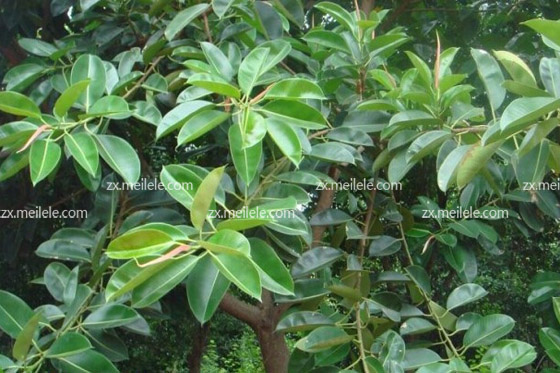
Rubber plant picture three
Common cultivated varieties and variants of the rubber plant include: golden-edged rubber plant, golden-star broadleaf rubber plant, and white-spotted rubber plant. The golden-edged rubber plant has golden-yellow leaf margins; the mosaic rubber plant's leaves are slightly rounder than those of other rubber plants, with many irregular yellow-white patches on the leaf margins and blades, and the mosaic rubber plant has weaker growth vigor and slower propagation. The white-spotted rubber plant has narrower leaves with many white patches; the golden-star broadleaf rubber plant's leaves are much larger and rounder than those of ordinary rubber plants. When young, it is brown-red-green, and after the leaves mature they become a slightly lighter red-brown with sparse pinhead-sized spots scattered near the edges.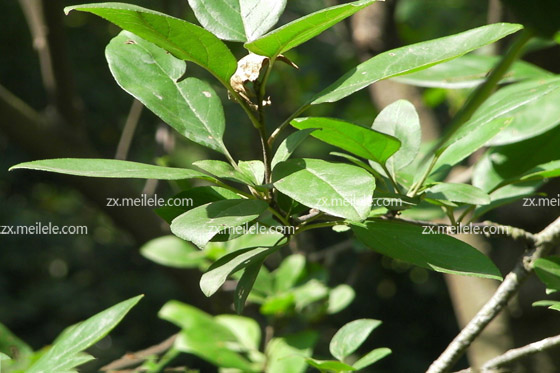
Rubber plant picture four
The rubber plant is a natural rubber plant. It has a unique ability to purify dust, and can also purify formaldehyde among volatile organic compounds. The rubber plant can absorb carbon monoxide, carbon dioxide and hydrogen fluoride from the air, thereby purifying the air. If a pot of rubber plant is placed by the window in an office with a lot of dust, it can improve the indoor air quality.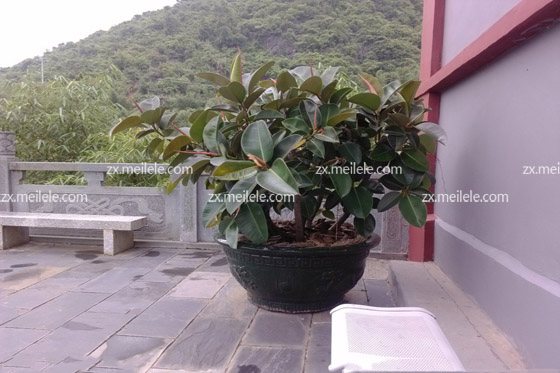
Summary: The above is the editor's introduction to rubber plant pictures and what uses the rubber plant has. After reading the editor's introduction, I believe everyone quite likes this plant. The rubber plant has large, glossy leaves, thick and beautiful, evergreen all year round, with a red growing tip resembling a crouching cloud, and when the stipules split open they hang down just like a red tassel, full of charm. It is a well-known potted foliage plant.