What is the flower language of roses? Let us take you through the story of roses
Roses are a flowering plant we are all fairly familiar with. Every flower has its own flower language, so what is the flower language of roses? Let us find out together.
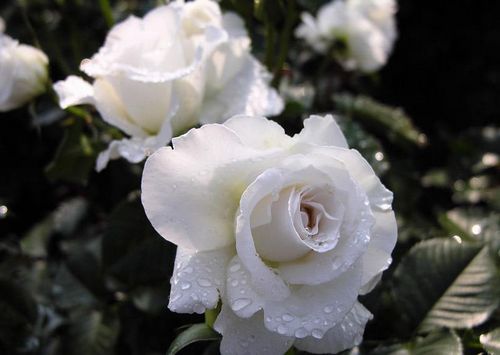
A brief introduction to roses
Rose, also known as multiflora rose, qiangmi, cimei and white canhua, has been a fine and famous flower since ancient times. Its fragrance is very strong and alluring, and aromatic oil can be extracted from its petals; this oil is worth more than gold and has high medicinal and culinary value. It mainly grows along roadsides, at field edges, on walls or among shrubs on hilly land.
Wild roses are mostly distributed naturally in the temperate, subtropical and tropical mountain regions of the Northern Hemisphere, often growing in dense thickets by streams, along roadsides, at garden edges and on odd corners of land, where the branches are covered in brilliant bloom; after light rain or morning dew, the petals are soaked with a rosy flush, making the scene quite lovely. There are many varieties of roses and their names are also very complicated. In the US state of Arizona there is a rose that grows like a big tree, with a trunk diameter of 1.41 m and a height of 2.75 m, making it the largest rose in the world.
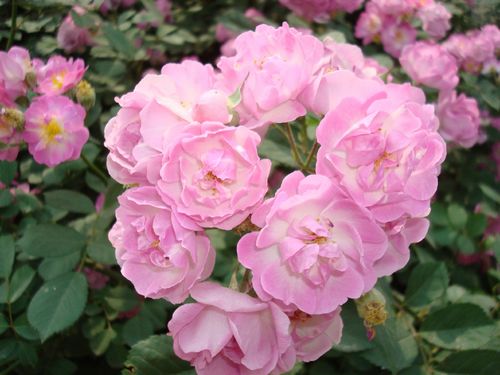
Rose flower language
Red rose: passionate love. The red flowers give a feeling of warmth and exuberance, and the flower language of the red rose is passionate love; it is suitable for use when declaring love and is an excellent gift for first-time lovers.
Pink rose: a vow of love, holding your hand and growing old together with you. The pink rose gives off a romantic air, representing "I want to spend my whole life with you; I want to marry you." It is suitable for use when proposing.
White rose: pure love. White is the purest, most flawless color, and the white rose expresses pure love.
Yellow rose: an eternal smile. Yellow is a warm color, and the yellow rose can soothe a restless heart, representing an eternal smile and forever watching over you.
Dark red rose: I only want to be with you. The dark red rose gives a feeling of firmness and certainty, and its flower language is "I only want to be with you; I only want to know you alone."
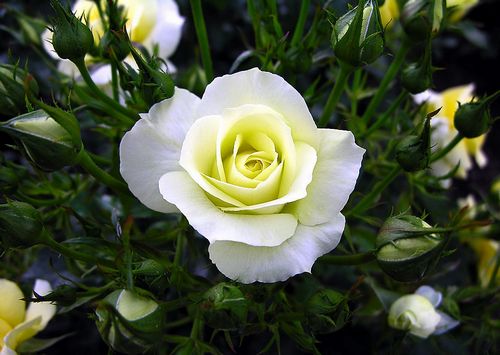
Wild rose: romantic love, repentance. Cultivated roses do not bear fruit, but wild roses produce delicate, vivid red fruit. Besides being as beautiful as other roses, the fruit is also edible. This flower has a poet-like temperament, so its flower language is romance.
Christmas rose: love in remembrance. The flower language of the Christmas rose is love in remembrance, expressing longing for a love that has passed. If you want to win back a lover you have broken up with, you might consider sending a bouquet of Christmas roses.
Black rose: gorgeous love. Black is the most mysterious color, and the black rose represents gorgeous love; desperate love; hatred; a curse; you are mine. It expresses devotion and extremism in love, which is where love is at its most resplendent.
Rock rose: rejection. Rock rose is a kind of grass that herbivorous animals deliberately avoid eating, mainly because its sap is poisonous and slight contact causes red, swollen skin. Therefore the flower language of the rock rose is rejection.
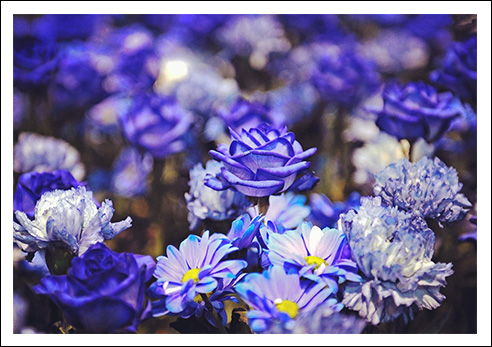
Blue rose: despair. Blue is the color of melancholy, and looking at a blue rose brings a sorrow that is hard to put into words; the blue rose represents despair.
Purple rose: imprisoned love. The purple of the purple rose symbolizes love that cannot be obtained. If you love her, express it loudly and let the world bear witness for us, but the purple rose is like a confinement, making it impossible for love to be expressed.
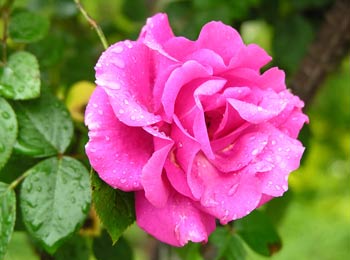
Historical stories of the rose:
In Japan it is called the "Rosicrucian Order," a secret society that spread in Europe. This was an order developed in the Middle Ages to practice the true teachings of Greece in opposition to the Roman Pope and the church, but it was regarded as heresy by Roman Catholicism.
During that period, this order never formed a legal organization, so it was viewed as a mysterious existence. The goal of its members was to become people thoroughly versed in occult knowledge, to hold "universal love" in the highest esteem, and to take it as their duty to rescue the gravely ill as quickly as possible. For this reason, the Rosicrucian Order needed to research and practice alchemical medicine. By the 18th century, because of its opposition to Roman Catholicism, the Rosicrucian Order was regarded as heresy.
If the alchemy that served as the foundation of the Rosicrucian Order had been practical, it might perhaps have replaced Roman Catholicism and become a state religion. "Alchemy serves the public" - a country like Amestris, which gives full play to its practicality, can also be seen as a country that does not exist in reality and takes the Rosicrucian Order as its mother body.
How to grow roses:
1. Sunlight: Roses are sun-loving flowering shrubs and need plenty of sunlight; during the growing period they must receive enough sunlight.
2. Watering: Roses like moisture but fear dampness and waterlogging. From bud break to before flowering, water a little more as appropriate, to the extent that the soil is moist but not waterlogged; after flowering, do not water too much, and the soil should alternate between dry and moist. In the rainy season, pay attention to drainage to prevent waterlogging.
3. Fertilizing: Roses like fertilizer and also tolerate poor soil. In March, apply 1 to 2 times a nitrogen-based liquid fertilizer to promote the growth of branches and leaves; in April and May, apply 2 to 3 times a phosphorus- and potassium-based fertilizer to encourage more buds and more flowers; after flowering, apply one more rejuvenating fertilizer, after which no further fertilizing is needed.
4. Pests and diseases: Roses can be infected by many diseases, most of which are caused by fungi. Before the disease appears, spray 200 times equal-amount Bordeaux mixture for prevention; when the disease appears, spray 15% triadimefon wettable powder at 1000 times dilution, or 70% thiophanate-methyl wettable powder at 1000 times dilution.
Roses are a common and very beautiful flowering plant, generally grown on balconies, in courtyards and other such places. Judging from how roses are grown, planting roses is not troublesome, so if you want to create a fresh, light home environment, you might consider them.