How long does the flowering period of a Phalaenopsis orchid generally last?
Nowadays, more and more people grow flowers in their leisure time. People feel that growing flowers is just like keeping a small pet, a kind of pleasure in life. And the Phalaenopsis is a beautiful flower, loved by many people. So do you know about the Phalaenopsis? Do you also want to grow a Phalaenopsis? Take a look at the content below!
Nowadays, more and more people grow flowers in their leisure time. People feel that growing flowers is just like keeping a small pet, a kind of pleasure in life. And the Phalaenopsis is a beautiful flower, loved by many people. So do you know about the Phalaenopsis? Do you also want to grow a Phalaenopsis? Take a look at the content below!
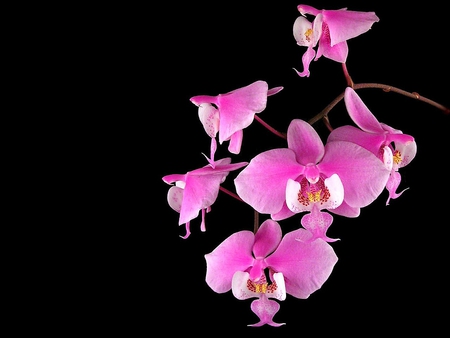
The Phalaenopsis is a traditional famous flower. Because of its graceful and distinctive form, huge blooms, brilliant colors, rich shades, and long flowering period, it is called the "Queen of Orchids". The natural flowering period of the Phalaenopsis is from April to May each year. The flowering period is too concentrated, which severely restricts the production and development of the Phalaenopsis. Therefore, artificially regulating the flowering period of the Phalaenopsis so that it can bloom as scheduled on important festivals increases the commercial value of the Phalaenopsis. This is an inevitable path to realizing the commercialization of the Phalaenopsis and has important economic and practical significance for promoting the healthy development of the Phalaenopsis industry. In this episode of the program, the main points introduced to the audience are several measures for controlling the flowering of the Phalaenopsis, including high-temperature treatment, low-temperature treatment, flower stalk stage management, and bud stage management.
Since the normal flowering period of the Phalaenopsis is from March to May, in order to allow the Phalaenopsis to be supplied to the Lunar New Year flower market, production generally adopts the method of artificially controlling temperature to force the stalk, thereby controlling the flowering period of the Phalaenopsis so that it blooms during the Spring Festival.
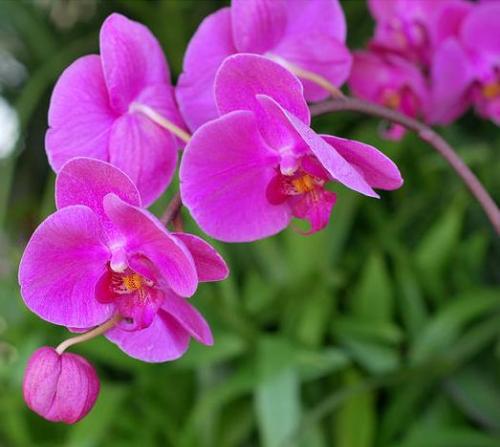
For the commercial production of the Phalaenopsis, from a practical point of view, going up the mountain to force flowering is relatively feasible. Although there is a transportation problem, it saves more expenses and lowers costs than cooling a greenhouse. The key to forcing flowering on the mountain is determining the time to go up the mountain and the time to come down. Research shows that different times to go up the mountain should be determined according to the age and condition of the plant. Plants that are small and have less leaf area can choose to go up the mountain in August. Planting on the mountain can further carry out vegetative growth, thereby promoting flowering. For Phalaenopsis plants with many leaves, large leaf area, and older age, going up the mountain can be postponed, such as going up in September, which can also achieve the goal of blooming during the Spring Festival. Once the time to go up the mountain is chosen well, they can come down once the flower stalk has developed to a certain extent. Under normal circumstances, coming down the mountain in late October is more suitable, because at this time the temperature on the mountain (Entrepreneurship Network: www.cyone.com.cn) is below 10°C, the Phalaenopsis grows and develops slowly, and the leaves are prone to frost damage. In the commercial production of the Phalaenopsis, normally growing tissue-cultured seedlings become robust mature large seedlings after 15~18 months of cultivation. Before low-temperature treatment of mature large Phalaenopsis seedlings, preparations for flower promotion must be made 1 month in advance, gradually increasing light intensity, accumulating sufficient nutrients for the flower bud differentiation of the Phalaenopsis, and allowing it to gradually adapt to the strong light environment during low-temperature treatment. 7~10d before low-temperature treatment, spray the leaf surface 1~2 times with a 1,000-fold solution of monopotassium phosphate, so that the Phalaenopsis begins to enter the physiological state of reproductive growth.
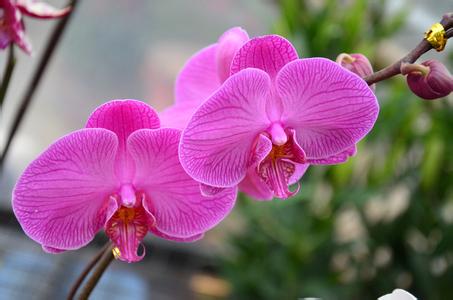
How long is the flowering period of the Phalaenopsis
The scientific name of the Phalaenopsis originally means in Greek "an orchid that looks like a butterfly". It can absorb nutrients from the air to survive, is very strong, and can be said to be a large family among tropical orchids. Generally, the flowering period is around the Spring Festival, and flowering can last 2-3 months. Such a long time means you can enjoy it well! And blooming during the Spring Festival adds even more festivity to the Spring Festival! Do you also want to grow one now?
How long does it take for the Phalaenopsis to bloom
When the Spring Festival season arrives, a small flower will poke its head out, and then the remaining flowers will open one after another. Each flower has 5 petals, with a lip embedded in the middle. The color of the flowers is very beautiful, including pure white, goose yellow, crimson, as well as light purple, orange-red, and azure blue. Quite a few Phalaenopsis varieties have two colors or three colors. Some look as if they are embroidered with patterned stripes, and some look as if they have been evenly sprayed with colored dots. It is a very beautiful kind of flower, even more beautiful than a butterfly! Are you tempted?
Phalaenopsis flowering period care
The flowering of the Phalaenopsis is induced by low temperature, so in addition to fine management, the temperature should also be well controlled. First, keep the temperature above 20°C for 2 months, then lower the nighttime temperature to below 18°C, and flower buds will form after 45 days. After the flower buds form, keep the nighttime temperature at 18~20°C and the daytime temperature at 25~28°C. It can bloom after 3~4 months. During the flowering period, the temperature is slightly lowered, but not below 15°C. After the flower buds extend, a support must be erected, that is, erect the support after the flower stem extends but before it lodges, and tie the flower stem to the support, leaving room for the flower stem to elongate and thicken. Does it look troublesome? It's okay, your efforts will be rewarded!
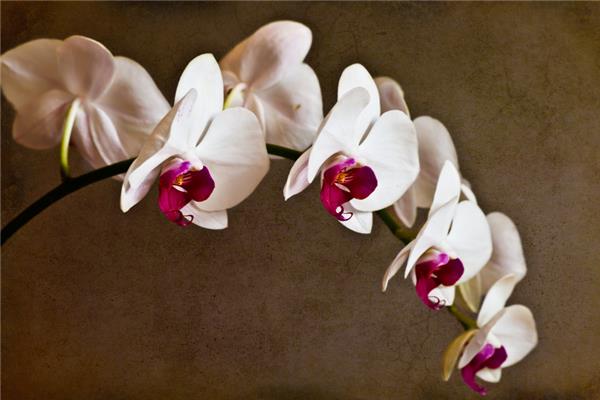
Phalaenopsis care after flowering
When the flowers wither, the faded flowers must be cut off as early as possible, as this can reduce the consumption of nutrients. The editor also knows that when you grow your own flowers and see them wither, you are already very sad, and having to cut them off is even sadder! But there is no way, if the old does not go, how can the new come back! The editor wishes that your trimmed flowers will be even more beautiful!
Late-stage care of the Phalaenopsis during the flowering period - repotting
Generally, after the flowering period of an orchid, the flower stalk must be cut off for its better growth next time. This is compiled from an article by the netizen dashi at Zanghua Pavilion. Because I thought he wrote it especially well, but when reposted here it became distorted, so I had to take screenshots. Thanks to this flower lover for the article.
1. Cut off the flower branch from the base [it will consume a lot of nutrients] and prune and remove rotten roots and dead roots.
2. Wash the whole plant
3. After pruning and washing are completed, apply plant ash to the cut. (Here I have seen many people use carbendazim mixed with water. Soak the entire plant for one hour, so you can also use the soaking method, or you can apply carbendazim dry powder. I think soaking the entire plant is better.) Place it in a low-light, cool, and ventilated place and keep it as it is for about 2 days; after the cut dries and heals, it can be potted and planted.
I also saw a flower lover say that if it is a southern place, because it is humid, you can use orchid stone, clay plus coal, with a bit of moss at the bottom as a base layer.
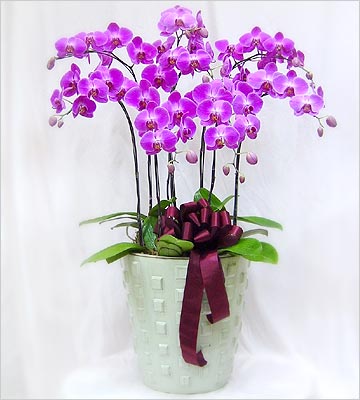
Conclusion: After reading so much, do you understand the flower language of the Phalaenopsis? The flower language of the Phalaenopsis is "I love you, happiness flies to you"! Grow a Phalaenopsis yourself, and let happiness fly to you!
Phalaenopsis care after flowering
When the flowers wither, the faded flowers must be cut off as early as possible, as this can reduce the consumption of nutrients. The editor also knows that when you grow your own flowers and see them wither, you are already very sad, and having to cut them off is even sadder! But there is no way, if the old does not go, how can the new come back! The editor wishes that your trimmed flowers will be even more beautiful!
Late-stage care of the Phalaenopsis during the flowering period - repotting
Generally, after the flowering period of an orchid, the flower stalk must be cut off for its better growth next time. This is compiled from an article by the netizen dashi at Zanghua Pavilion. Because I thought he wrote it especially well, but when reposted here it became distorted, so I had to take screenshots. Thanks to this flower lover for the article.
1. Cut off the flower branch from the base [it will consume a lot of nutrients] and prune and remove rotten roots and dead roots.
2. Wash the whole plant
3. After pruning and washing are completed, apply plant ash to the cut. (Here I have seen many people use carbendazim mixed with water. Soak the entire plant for one hour, so you can also use the soaking method, or you can apply carbendazim dry powder. I think soaking the entire plant is better.) Place it in a low-light, cool, and ventilated place and keep it as it is for about 2 days; after the cut dries and heals, it can be potted and planted.
I also saw a flower lover say that if it is a southern place, because it is humid, you can use orchid stone, clay plus coal, with a bit of moss at the bottom as a base layer.
Conclusion: After reading so much, do you understand the flower language of the Phalaenopsis? The flower language of the Phalaenopsis is "I love you, happiness flies to you"! Grow a Phalaenopsis yourself, and let happiness fly to you!