How do you grow potted lotus? This technical guide teaches you how to grow lotus in pots
Potted lotus makes it much easier for people to enjoy lotus flowers and ends the traditional pond-cultivation method. The scorching summer is the season when lotus is in bloom, providing a better ornamental effect for public areas and adding more pleasure to life. For potted lotus to survive and bloom successfully, technique is very important. Below is the technical guide to growing lotus in pots compiled by Meilele Decoration Network.

Lotus has relatively high soil requirements; fertile clay loam rich in humus is best. Soil that is too heavy and sticky affects the elongation of the lotus rhizome and the swelling of the lotus root, while loose soil is prone to wind damage and hinders root development; neither is good for lotus growth. Generally, pond mud can be used as the soil, or it can be made by mixing and stirring loess and sandy soil. The soil pH should be about 6.5-7.5, and it should not be too acidic or too alkaline.
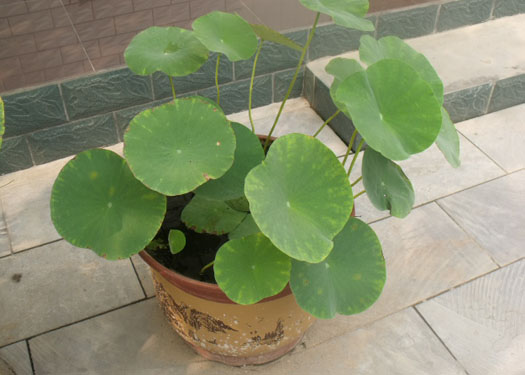
In the vat or pot for planting lotus, first put in 3/5 pond silt, then add a small amount of water and stir it into a thin muddy state, then cut three sections as one plant, keeping the terminal bud, middle bud and tail bud intact and undamaged. Generally, it is suitable to plant two seed lotus rhizomes per vat or pot. After planting, there is no need to add water to the pot or vat for 3-5 days; only when the mud surface shows cracking should a small amount of water be added, so that the seed lotus rhizome is firmly fixed in the mud and can sprout easily. As floating leaves appear and the temperature rises, and standing leaves grow, gradually add water to the vat or pot up to the rim. Newly planted vat or pot lotus should be maintained in a wind-sheltered, sunny, flat place. The arrangement of vats and pots should consider both the growth needs of the lotus and ease of operation and economical use of land; the vat spacing is generally 70cmx70cm. The walkway is about 100cm, the pot spacing is 50cmx50cm, and the walkway is about 80cm.
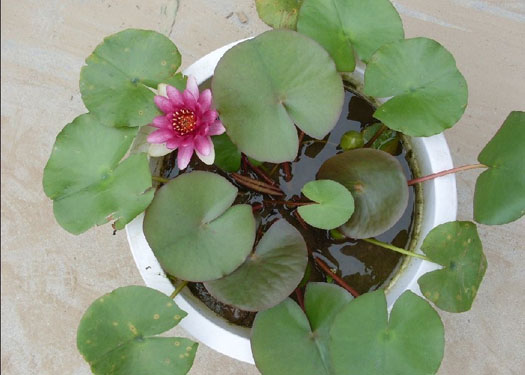
Lotus likes strong light. Being able to receive seven to eight hours of sunlight every day can promote more flower buds and continuous blooming. Do not cultivate it in the shade, otherwise it will be reluctant to bloom and the flowering season will be short. Therefore, lotus is best grown in the open air. For home cultivation of lotus, it can be placed in a courtyard or on a rooftop, balcony and other positions with relatively good light. However, bowl lotus is delicate. In the Yangtze River basin area, May and June often bring continuous rainy weather and very low temperatures; once there is sudden clear weather and the temperature rises, the tender small lotus leaves often wither along the leaf edges and die. Therefore, at noon it should be moved to a cool place to avoid the scorching sun. Lotus has strict temperature requirements. Generally, sprouting begins at 8°C~10°C, the lotus rhizome begins to elongate at 14°C, and 25°C-30°C is the most suitable temperature for lotus growth and development; especially in weather with alternating rain and sunshine, it is even more favorable for plant growth. At 18°C~21°C, standing leaves begin to emerge. Flowering requires high temperatures. New lotus roots grow at 25°C, and most cultivated varieties enter the lotus-root-growing stage when the temperature drops around the Beginning of Autumn.
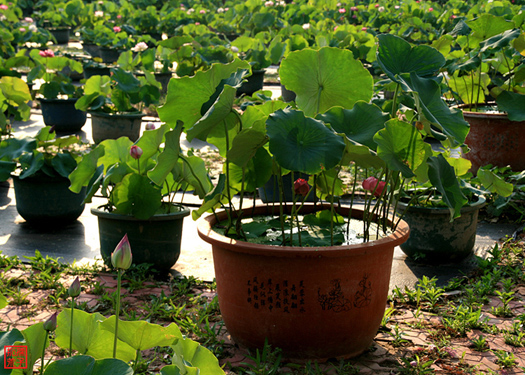
For vat-cultivated lotus, apply 200g-500g of chicken manure as base fertilizer according to the size of the pot or vat. Lotus cultivated with this fertilizer produces more flowers, brighter colors and higher lotus seed yields than lotus cultivated with pig manure, cow manure or human excrement and urine as base fertilizer. One month after planting, apply once a liquid fertilizer mainly of decomposed soybean cake water or human excrement and urine at a concentration of 10%. After standing leaves emerge, apply topdressing another 1 or 2 times; during the flowering period, apply topdressing of superphosphate and potassium sulfate once every 7 days. In summer, when the temperature is high, lotus easily loses water, so at this time vat-cultivated lotus should be given water once every 1-2 days, and potted lotus should be given water 1-2 times daily; the water should be roughly the same temperature as the water in the vat or pot, and the water quality should be kept clean. If the water is found to be turbid, change the water. From late autumn to early winter, lotus enters dormancy, so it is not necessary to add water frequently; just keep shallow water in the vat or pot.
For vat or pot lotus cultivation, in addition to choosing a wind-sheltered location, supports need to be set up to hold and prop up the flowers, especially the flower buds of double-petaled varieties, which are particularly heavy; if there is any carelessness, the stem of an unopened lotus flower is likely to be damaged and broken. Bowl lotus flower stems are especially thin and weak and are even more likely to bend and be damaged, so if lotus is to remain good in flowering and fruiting, setting up supports to hold the flowers is indispensable.
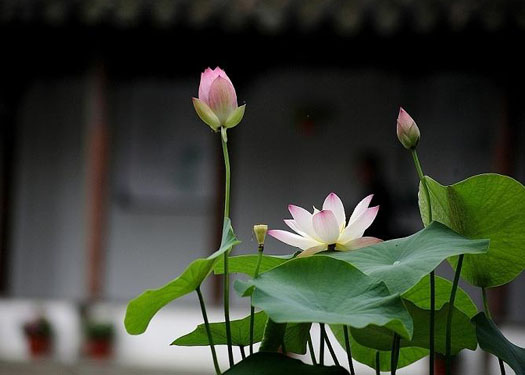
For vat-cultivated lotus, in the Yangtze River basin area it can overwinter in the open ground. Bury the flower vat deep in the soil, or bank soil around the vat to protect against the cold. For potted bowl lotus, because the pot is small and the mud is thin and the new lotus root is small, it cannot withstand wind and cold; before the severe winter arrives, it must be moved indoors or buried deep in the soil to overwinter, and the pot surface should also be covered with straw for insulation.
Common lotus pests include aphids appearing on floating leaves or small standing leaves and the cotton leafworm occurring from July to August. They can be sprayed with 50% dimethoate emulsifiable concentrate at 1500x-2000x dilution or 2.5% derris extract at 500x dilution. Repeat once after one week, and the effect is remarkable. Lotus has few diseases, mainly rot disease. If diseased leaves are found, remove and burn them immediately; in the early stage of the disease, spray with 800x thiophanate-methyl solution.
Editor's recommendation: Moisture-proof measures before wooden floor installation. Power Dekor flooring. Carrying the brand with love.
Bury the flower vat deep in the soil, or bank soil around the vat to protect against the cold. For potted bowl lotus, because the pot is small and the mud is thin and the new lotus root is small, it cannot withstand wind and cold; before the severe winter arrives, it must be moved indoors or buried deep in the soil to overwinter, and the pot surface should also be covered with straw for insulation.Common lotus pests include aphids appearing on floating leaves or small standing leaves and the cotton leafworm occurring from July to August. They can be sprayed with 50% dimethoate emulsifiable concentrate at 1500x-2000x dilution or 2.5% derris extract at 500x dilution. Repeat once after one week, and the effect is remarkable. Lotus has few diseases, mainly rot disease. If diseased leaves are found, remove and burn them immediately; in the early stage of the disease, spray with 800x thiophanate-methyl solution.
Editor's recommendation: Moisture-proof measures before wooden floor installation. Power Dekor flooring. Carrying the brand with love.