How to Grow a Lipstick Plant: Blooming Time and Care Tips Explained
The lipstick plant, also known as Huaman grass, is a perennial evergreen trailing herbaceous flower of the genus Aeschynanthus in the family Gesneriaceae. Its leaves are ovate, opposite, and slightly fleshy. The inflorescences are mostly axillary or terminal, closely resembling a lipstick; the calyx is tubular, much like the tubular casing of a lipstick, which is why it is called the lipstick plant. Its deep green leaves paired with bright red, uniquely shaped corollas make it widely loved, and it is an excellent choice among hanging flowering plants for the home. But when growing a lipstick plant, do you understand its cultivation methods and related knowledge? Here is a detailed introduction.
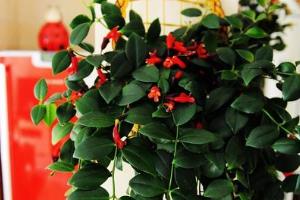 First: How to Grow a Lipstick Plant
I. Growing Methods
The lipstick plant is easy to grow and can be managed casually in ordinary conditions; being overly attentive will only backfire. The growing medium is best a loose, fertile sandy loam with good drainage. The ideal temperature is 15-25°C. From March to September each year is the lipstick plant's growing season, when its water demand is relatively high, so it should be watered and misted frequently to increase humidity. After autumn, gradually reduce watering to improve the plant's cold resistance.
Throughout the year, except for the strong midday sun in midsummer, which should be properly shaded, the lipstick plant should receive ample light at other times, especially in winter. It prefers a semi-shaded environment. If the light at its location is too strong or insufficient, the leaves easily turn pale green or yellow-green, lose their vitality, and lose their ornamental value, or even dry up and die. If exposed to direct sunlight and dry air, it is most prone to scorching, so it should be placed in a cool, ventilated spot, and attention should be paid to maintaining environmental humidity. Continuous high temperature and high humidity should be avoided; poor drainage and ventilation will cause rot.
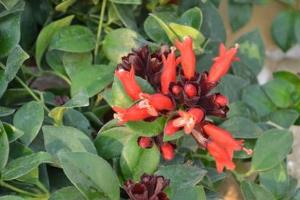 1. Suitable soil: The lipstick plant's soil is best a loose, fertile sandy loam with good drainage. For potted plants, slightly acidic soil is preferable; a potting mix made from peat soil, sand, and vermiculite can be used, with an appropriate amount of superphosphate added.
2. Light: It prefers a semi-shaded environment. Throughout the year, except for the strong midday sun in midsummer, which should be properly shaded, it should receive ample light at other times, especially in winter. If the light at its location is too strong or insufficient, the leaves easily turn pale green or yellow-green.
 3. Temperature: The lipstick plant should be placed in a cool, ventilated spot, and attention should be paid to maintaining environmental humidity. Continuous high temperature and high humidity should be avoided; poor drainage and ventilation will cause rot. The lipstick plant is not cold-tolerant and must be brought indoors to overwinter in winter.
4. Watering frequency: The potting soil should be kept constantly moist, but never allow water to accumulate in the pot, as this can cause root rot. From March to September, during the peak growing period, the water demand is relatively high, so it should be watered and misted frequently to increase humidity; as the weather gradually turns cooler in autumn, gradually reduce watering and fertilizing. In winter, the potting soil should be kept slightly dry.
5. Pruning tips: During vigorous growth, pinch back the tips appropriately to encourage branching. After the winter flowering period ends, promptly cut off the spent stems that have flowered, which saves nutrients, promotes new shoots, and helps the plant produce more buds and flowers.
II. Precautions for the Lipstick Plant
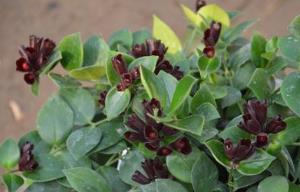 1. Avoid water accumulation; this point must be noted, as water accumulation will cause the lipstick plant to rot and die.
2. Avoid harsh sun exposure. The lipstick plant prefers a semi-shaded environment. Although it needs ample light, overly intense light is not good for its growth, especially in summer.
Second: When Does the Lipstick Plant Bloom
The main reasons for the large differences in flowering periods are, first, the significant climate differences between north and south, and second, the strong ability of people today to artificially modify the environment, so it can no longer be judged solely by natural flowering periods.
During the flowering period, the lipstick plant should be given less nitrogen fertilizer; increasing indoor light intensity and keeping the room temperature relatively low will promote flowering. After the winter flowering period ends, promptly cut off the spent stems that have flowered, which saves nutrients, promotes new shoots, and helps the plant produce more buds and flowers. Sometimes the terminal buds of the lipstick plant will inexplicably die, which is caused by a calcium deficiency; at this time, applying an appropriate amount of calcium fertilizer will make the terminal bud necrosis disappear.
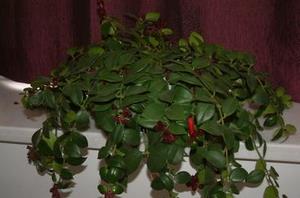 The lipstick plant is not cold-tolerant, and its growing method in winter requires bringing it indoors to overwinter. The lipstick plant is not strict about air humidity and can adapt as long as the indoor air is not overly dry. The optimal growing temperature for the lipstick plant is around 25°C, and the overwintering temperature should be above 12°C. If the leaves are found to turn red, it is either due to excessive light or too low a room temperature; the room temperature should be raised promptly, because too low a room temperature will cause leaf drop and dry, withered branches. If the room temperature is suitable, the lipstick plant's flowering period will be concentrated from December to February of the following year; at this time, it should be given less nitrogen fertilizer, and increasing indoor light intensity and keeping the room temperature relatively low will promote flowering. After the winter flowering period ends, promptly cut off the spent stems that have flowered, which can save the plant's internal nutrient consumption, promote new shoots, and help it produce more buds and flowers. Sometimes the terminal buds of the flowers will inexplicably die, which is caused by a calcium deficiency; at this time, applying an appropriate amount of calcium fertilizer will make the terminal bud necrosis disappear. Lipstick plant propagation is mainly by cuttings. Cut 10 to 15 cm long terminal shoots, insert them into clean river sand, maintain an appropriate room temperature, and they will take root and survive in about a month, then transplant them separately into pots, with 4 to 6 plants per pot. In summer, lipstick plant cuttings can be inserted directly into the potting soil; in a greenhouse, this can be done year-round. During vigorous growth, pinch back the tips appropriately to encourage branching.