Stringy Stonecrop: Benefits, Uses and How to Eat It, and How It Differs from Japanese Stonecrop
First, Stringy Stonecrop's Benefits, Uses and How to Eat It
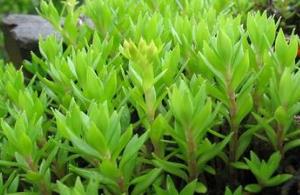
Benefits: clearing heat and removing toxin, clearing damp-heat, and lowering alanine aminotransferase.
Indications: clearing damp-heat, removing toxin, damp-heat jaundice, strangury, diarrhea and dysentery, sore throat, carbuncle swelling and sores, eczema, scalds, insect and snake bites, hemoptysis, epistaxis, hematuria. Acute and chronic hepatitis. For damp-heat jaundice. It can remove toxin, drain dampness and relieve jaundice. It is often used together with Yujin (Curcuma aromatica), Yinchenhao (Artemisia capillaris) and Jinqiancao (Lysimachia christinae). For carbuncle sores and swellings, venomous snake bites, scald and burn injuries, etc. It can clear heat and remove toxin. The fresh product can be used alone: wash it, mash it and take the juice; also apply the juice externally or apply the residue externally to the affected area.
2. The effects of Stringy Stonecrop:
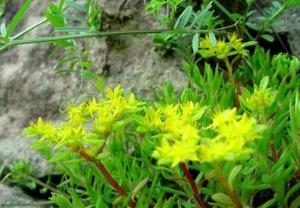
1. Stringy Stonecrop is used for scald and burn injuries and carbuncle swellings, sores and ulcers and other conditions: this product has a good effect of clearing heat and removing toxin. For scald and burn injuries, fresh herb can be washed, mashed and the juice applied externally; for the early stage of carbuncle swelling, in addition to decocting it in water for internal use, fresh herb can also be washed, mashed and applied externally at the same time, which can also reduce the carbuncle and swelling.
2. Stringy Stonecrop treats animal bites. Generally, after a venomous snake bite, first disinfect the wound, use a three-edged needle or a thick needle to prick the "Bafeng" acupoints or "Baxie" acupoints between the fingers or toes with obvious swelling, drain toxin by pricking, take antidote medicine internally, then apply pre-mashed fresh Stringy Stonecrop around the wound, change the dressing 2 times a day, and it will heal after several days of continuous application.
3. Stringy Stonecrop is used for venomous snake bites: Stringy Stonecrop is good at neutralizing snake venom and is a commonly used folk medicine for treating venomous snake bites. Half a jin of fresh herb can be used alone: wash it with cool boiled water, mash it, squeeze out the juice and take it internally, 1 to 2 times a day; it can also be combined with Banzhilian (Scutellaria barbata), wild chrysanthemum, Guizhencao (Bidens bipinnata), plantain herb, raw rhubarb and other medicines, decocted in water for internal use, and fresh herb washed, mashed and applied externally.
4. Stringy Stonecrop treats scald and burn injuries, carbuncle swellings and malignant sores, mastitis, mumps, erysipelas, scars and boils, etc. Generally, collect the fresh herb, wash it clean, mash it and apply it externally, change it 2 times a day, and it will heal after several days.
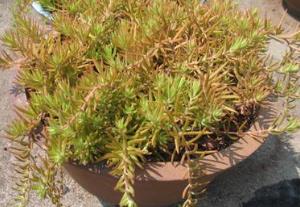
6. Stringy Stonecrop treats liver cancer. Stringy Stonecrop, Banzhilian (Scutellaria barbata), raw Waleng and Shiyan 30 grams each, Loulu (Rhaponticum uniflorum) and Yiyiren (Coix seed) 15 grams each, Danggui (Angelica sinensis), Danshen (Salvia miltiorrhiza) and Honghua (safflower) 9 grams each, Bayuezha (Akebia trifoliata), Baishao (white peony root) and Chenpi (dried tangerine peel) 6 grams each. Decoct in water 3 times and take in divided doses, 1 dose a day. It can eliminate symptoms and shrink liver swelling.
7. Stringy Stonecrop reduces inflammation and swelling, and is used for inflammatory swelling and pain: cellulitis. Grind Stringy Stonecrop into powder, mix with vaseline to make a 50% ointment, and apply externally to the affected area.
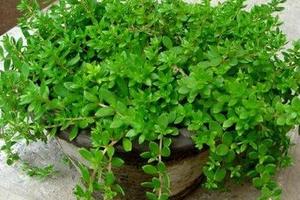
9. Stringy Stonecrop treats nasopharyngeal cancer. Take an appropriate amount of fresh Stringy Stonecrop, mash it and apply externally to the affected area, 1 to 2 times a day. Separately, take crushed Juncus effusus and hold it in the mouth. At the same time use: wild buckwheat, Hanfangji (Stephania tetrandra) and Tuniuxi (Achyranthes bidentata) 30 grams each, all using fresh products, decocted and taken. Continue until the nasopharyngeal mass disappears and the symptoms are cured in the recent term.
10. Stringy Stonecrop treats lung cancer. Stringy Stonecrop and Baiying (Solanum lyratum) 30 grams each, decoct in water and take, 1 dose a day. Taken persistently, it can improve the condition, basically eliminate clinical symptoms, and gradually shrink the lesions.
People suitable for Stringy Stonecrop: those with diarrhea due to spleen deficiency should take it with caution.
Dietary therapy effects of Stringy Stonecrop: Stringy Stonecrop is sweet and bland in taste, cool in nature; it enters the liver, stomach and large intestine meridians; it has the effects of clearing heat and draining dampness, removing toxin and reducing swelling, and cooling blood and stopping bleeding; it is mainly used for damp-heat jaundice, strangury, diarrhea and dysentery, sore throat, carbuncle swelling and sores, eczema, scalds, insect and snake bites, hemoptysis, epistaxis and hematuria.
Usage and dosage
Internal use: decoct in water, 15-30 g; fresh product 50-100 g; or mash for juice. External use: appropriate amount, mash and apply; or grind into powder and mix for application; or take the juice and apply externally; or decoct in water for wet compress.
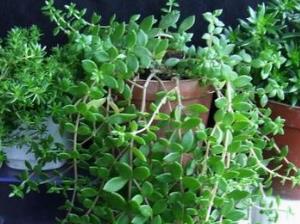
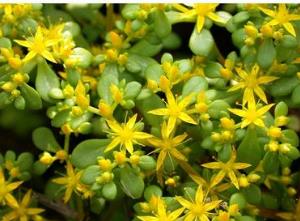
1. Japanese Stonecrop (Sedum lineare): a perennial herbaceous plant of the genus Sedum in the Crassulaceae family, also called Wanniancao, Fozhijia, Banzhilian, etc. (just using the common names is enough, because a flower has different common names in different places, and one common name is sometimes used for two kinds of flowers). Japanese Stonecrop leaves are narrow and have a slightly round feeling. 2. Stringy Stonecrop (Sedum sarmentosum): a succulent plant of the genus Sedum in the Crassulaceae family, and like Japanese Stonecrop, it is relatively common in rural areas; in rural areas it is often called Gouyaban, Shitoucai, etc. Stringy Stonecrop is a commonly used medicinal herb widely circulated among the people; the whole plant is used as medicine, and it has effects such as clearing heat and removing toxin, reducing swelling and promoting urination, and discharging pus and promoting tissue regeneration. Compared with Japanese Stonecrop, Stringy Stonecrop leaves are wide and flat.
3. Dietary therapy methods with Stringy Stonecrop
People suitable for Stringy Stonecrop: those with diarrhea due to spleen deficiency should take it with caution.
Dietary therapy effects of Stringy Stonecrop: Stringy Stonecrop is sweet and bland in taste, cool in nature; it enters the liver, stomach and large intestine meridians; it has the effects of clearing heat and draining dampness, removing toxin and reducing swelling, and cooling blood and stopping bleeding; it is mainly used for damp-heat jaundice, strangury, diarrhea and dysentery, sore throat, carbuncle swelling and sores, eczema, scalds, insect and snake bites, hemoptysis, epistaxis and hematuria.
Usage and dosage
Internal use: decoct in water, 15-30 g; fresh product 50-100 g; or mash for juice. External use: appropriate amount, mash and apply; or grind into powder and mix for application; or take the juice and apply externally; or decoct in water for wet compress.
1. Japanese Stonecrop (Sedum lineare): a perennial herbaceous plant of the genus Sedum in the Crassulaceae family, also called Wanniancao, Fozhijia, Banzhilian, etc. (just using the common names is enough, because a flower has different common names in different places, and one common name is sometimes used for two kinds of flowers). Japanese Stonecrop leaves are narrow and have a slightly round feeling. 2. Stringy Stonecrop (Sedum sarmentosum): a succulent plant of the genus Sedum in the Crassulaceae family, and like Japanese Stonecrop, it is relatively common in rural areas; in rural areas it is often called Gouyaban, Shitoucai, etc. Stringy Stonecrop is a commonly used medicinal herb widely circulated among the people; the whole plant is used as medicine, and it has effects such as clearing heat and removing toxin, reducing swelling and promoting urination, and discharging pus and promoting tissue regeneration. Compared with Japanese Stonecrop, Stringy Stonecrop leaves are wide and flat.