A Complete Collection of Phalaenopsis Pictures and a Detailed Guide to Their Cultivation
The Phalaenopsis is a very beautiful flower. What exactly is a Phalaenopsis like? Below, the editor gives you a detailed introduction to the characteristics of the Phalaenopsis.
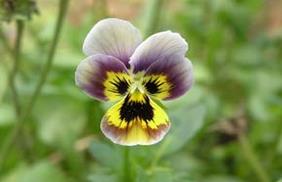
A Brief Introduction to the Phalaenopsis
1. Its appearance already leaves you nothing to find fault with. The Phalaenopsis has graceful flower posture and elegant, richly varied flower colors, and is named for its butterfly-like flower shape. It is widely cultivated in countries around the world. Although it is an epiphytic orchid, it has no pseudobulbs, only an extremely short stem at the base. The leaves are broad and thick, oblong, and can reach more than 50 cm.
2. There are about 100 species of Phalaenopsis, native to Europe and Asia, North Africa, North America and Central America. There are two very famous species: Platanthera chlorantha, which bears white flowers and is a smaller plant; and Platanthera hologlottis, which has large greenish-white flowers and a larger plant form.
3. The colors are bright, the flowering period is long, and it has great ornamental value. The scientific name of the Phalaenopsis, according to its original Greek meaning, is "an orchid like a butterfly." It can absorb nutrients from the air to survive and is classified in the category of epiphytic orchids, and can be said to be a large clan among tropical orchids. Its plant is very peculiar, having neither stolons nor pseudobulbs.
4. Its emergence and development have a history. The Phalaenopsis was discovered in 1750, and more than seventy native species have been discovered to date, most of them produced in the humid regions of Asia, naturally distributed in low-latitude tropical islands such as Assam, Myanmar, the islands of the Indian Ocean, the Malay Peninsula, the South Sea Islands, the Philippines and even Taiwan, China.
5. Many varieties compete for favor, and in the end the following few stand out.
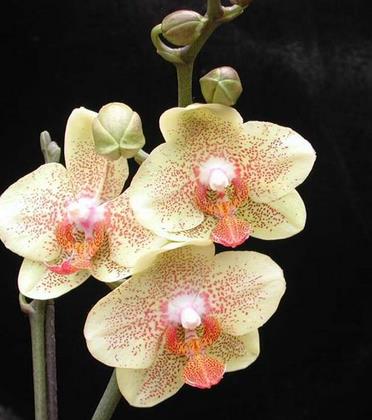
The Phalaenopsis's Influence on the Home Environment
Let us now look at what extraordinary qualities the queen of flowers has in its effect on the home environment.
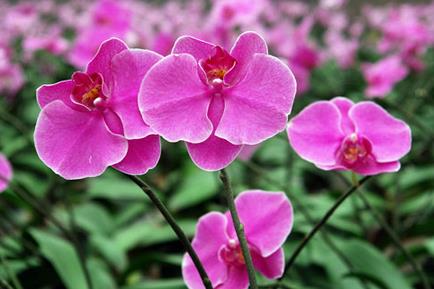
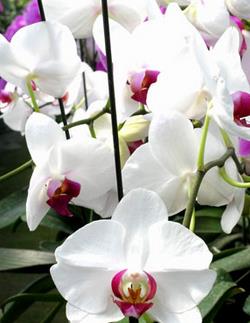
1. It has a powerful effect in beautifying the home environment. Its plant is very peculiar, having neither stolons nor pseudobulbs. Each plant grows only a few broad leaves as plump as spoons, alternately stacked above the base. Thick white aerial roots are exposed around the leaves, some clinging to the outer wall of the flowerpot, full of natural wild charm. When the Chinese New Year season arrives, a flower stalk a full chi long is sent out from the leaf axils, and then blooms one after another. Each flower has 5 petals, with a lip embedded in the middle. The flower colors are bright and dazzling, including pure white, goose yellow and purplish red, as well as light purple, orange-red and azure. Quite a few varieties combine two or three colors; some look as if patterns and stripes have been embroidered on them, and some look as if even colored dots have been sprayed on them. Each stalk bears seven or eight flowers, and at most twelve or thirteen, and can be enjoyed continuously for sixty or seventy days. With such a beautiful appearance, could you still resist it?
2. From the outside to the inside, it can fill a home with vitality. The name "butterfly flower" carries a meaning many people do not know. The scientific name of the Phalaenopsis, according to its original Greek meaning, is "an orchid like a butterfly." It can absorb nutrients from the air to survive, which proves its dynamic role in the home, flying about in the air like a butterfly; vitality and liveliness are generated right here. And although its appearance does not move, it is so beautiful and eye-catching that it can add a great deal of atmosphere to a home, festive and joyful like a holiday.
3. It has many very interesting flower meanings, making the home style even more poetic. The flower meaning of the Phalaenopsis is "I love you" and "happiness flies to you." Therefore, many people give Phalaenopsis to the bride when they marry. Also, the Phalaenopsis corresponds to the zodiac signs Aquarius & Sagittarius, representing loyalty, wisdom, rationality and virtue. Such a romantic flower placed at home is sure to add a great deal of good atmosphere to the home.
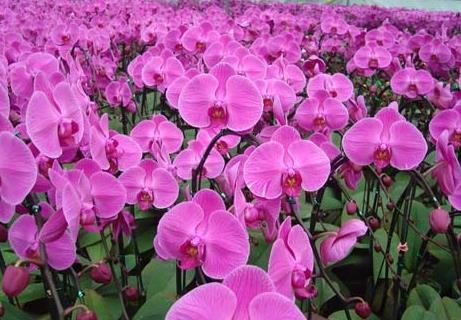
The Uses of the Phalaenopsis
Besides its appearance, the Phalaenopsis actually has many other uses. Below, the editor introduces them to you.
1. It serves as a standard for the quality of a household's air environment. The Phalaenopsis likes high temperatures, high humidity, and a ventilated, semi-shaded environment; it dislikes waterlogging and stuffiness. Its overwintering temperature should not be lower than 15 degrees. When it encounters cold, it should immediately be moved indoors and kept warm to pass the winter safely. The Phalaenopsis likes an environment with high air humidity and good ventilation. Ventilation is the key to growing Phalaenopsis well, but it dislikes dry, hot wind blowing on it. When growing it in winter in the north, it cannot be placed on a radiator or directly facing the airflow of an air conditioner. Therefore, the more beautiful the Phalaenopsis that can be grown, the better the home environment there is and the more suitable it is for people to live in. In addition, the red-heart Phalaenopsis means great fortune and a union of hearts forever; the red Phalaenopsis indicates a smooth official career and happiness and fulfillment; the striped Phalaenopsis represents everything going smoothly and wishes coming true; the yellow Phalaenopsis carries the meaning of a thriving career and booming business; and the mini Phalaenopsis can convey the blessings of a happy angel and flourishing youth.
2. It is a "carrier pigeon" that conveys friendship, love, and even family affection. The Phalaenopsis has many very interesting meanings. For example, the flower meaning of the Phalaenopsis is "I love you" and "happiness flies to you." Here one can see that if a boy or a girl gives a Phalaenopsis, it fully expresses what they want to convey; it is subtle while also expressing their true feelings. Also, the white Phalaenopsis represents purity of love and the preciousness of friendship. If one day an old friend with whom one has not been in contact for a long time sends a bouquet of white Phalaenopsis, then from both the price and the meaning of the Phalaenopsis, one can see that this friend places great importance on this relationship.
3. The Phalaenopsis can beautify and purify the home. The Phalaenopsis is the most beautiful flower among flowers, and using it to decorate the home is an unquestionable practice. Its beauty can surpass any kind of flower, and one can imagine how beautiful and full of life a home with Phalaenopsis is. At the same time, it can purify the home, absorbing exhaust gases from the air and then releasing the oxygen we need, achieving a ventilating effect.
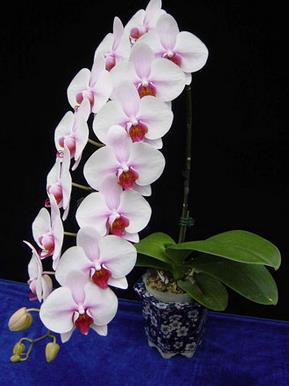
How to Care for the Phalaenopsis
1. The care of the Phalaenopsis needs to be divided into two stages: early-stage management and late-stage management. At each different period, the care temperature and moisture must be adjusted well and pest removal must be paid attention to. For example, in the flowering period of late-stage care, water and fertilizer management is especially important.
2. During care, the following issues must be given key attention.
1. Watering too frequently will cause root rot. Friends who grow Phalaenopsis always worry that the Phalaenopsis lacks water, and regardless of whether the growing medium is dry, they water it every day, causing severe root rot.
2. Maintain an appropriate temperature; do not let the temperature be too low. Usually the flowering plants of Phalaenopsis are mostly brought to market in early spring, and after being bought home they are generally placed in places such as the living room for appreciation. Although the daytime temperature in these places is sufficient, the nighttime temperature is somewhat on the low side. On the other hand, professionally cultivated orchids are mostly in well-equipped greenhouses. By comparison, the temperature and humidity at home are somewhat insufficient, so that the plant's growth tends to weaken day by day. Therefore, sometimes no matter how well it is cared for, the orchid still has times when it does not bloom.
3. Prevention of diseases. The Phalaenopsis mainly has the following diseases, which we should pay key attention to.
1. Bacterial brown spot disease is the most serious disease of the Phalaenopsis. The symptom is the appearance of brown spots on the leaves. They are oily or heart-shaped, and are surrounded by yellow-shaped material. Treatment methods include adjusting the nitrogen amount of the fertilizer solution, removing diseased plants, and maintaining stable relative humidity. Chemical agents have no effect on this disease. Only by using plants in good growing condition and healthy can this bacterial problem be avoided.
2. Mold. Too great a change in moisture in the medium or an unsuitable EC value causes root damage, thereby prompting mold to attack the tissue. The way to deal with it is to lower the EC value of the irrigation water and temporarily reduce the moisture content of the medium.
4. How to Water the Phalaenopsis
The Phalaenopsis likes moisture but dislikes water accumulation. During the growing period it must not lack water; if it lacks water for a long time, the leaves will turn yellow and cannot be remedied. Phalaenopsis grown in pine needles will not accumulate water. When watering, use a spray bottle to spray water until water flows out from the bottom of the pot. Frequently sprinkle water around the orchid pot to keep the air moist, but be careful not to let water accumulate in the heart of the orchid leaves, and especially in winter at night it is forbidden to spray water onto the leaves.
Watering and fertilizing the Phalaenopsis must be determined according to its growth and development stage. During the new root elongation period, more water should be given; during the post-flowering dormant period, less water should be given. Generally, in spring and autumn it can be watered once a day; in summer it should be watered once each morning and evening; in winter watering should be controlled, just keeping the potting soil moist. Spring and summer are its vigorous growth period, and about once every 2 weeks a thin liquid fertilizer mainly of nitrogen fertilizer should be applied; autumn and winter are its flower stalk growth period, and every 10--14 days a liquid fertilizer mainly of phosphorus and potassium fertilizer should be applied. After the buds appear, fertilization should be stopped, otherwise it easily causes bud drop. To propagate the Phalaenopsis, division is mostly used.
Propagation Methods of the Phalaenopsis
Aseptic sowing of orchids has 2 ways of plant germination.
One is the protocorm method. At the initial stage of seed germination, white spherical protocorms are formed. As the protocorms increase in size, hairy rhizoids appear on them, and then the protocorms turn green, but the protocorms do not elongate; buds sprout from the tips of the protocorms. Generally, protocorms can all differentiate into seedlings. Epiphytic orchid species germinate in this way; the seeds of Phalaenopsis, Cattleya and Cymbidium all germinate by the protocorm method.
The other is the rhizome method. When its seeds germinate, they also initially appear as white spheres, but they quickly elongate into long columnar shapes, forming rhizomes. Then, on the surface of the rhizomes, clusters of root-hair-like rhizoids grow at intervals. Only on the differentiation medium can the apical buds of the rhizomes grow seedlings, but the rate of differentiation into seedlings is extremely low. Terrestrial orchid species germinate in this way.
Also, the white Phalaenopsis represents purity of love and the preciousness of friendship. If one day an old friend with whom one has not been in contact for a long time sends a bouquet of white Phalaenopsis, then from both the price and the meaning of the Phalaenopsis, one can see that this friend places great importance on this relationship.3. The Phalaenopsis can beautify and purify the home. The Phalaenopsis is the most beautiful flower among flowers, and using it to decorate the home is an unquestionable practice. Its beauty can surpass any kind of flower, and one can imagine how beautiful and full of life a home with Phalaenopsis is. At the same time, it can purify the home, absorbing exhaust gases from the air and then releasing the oxygen we need, achieving a ventilating effect.
How to Care for the Phalaenopsis
1. The care of the Phalaenopsis needs to be divided into two stages: early-stage management and late-stage management. At each different period, the care temperature and moisture must be adjusted well and pest removal must be paid attention to. For example, in the flowering period of late-stage care, water and fertilizer management is especially important.
2. During care, the following issues must be given key attention.
1. Watering too frequently will cause root rot. Friends who grow Phalaenopsis always worry that the Phalaenopsis lacks water, and regardless of whether the growing medium is dry, they water it every day, causing severe root rot.
2. Maintain an appropriate temperature; do not let the temperature be too low. Usually the flowering plants of Phalaenopsis are mostly brought to market in early spring, and after being bought home they are generally placed in places such as the living room for appreciation. Although the daytime temperature in these places is sufficient, the nighttime temperature is somewhat on the low side. On the other hand, professionally cultivated orchids are mostly in well-equipped greenhouses. By comparison, the temperature and humidity at home are somewhat insufficient, so that the plant's growth tends to weaken day by day. Therefore, sometimes no matter how well it is cared for, the orchid still has times when it does not bloom.
3. Prevention of diseases. The Phalaenopsis mainly has the following diseases, which we should pay key attention to.
1. Bacterial brown spot disease is the most serious disease of the Phalaenopsis. The symptom is the appearance of brown spots on the leaves. They are oily or heart-shaped, and are surrounded by yellow-shaped material. Treatment methods include adjusting the nitrogen amount of the fertilizer solution, removing diseased plants, and maintaining stable relative humidity. Chemical agents have no effect on this disease. Only by using plants in good growing condition and healthy can this bacterial problem be avoided.
2. Mold. Too great a change in moisture in the medium or an unsuitable EC value causes root damage, thereby prompting mold to attack the tissue. The way to deal with it is to lower the EC value of the irrigation water and temporarily reduce the moisture content of the medium.
4. How to Water the Phalaenopsis
The Phalaenopsis likes moisture but dislikes water accumulation. During the growing period it must not lack water; if it lacks water for a long time, the leaves will turn yellow and cannot be remedied. Phalaenopsis grown in pine needles will not accumulate water. When watering, use a spray bottle to spray water until water flows out from the bottom of the pot. Frequently sprinkle water around the orchid pot to keep the air moist, but be careful not to let water accumulate in the heart of the orchid leaves, and especially in winter at night it is forbidden to spray water onto the leaves.
Watering and fertilizing the Phalaenopsis must be determined according to its growth and development stage. During the new root elongation period, more water should be given; during the post-flowering dormant period, less water should be given. Generally, in spring and autumn it can be watered once a day; in summer it should be watered once each morning and evening; in winter watering should be controlled, just keeping the potting soil moist. Spring and summer are its vigorous growth period, and about once every 2 weeks a thin liquid fertilizer mainly of nitrogen fertilizer should be applied; autumn and winter are its flower stalk growth period, and every 10--14 days a liquid fertilizer mainly of phosphorus and potassium fertilizer should be applied. After the buds appear, fertilization should be stopped, otherwise it easily causes bud drop. To propagate the Phalaenopsis, division is mostly used.
Propagation Methods of the Phalaenopsis
Aseptic sowing of orchids has 2 ways of plant germination.
One is the protocorm method. At the initial stage of seed germination, white spherical protocorms are formed. As the protocorms increase in size, hairy rhizoids appear on them, and then the protocorms turn green, but the protocorms do not elongate; buds sprout from the tips of the protocorms. Generally, protocorms can all differentiate into seedlings. Epiphytic orchid species germinate in this way; the seeds of Phalaenopsis, Cattleya and Cymbidium all germinate by the protocorm method.
The other is the rhizome method. When its seeds germinate, they also initially appear as white spheres, but they quickly elongate into long columnar shapes, forming rhizomes. Then, on the surface of the rhizomes, clusters of root-hair-like rhizoids grow at intervals. Only on the differentiation medium can the apical buds of the rhizomes grow seedlings, but the rate of differentiation into seedlings is extremely low. Terrestrial orchid species germinate in this way.