How do you grow a bromeliad so it thrives? And whether it's toxic, we'll explain that clearly too
First, how do you grow a bromeliad
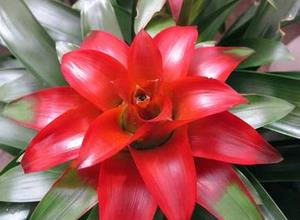
1. How to grow it
1. Temperature
The bromeliad likes a warm and humid environment; the suitable growing temperature is 15°C to 22°C. In winter, the room temperature must be kept above 15°C, and the lowest temperature must not fall below 10°C.
2. Light
The bromeliad likes scattered light. In summer, the pot should be placed in the shade of trees; in winter, it needs at least 4 hours of direct sunlight every day. When the light is too strong, the leaves are prone to sunburn, and when it is too weak, growth will be poor.
3. Watering
The bromeliad likes a humid environment. When watering, it is best to use clean water that has been left standing for 2-3 days, and water moderately to keep the potting soil moist. During the winter dormant period, pay attention to properly controlling moisture and just spray water on the leaves. The bromeliad is not watered in the pot like other flowers and plants, because the bromeliad is an epiphytic plant, so growers only need to pour water into the center of the bromeliad.
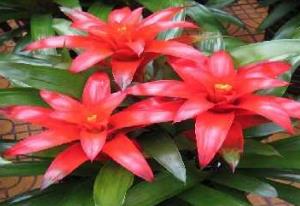
In an environment with high temperature and humidity and poor ventilation, the bromeliad is prone to pest and disease damage. Move the bromeliad outdoors and spray carbendazim; for pests, omethoate can be sprayed.
5. Fertilizing
For the bromeliad, during the peak growing season from May to September, apply a trace amount of compound fertilizer solution once every half month.
6. Environment
The bromeliad fears the scorching sun, so it is best to choose a semi-shady environment for care, such as indoors, and that is enough. Some growers always ask around for help saying why their bromeliad is not growing well. Here it should be said that the bromeliad is a tropical plant, and it is not that it can be grown well anywhere. Why is it good at the seller's place? That is because the seller's flowers are all grown in greenhouses with a high-temperature, high-humidity environment, and after growers buy them and take them home, the environment changes, so growers should not blindly think that as long as they buy a plant and take good care of it at home, it will definitely grow well; the climate issue must be considered.
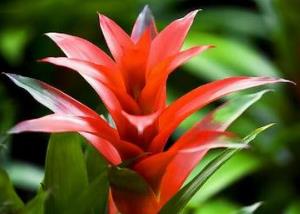
What should be said here is that although the bromeliad is a perennial plant, it blooms only once in its lifetime, and after the flower fades, it slowly dies, so for ordinary growers, do not expect to grow it for many years. The bromeliad blooms only once in its life, and after flowering it will grow one to several offsets at the base of the old plant; at this time it should not be divided too early. Otherwise it is not easy to survive. The division method is: first cut off the flower stem from the base, then leave 5-8 cm of the old plant's leaves and remove all the rest; the base of the remaining leaves just forms a tube that can hold water. When cutting, be sure not to injure the small offsets. When the offsets are about 10 cm tall, use a sharp knife to gently cut at the connection between the offset and the mother plant, plant the small offsets into potting soil made of leaf mold, and after careful care for one year, they can again produce brilliant flowers.
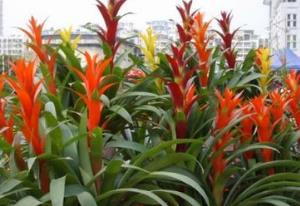
After flowering, one to several offsets will grow at the base of the old plant; at this time it should not be divided too early. Otherwise it is not easy to survive. The division method is: first cut off the flower stem from the base, then leave 5-8 cm of the old plant's leaves and remove all the rest; the base of the remaining leaves just forms a tube that can hold water. When cutting, be sure not to injure the small offsets. When the offsets are about 10 cm tall, use a sharp knife to gently cut at the connection between the offset and the mother plant, plant the small offsets into potting soil made of leaf mold, and after careful care for one year, they can again produce brilliant flowers.
Second, points to note when growing it
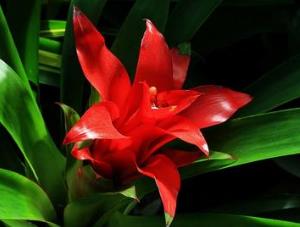
Air humidity should be high, generally 75-85% is best; when it is below 50%, the plant will show leaf shrinkage, curling, and other phenomena. Light is best at 18,000-25,000 lux. When the light is too strong, the leaves are prone to sunburn, and when it is too weak, growth will be poor. Ventilation is also extremely important. When the temperature is not high, the effect is not obvious, but in hot seasons it is especially prominent. Ventilation not only makes the plant grow robustly, but also reduces infection by diseases.
The bromeliad does not need fertilizing during the flowering period. After flowering, cut off the flower in time and supplement fertilizer. Fully water-soluble fertilizer can also be poured into the leaf cup along with watering, but others such as cake fertilizer and granular chemical fertilizers should not be applied in the leaf cup. After the small plants have grown, you can use a sharp knife to cut them off from the mother plant and plant them separately. Generally, the old plant will not bloom again, and afterward it can be used as a mother plant to propagate new plants.
As long as the care location has suitable light and watering is done properly, in general the bromeliad is very easy to grow. In addition, when watering, try to avoid the flower bracts to prevent rot.
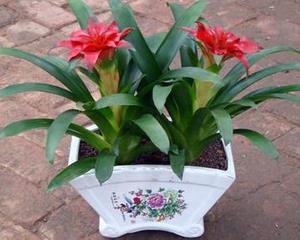
The role of the bromeliad: ornamentation, an auspicious meaning, and purifying indoor air. The bromeliad is also known as "hongyun dangtou," and some people mistakenly write it as "hongyun dangtou" with different characters. The flower language and symbolic meaning of the bromeliad (bromeliad flower): perfection. The bromeliad goes from sprouting, to growing, and then to splendid full bloom. Numerous small flowers cluster densely on the flower stem, forming a thick flower spike, and the bracts at the tip of the flower spike extend in a radial pattern.
Fourth, is the bromeliad toxic
The bromeliad is a plant in the Bromeliaceae family, and the pineapple we are familiar with is also a plant in this family; the pineapple is edible, so you can imagine whether the bromeliad is toxic.
The bromeliad can release oxygen at night. For most plants, when the leaves carry out photosynthesis during the day, their stomata open, and at night the plant enters a sleep state and the stomata close, while bromeliad-family plants are just the opposite. In botany this phenomenon is called crassulacean acid metabolism. Under this effect, the bromeliad absorbs a large amount of carbon dioxide and releases oxygen at night. Therefore, placing a pot of bromeliad in a room means having a home oxygen bar.
The bromeliad is suitable for placement in the living room, with the meaning of gathering wealth and bringing good fortune. In addition, it also likes an environment with relatively high humidity, so it can be placed in the bathroom to absorb stale air. Of course, if the bathroom is both spacious and bright and has air conditioning, using a gorgeous plant like the bromeliad can decorate the bathroom like a mini garden, making people enjoy it. However, the bromeliad should also be allowed to absorb some sunlight appropriately. So if your balcony is relatively empty, you can also grow this uniquely colorful and evergreen-leaved flower, and sometimes it can produce the feng shui effect of promoting prosperity and dissolving negative energy.
We say that growing flowers can cultivate the mind and character, eliminate worries, relax the mood, and is also moderate physical activity. The bromeliad can increase indoor humidity, beautify the environment, and also produce oxygen, relieving nervous tension and visual fatigue. When you feel mentally tired, you can look at the bromeliad beside you, letting your thoughts open up and relaxing tense nerves. The bromeliad likes a semi-shady environment and is suitable for places such as halls, desks, living rooms, offices, and meeting rooms. Imagine being able to admire such a lovable flower in your leisure time, and your mood will naturally feel cheerful.
The bromeliad likes a warm and humid environment; the suitable growing temperature is 21-28°C during the day and 18-21°C at night, and the maximum temperature must not exceed 35°C. High temperatures are unfavorable for growth, but being in a 10°C environment for a long time can easily cause slow plant growth and loss of color, such as leaves or bracts turning red or white. If the temperature continues to drop, it will cause the plant to die.
Air humidity should be high, generally 75-85% is best; when it is below 50%, the plant will show leaf shrinkage, curling, and other phenomena. Light is best at 18,000-25,000 lux. When the light is too strong, the leaves are prone to sunburn, and when it is too weak, growth will be poor. Ventilation is also extremely important. When the temperature is not high, the effect is not obvious, but in hot seasons it is especially prominent. Ventilation not only makes the plant grow robustly, but also reduces infection by diseases.
The bromeliad does not need fertilizing during the flowering period. After flowering, cut off the flower in time and supplement fertilizer. Fully water-soluble fertilizer can also be poured into the leaf cup along with watering, but others such as cake fertilizer and granular chemical fertilizers should not be applied in the leaf cup. After the small plants have grown, you can use a sharp knife to cut them off from the mother plant and plant them separately. Generally, the old plant will not bloom again, and afterward it can be used as a mother plant to propagate new plants.
As long as the care location has suitable light and watering is done properly, in general the bromeliad is very easy to grow. In addition, when watering, try to avoid the flower bracts to prevent rot.
The role of the bromeliad: ornamentation, an auspicious meaning, and purifying indoor air. The bromeliad is also known as "hongyun dangtou," and some people mistakenly write it as "hongyun dangtou" with different characters. The flower language and symbolic meaning of the bromeliad (bromeliad flower): perfection. The bromeliad goes from sprouting, to growing, and then to splendid full bloom. Numerous small flowers cluster densely on the flower stem, forming a thick flower spike, and the bracts at the tip of the flower spike extend in a radial pattern.
Fourth, is the bromeliad toxic
The bromeliad is a plant in the Bromeliaceae family, and the pineapple we are familiar with is also a plant in this family; the pineapple is edible, so you can imagine whether the bromeliad is toxic.
The bromeliad can release oxygen at night. For most plants, when the leaves carry out photosynthesis during the day, their stomata open, and at night the plant enters a sleep state and the stomata close, while bromeliad-family plants are just the opposite. In botany this phenomenon is called crassulacean acid metabolism. Under this effect, the bromeliad absorbs a large amount of carbon dioxide and releases oxygen at night. Therefore, placing a pot of bromeliad in a room means having a home oxygen bar.
The bromeliad is suitable for placement in the living room, with the meaning of gathering wealth and bringing good fortune. In addition, it also likes an environment with relatively high humidity, so it can be placed in the bathroom to absorb stale air. Of course, if the bathroom is both spacious and bright and has air conditioning, using a gorgeous plant like the bromeliad can decorate the bathroom like a mini garden, making people enjoy it. However, the bromeliad should also be allowed to absorb some sunlight appropriately. So if your balcony is relatively empty, you can also grow this uniquely colorful and evergreen-leaved flower, and sometimes it can produce the feng shui effect of promoting prosperity and dissolving negative energy.
We say that growing flowers can cultivate the mind and character, eliminate worries, relax the mood, and is also moderate physical activity. The bromeliad can increase indoor humidity, beautify the environment, and also produce oxygen, relieving nervous tension and visual fatigue. When you feel mentally tired, you can look at the bromeliad beside you, letting your thoughts open up and relaxing tense nerves. The bromeliad likes a semi-shady environment and is suitable for places such as halls, desks, living rooms, offices, and meeting rooms. Imagine being able to admire such a lovable flower in your leisure time, and your mood will naturally feel cheerful.