How to propagate crown of thorns? Introduction to several common propagation methods
Crown of thorns (Euphorbia milii) blooms in all four seasons and has an elegant form, so many people like to place it as a decoration in their homes. Below, we introduce the propagation methods for crown of thorns.
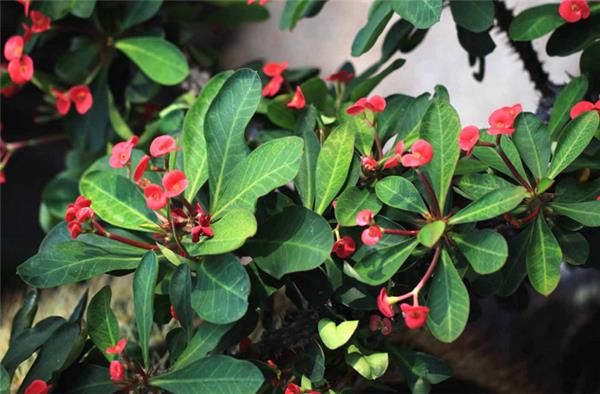
Propagation methods for crown of thorns
Crown of thorns is mainly propagated by cuttings.
Cutting propagation. Cutting medium: this refers to the nutrient soil, river sand, peat soil and other materials used for cuttings. For home cuttings, it is difficult to obtain an ideal cutting medium due to limited conditions, so it is recommended to use a ready-mixed and sterilized cutting medium; medium-coarse river sand can also be used, but it should be rinsed several times with clean water before use. Do not use sea sand or river sand from saline-alkali areas, as they are not suitable for the growth of flowering plants.
In early spring or late autumn (when the highest midday temperature does not exceed 28°C and the lowest nighttime temperature is not below 15°C), during the peak growth season, cut off a leaf or stem segment (with 3 to 4 leaf nodes), wait for the wound to dry, then insert it into the medium, and lightly spray the cutting and medium with water. As long as the medium is not excessively dry or waterlogged, roots and new shoots will grow quickly.
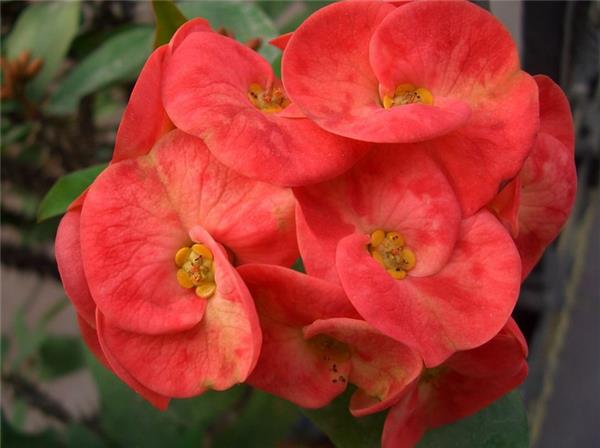
From late spring to early autumn, when temperatures are relatively high, cuttings rot very easily, so it is best not to take cuttings then.
After potting, gradually move it out of the shade shed and place it in a sunny, cool, well-ventilated spot. Usually, do not water too much or too often, but during the growing seasons in spring and autumn, provide sufficient water, watering as appropriate according to the principle of "do not water if dry, water thoroughly when watering." Generally, water once every 3 to 4 days, that is, water after the potting soil has dried slightly. Never water heavily, especially during the flowering period, otherwise it easily causes flower drop and root rot; in summer, because temperatures are high, water once a day, and the potting soil must not be too dry, as overly dry potting soil easily causes leaf drop.
Once it enters the dormant period, keep the potting soil even drier. Generally, water once every 1 to 2 months, keeping the potting soil merely moist. Fertilize from early April to the end of September. If soil moisture is kept moderate and fertilizer is applied in time to supplement nutrients, crown of thorns will keep blooming continuously. If the winter temperature is above 15°C, it can continue to bloom. For cultivation purposes, overly long branches on the plant are often shortened to encourage new shoots to sprout from the cut, or wire or bamboo strips are used to tie it into various shapes to form an attractive and well-proportioned plant shape, improving the ornamental value of crown of thorns.
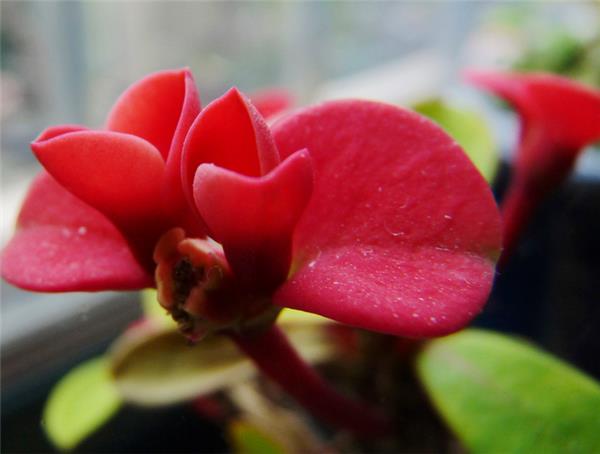
Crown of thorns cultivation and management methods
Humidity management:
It prefers a relatively dry air environment; if rainy weather lasts too long, it is easily infected by pathogens. It is afraid of rain, so keep the leaves dry at night. The most suitable relative air humidity is 40 to 60%. Temperature management for crown of thorns: the most suitable growth temperature is 15°C to 32°C. It is afraid of high temperatures and stuffiness, and enters a dormant state in summer when the sweltering temperature is above 33°C. It avoids cold and frost, and the overwintering temperature needs to be kept above 10°C. In winter, when the temperature drops below 4°C, it also enters a dormant state. If the ambient temperature approaches 0°C, it will die from frost damage.
In summer:
1. Strengthen air convection so that the heat inside the plant can be released;
2. Place it in partial shade, or give it 50% shade;
3. Mist it appropriately, 2 to 3 times a day.
In winter:
1. Move it indoors to a brightly lit place for care;
2. Outdoors, it can be wrapped in plastic film to overwinter, but every two days at the warmer midday period the film must be opened to let it breathe.
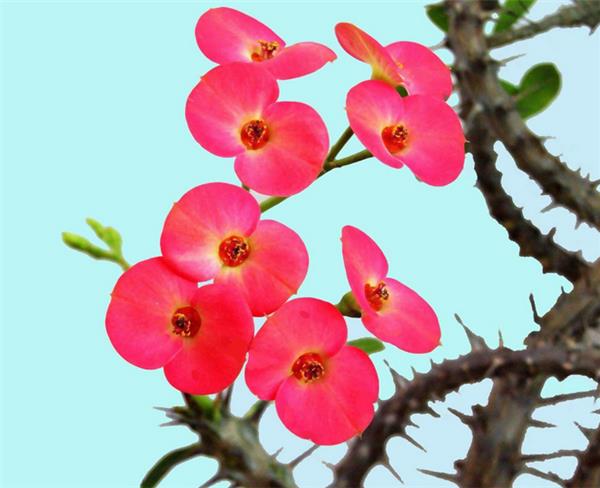
Light management:
Summer: during the high-temperature period in summer, it often enters a dormant state and does not require much fertilizer or water; it may even be necessary to restrict fertilizer and water. The interval is about: 3 to 5 days for outdoor care and 4 to 7 days for indoor care. Try to schedule watering in the morning or evening when temperatures are lower. Also mist the plant frequently.
In summer, when it is kept in partial shade or given 50% shade, the leaf color becomes more beautiful. In spring and autumn, because temperatures are not very high, give it direct sunlight to help it carry out photosynthesis and accumulate nutrients.
Winter: during the winter dormant period, the main task is to control fertilizer and water well. Fertilizer and water management follows the cycle of "Hua Bao" - clear water - clear water - "Hua Bao" - clear water - clear water, with an interval of about 7 to 10 days. Try to schedule watering at midday on sunny days when temperatures are higher.
In winter, place it indoors in a place with bright light for care. If it is normally kept indoors, place it near southeast-facing doors and windows so it can receive light, and after every one month or one and a half months, move it outdoors for two months of care; otherwise the leaves will grow thin and yellow, and new branches or leaf stalks will be slender with elongated internodes, in a state of leggy growth. Fertilizer and water management: it has strong drought tolerance and can grow even under dry environmental conditions, but this does not mean it should not be watered or fertilized; its root system is afraid of waterlogging. If water accumulates in the flowerpot, or if it is watered and fertilized too frequently, root rot is easily caused. The principle for watering and fertilizing it is "alternate dry and wet, dry thoroughly when dry, do not water if dry, water thoroughly when watering." When watering and fertilizing, avoid getting the plant wet.
Spring and autumn: these two seasons are its peak growth seasons. Fertilizer and water management follows the cycle of "Hua Bao" - clear water - "Hua Bao" - clear water, with an interval of about: 2 to 4 days for outdoor care and 3 to 6 days for indoor care. On sunny days or during high temperatures, the interval is shorter; on rainy days or during low temperatures, the interval is longer or no watering is done.
in a state of leggy growth. Fertilizer and water management: it has strong drought tolerance and can grow even under dry environmental conditions, but this does not mean it should not be watered or fertilized; its root system is afraid of waterlogging. If water accumulates in the flowerpot, or if it is watered and fertilized too frequently, root rot is easily caused. The principle for watering and fertilizing it is "alternate dry and wet, dry thoroughly when dry, do not water if dry, water thoroughly when watering." When watering and fertilizing, avoid getting the plant wet.Spring and autumn: these two seasons are its peak growth seasons. Fertilizer and water management follows the cycle of "Hua Bao" - clear water - "Hua Bao" - clear water, with an interval of about: 2 to 4 days for outdoor care and 3 to 6 days for indoor care. On sunny days or during high temperatures, the interval is shorter; on rainy days or during low temperatures, the interval is longer or no watering is done.