How to care for Crown of Thorns (Euphorbia milii)? A complete guide to care methods and key points
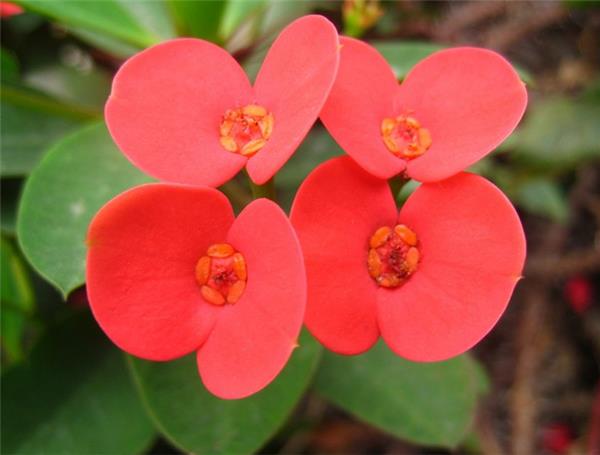
The flowers of Crown of Thorns are generally dark red or yellow, relatively small, usually growing in pairs or in small clusters, carrying a unique gorgeous beauty that dazzles the heart. Below, let us look at the care methods and key points for Crown of Thorns.
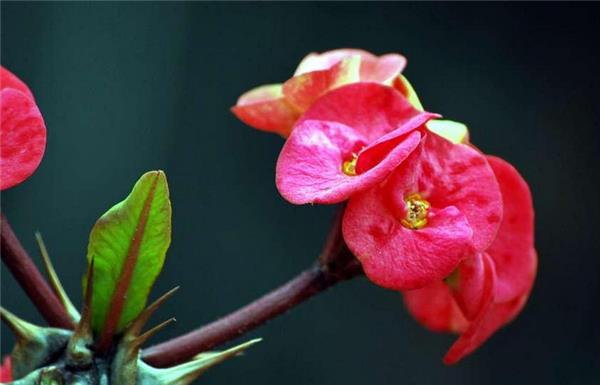
Care methods for Crown of Thorns
Crown of Thorns grows relatively slowly when planted, growing only about 10-12 cm in a year's time, so in order to promote good growth of Crown of Thorns, you can choose to repot it once every spring, which can better promote better growth of Crown of Thorns.
When choosing soil for Crown of Thorns, the requirements are relatively strict. Generally, you can choose 3 parts garden soil mixed with 1 part furnace slag, or you can use 4 parts medium-coarse river sand mixed with 1 part sawdust, and at the same time you can add other nutrient soils as a substrate, all of which are fine.
In terms of humidity, Crown of Thorns prefers a sunny, dry and well-ventilated environment. If rainy weather occurs, make sure to manage the surface humidity of Crown of Thorns well to avoid pathogen infection.
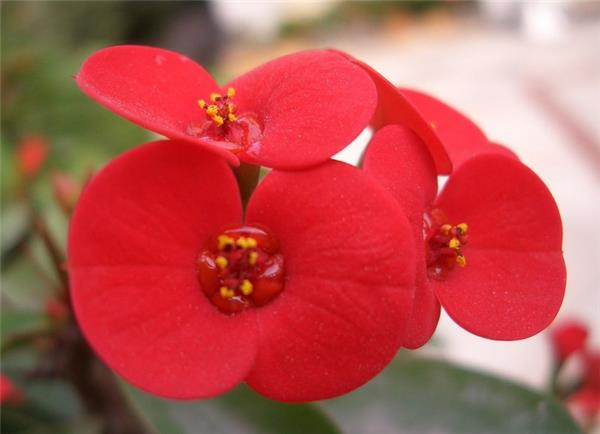
The growth temperature for Crown of Thorns can be maintained at 22°C during the day and around 15°C at night. Living in such an environment, Crown of Thorns can keep blooming for a long time. If the temperature is below 10°C, Crown of Thorns will enter a dormant state, so in winter try to maintain the temperature for Crown of Thorns.
Crown of Thorns is naturally fond of sunlight, so it can be placed in a sunny environment, but what must be maintained is air circulation around Crown of Thorns.
When planting Crown of Thorns, you can choose some culture soil with hoof and horn pieces added as base fertilizer. During its growing period, you can choose to fertilize once every half a month. Generally, fertilization can be stopped after the Start of Autumn. At the same time, Crown of Thorns must not be given fertilizer containing grease.
In terms of watering, in summer you can water Crown of Thorns once a day. In spring and autumn, water when the soil is dry and withhold when it is wet. In winter, do not water unless the soil is dry. At the same time, properly control the water to avoid root rot.
Key points for caring for Crown of Thorns
1. It is best to pot it in spring from March to April.
2. The potting soil should preferably be prepared with half mountain soil or leaf mold, an appropriate amount of sand soil and bone meal.
3. The roots of cultivated seedlings must retain the original soil, and at the same time cut off dead roots, injured roots and overly long main roots, and also properly prune overly dense branches and leaves.
4. Pay attention to keeping the potting soil moist; it must not be too wet or waterlogged. In winter the potting soil needs to be slightly dry.
5. After new branches unfurl leaves, apply 1 time of diluted cake fertilizer water every 1-2 months. Before flowering and fruiting, phosphorus and potassium fertilizers need to be applied.
6. In winter the room temperature must not be lower than 6°C.
7. Prune away diseased branches, dead branches and overly dense branches.
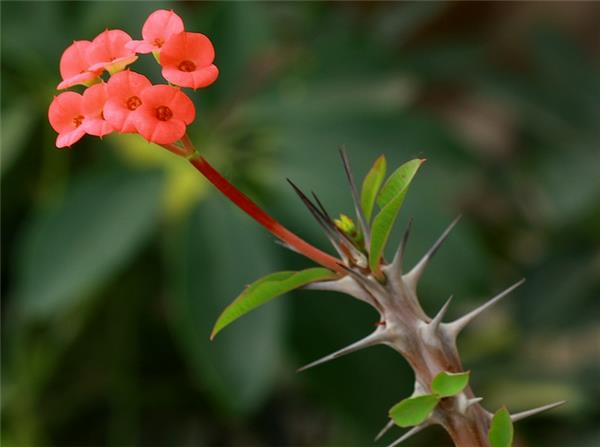
At the end of the article, let us look at the characteristics of Crown of Thorns.
Crown of Thorns is probably the most well-behaved flower of all. It is not as brilliant and brocade-like as the azalea, nor as pure and elegant as the narcissus, and it cannot compare with the peony's gaudy richness, yet it still lives in a decent manner. On its branch tips it still blooms with small, tender and lovely flower buds. In the winter when flowers and trees wither, only Crown of Thorns stands undefeated against the cold, with a few bright red small flowers blooming among them, appearing all the more graceful, adding quite a bit of spring feeling to the room.
Its iron-gray gnarled branches, hard and strong as if chopped by an axe, with sharp hard spines covering the stems and branches, hold up proudly a solemn and inviolable seasonal image: its loquat-like leaves are tender and green, slender and long, and now it is already a pot full of lush, abundant green, naturally drawing people into deep thoughts of lingering notes and where the beauty might be.
On the branch tips, small red flowers like butterflies, each two petals forming one small flower, then forming a not-too-large cluster, green in summer and red in winter, seem to swear an oath of persistent, never-abandoning love. The overall shape is rugged, natural, simple, elegant, pure, proud and aloof, with varying shades and well-spaced density, beautiful and moving! Like a philosophical poem that one can savor endlessly!
The combination of the tiger's thorn and the plum alone is quite meaningful, giving it the tiger's ferocity, the thorn's sharpness and the plum's charm. If you gaze at Crown of Thorns, its sparse little flowers and the clear fragrance drifting from afar make one's heart yearn for it.
That is all for today's introduction to the care methods and key points for Crown of Thorns. I hope the above content can help flower lovers.