Why Are the Leaves of the Crown of Thorns Turning Yellow? Causes and Solutions
The crown of thorns (Euphorbia milii) is a tough flower, intelligent, understated, plain and lovely, and it can bloom all year round. But what should you do when its leaves turn yellow? Let's first look at the causes of yellowing leaves on the crown of thorns.
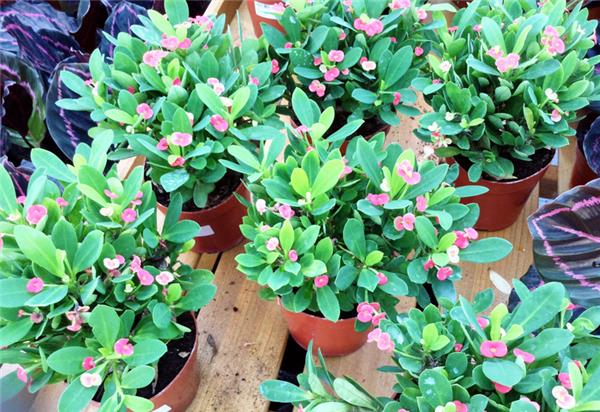
Causes of Yellowing Leaves on the Crown of Thorns
1. Too much watering: The crown of thorns has fleshy stems and leaves; it is not afraid of drought, but it fears waterlogging. Too much watering damages the root system and causes the leaves to turn yellow and drop off.
2. Too much fertilizer: The crown of thorns does not like fertilizer. During cultivation, if too much fertilizer is applied or unfermented raw fertilizer is used, it will burn the root system and cause the leaves to turn yellow.
3. Poor air circulation: The crown of thorns has certain requirements for its surrounding growing environment and does best in a ventilated, airy spot, so it is generally planted more in courtyards and on balconies. If indoor ventilation is poor and it is rather stuffy and hot, the leaves of the crown of thorns will turn yellow.
4. Damage from chemicals: When watering the crown of thorns, if tap water is used, it should be left to stand for a few days first; otherwise the chloride in the water is toxic to the plant and causes the leaves of the crown of thorns to turn yellow and fall off.
5. Winter dormancy: In late autumn, as the crown of thorns enters its peak flowering period, it is also about to enter its winter dormancy period, so some yellowing of the leaves is normal. Even if all the leaves drop off, new leaves will sprout again in spring.
6. Too low a temperature: In areas where the winter temperature drops below 10 degrees, the old leaves of the crown of thorns will fall off, leaving only the tender leaves at the top; when the temperature is even lower, the leaves will all dry up and drop off.
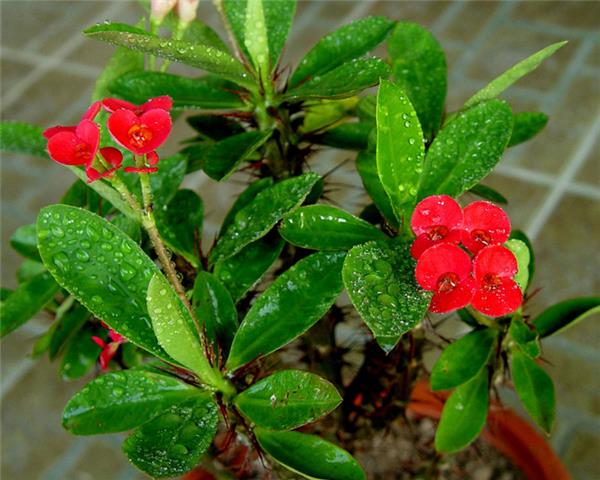
What to Do When the Leaves of the Crown of Thorns Turn Yellow
If you have watered too much, reduce watering and move it to a spot with plenty of sunlight. If it is caused by too much fertilizer, then fertilize appropriately, and before fertilizing check and make sure the fertilizer is suitable for the growth of the crown of thorns. Try not to place the crown of thorns in a rather stuffy, unventilated spot; it is best to plant it in a courtyard. After all, the crown of thorns is somewhat toxic, so for safety it is not suitable to keep it indoors.
In addition, the crown of thorns is easy to cultivate and generally rarely suffers from pests or diseases. It also has elegant flowers and a long flowering period, making it one of people's favorite ornamental plants. However, the crown of thorns has thorns, so be careful not to get pricked. If the yellowing is caused by too low a temperature, you should increase the amount of direct sunlight the crown of thorns receives.
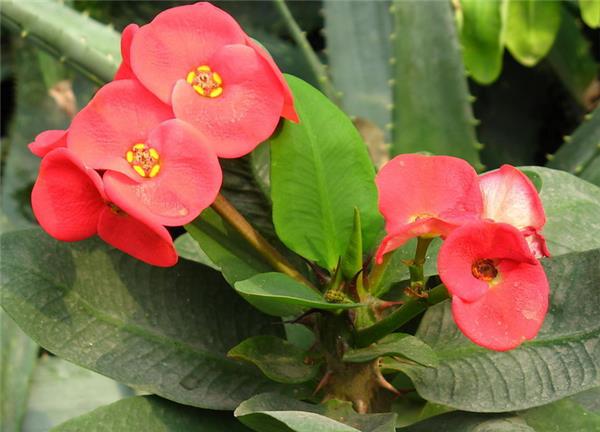
Finally, let's look at what roles the crown of thorns plays in home life.
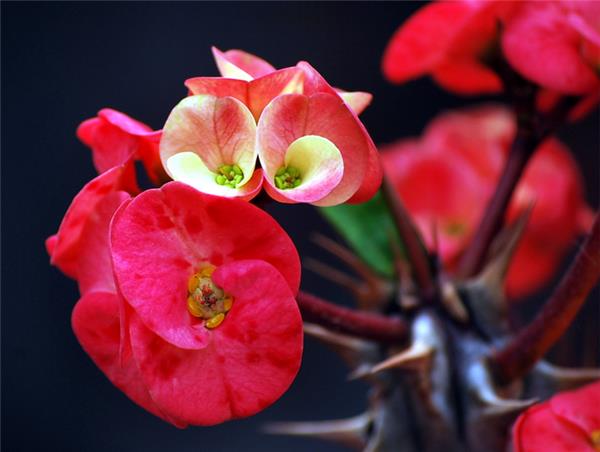
The crown of thorns has grayish-green, thorny dry branches, and bright red and rose-red small flowers bloom at the tips of the branches. It has a long flowering period, vivid flower colors, an elegant form, and is easy to cultivate, making it a fine flower that people love. The blooming crown of thorns flowers look from afar like little rubies, and also like tiny stars; up close, they look like a little doll's smiling face. When the flowers on all the branches are open, a few dots of red among the green leaves are even more beautiful and lovely.
The crown of thorns is a vine-like, many-spined plant of the Euphorbiaceae family. A common feature of Euphorbia plants is that after the plant body is injured, a white milky sap oozes from the wound, and it is toxic. The white milky sap secreted from the wounds of crown of thorns plants irritates human skin and mucous membranes, and accidental ingestion can cause nausea, dizziness and so on. It is a powerful weapon by which the plant protects itself during the course of evolution and prevents damage from pests and diseases. As long as you do not casually break off the flowers for children to play with, home cultivation will not cause harm. People can use the soaked and filtered liquid from the stems and leaves of Euphorbia plants to control flower pests such as aphids and red spiders. Because its sap is toxic, it is best not to grow it in pots indoors; as an outdoor ornamental flower it is also a very good choice.