What are the functions and uses of the watermelon rind peperomia?
The watermelon rind peperomia is one of the common household potted plants today, and many families grow it, but do you know what the functions of the watermelon rind peperomia are? Below we give a brief introduction.
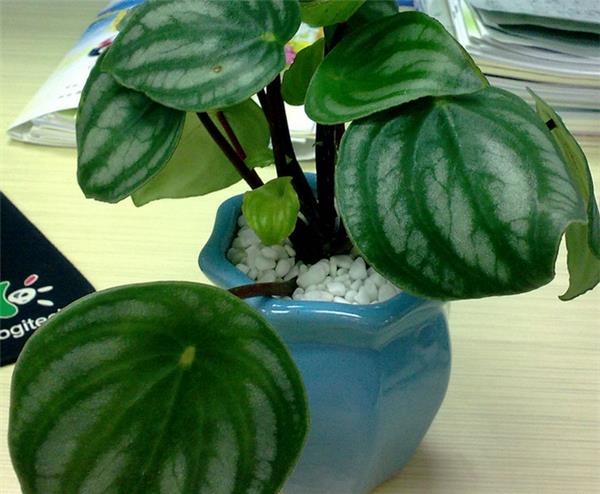
Introduction to the watermelon rind peperomia
The watermelon rind peperomia, also known as the jade peperomia, is a perennial herbaceous plant that stays evergreen all year round. The stem is short and clumping, and the leaf stalks are reddish brown. The leaves are ovate with pointed tips, about 6cm long. The leaf veins radiate from the center to the surroundings, with 8 main veins in deep green, and the areas between the veins are silvery gray, resembling watermelon rind, hence the name watermelon rind peperomia.
The watermelon rind peperomia likes warm, humid and semi-shaded environments. During the hot and dry seasons of summer and autumn, attention should be paid to frequently misting the leaves to keep them moist. Overwatering easily causes the stems and leaves to rot. The growing medium should be loose with good drainage and aeration. Its cold tolerance is somewhat weak, and the winter temperature should be kept above 8°C. It grows best at 20-25°C, and grows slowly above 30°C and below 15°C. Too much nitrogen fertilizer tends to make the markings less distinct and reduces its ornamental value.
The watermelon rind peperomia is short in stature and grows luxuriantly, making it very suitable both as a potted display and for hanging appreciation. Its leaf color stripes resemble watermelon. It is suitable for pot cultivation or hanging cultivation.
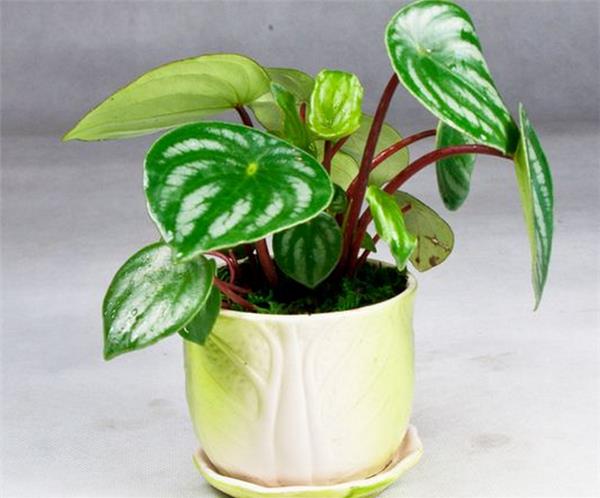
The functions of the watermelon rind peperomia
1. Accenting the home
The watermelon rind peperomia has a delicate shape, with elegant leaves growing in clusters, a rounded form, green as jade, white as fine jade, elegant and delicate, and it has a unique charm when used as an indoor decorative plant. It can be placed as a small potted plant on a coffee table or desk for close appreciation, with a distinctive flavor. It is a small foliage plant very suitable for desk display, and a great helper for accenting and beautifying the home interior.
2. Purifying the air
The watermelon rind peperomia is an expert at accenting and beautifying the home, and it is also quite good at purifying and improving indoor air. The watermelon rind peperomia has strong photosynthesis, can absorb a large amount of carbon dioxide and release a large amount of oxygen, has a certain resistance to sulfur dioxide, can also absorb a small amount of formaldehyde and ammonia, and also has a strong absorbing effect on cooking fumes and dust. It is a plant with a very strong air-purifying and improving effect, and is very good to use in the home interior.
3. Home feng shui
The leaves of a vigorously growing watermelon rind peperomia are round, emerald green and smooth, carrying the feng shui meaning of good fortune and health, and also symbolizing the ability to adapt flexibly to various environments and people. It has good feng shui significance for the owner's health and social interactions, and can arrange good home feng shui.
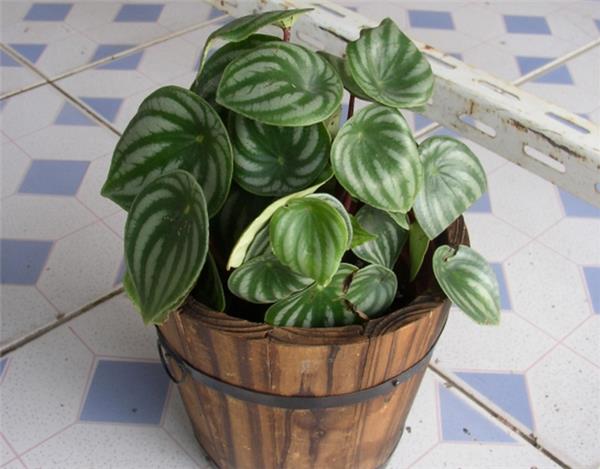
Finally, let us look at the propagation methods of the watermelon rind peperomia.
Division and cuttings are commonly used for propagation:
Division propagation
This can be done in spring and autumn. Select plants that have new shoots growing at the base of the mother plant, take out the plant when repotting and changing the soil, shake off the attached soil, and use a sharp knife to cut off the new shoots according to their position and pot them up. When dividing, be careful to protect the root systems of the mother plant and the new shoots. Alternatively, when the plant has filled the pot, take it out and divide it into several pots for planting.
Cutting propagation: cuttings are further divided into stem cuttings and leaf cuttings.
(1) Stem cuttings can be done in spring and summer. Select robust branches, cut 5-8cm cuttings, remove the lower leaves, let the cut dry, and then insert them into a moist sand bed. Under semi-shade, keeping the temperature at 18-25°C, they will take root.
(2) Leaf cuttings are mostly done from May to October. For leaf cuttings, select robust and plump leaves, remove all the plump leaves with leaf stalks, with 2-3cm of leaf stalk attached, let them dry for 2-3 hours until the wounds are slightly dry, then insert them obliquely into a sand bed or pot. The angle between the leaf stalk and the seedbed is 35 degrees to 45 degrees, and the medium is washed river sand mixed with 20%-30% vermiculite. Keep it moist, place it under semi-shade at 20-25°C, and in about 4-5 weeks adventitious roots and adventitious buds will grow, and in about 2 months small seedlings will have grown. When the seedlings grow to 4-5cm, transplant them into pots. But avoid overly wet medium to prevent the cuttings from rotting. When taking cuttings, avoid covering with plastic film or glass, otherwise they easily rot.
That is all for today's introduction to the functions of the watermelon rind peperomia. I hope the above content can help everyone!