How to grow the fairy mountain cactus, care tips, and bonsai-making methods
The fairy mountain cactus is also called mountain shadow fist, or mountain shadow for short, and some people also call it ten-thousand-layer mountain. It is a variant of the cactus column and belongs to the Cactaceae family, the genus Cereus, a succulent plant. Mountain shadow fist originated in Mexico. Because its shape is towering and abrupt, resembling mountain ranges, it is named fairy mountain. Depending on the variety, the shape, number, and color of its peaks differ, and there are so-called coarse code, fine code, and dense code types. If planted in a purple clay pot, its form seems like a mountain yet not a mountain, like a stone yet not a stone, green all year round and full of vitality, just like a uniquely styled mountain-stone bonsai. But do you know how to grow the fairy mountain cactus? Now here is a detailed introduction for you.

First, the fairy mountain cactus
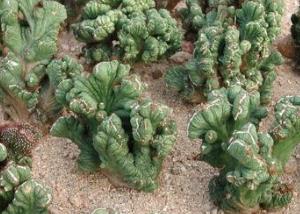
Because the ribs of the fairy mountain cactus are shortened and irregular, and its stems appear in jagged rock-like forms, like grotesque rocks and strange peaks, it is used as a decorative bonsai and so on. A fairy mountain cactus bonsai is always very suitable for placing in courtyards, halls, studies, or balconies.
Place of origin and distribution: native to Mexico
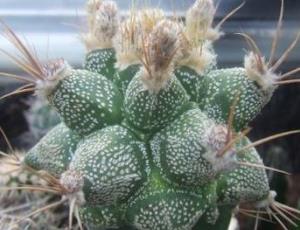
Morphological characteristics: its form seems like a mountain yet not a mountain, like a stone yet not a stone, but rather a living, lush, layered and overlapping, evergreen succulent plant. Because its shape is towering and abrupt, resembling mountain ranges, it is named fairy mountain. It is irregularly cylindrical or rockery-shaped, with thick fleshy stems and hairs and spines, and a spectacular form. It takes 8-9 years of cultivation before it can bloom.
Second, how to grow the fairy mountain cactus and care tips
How to grow the fairy mountain cactus
The fairy mountain cactus likes sunlight, is drought-tolerant, tolerant of poor soil, and also shade-tolerant. For pot cultivation, choose a sandy soil with good aeration and drainage and rich in lime. The fairy mountain cactus is not suited to overly wet soil or an environment with too little light. Watering should be on the light side rather than excessive; water once every 3-5 days and keep the soil slightly dry. This can make the plant grow slowly, thick and plump, with a beautiful shape. The fairy mountain cactus generally does not need fertilizing. Each year when repotting, place a small amount of crushed bone meal or organic fertilizer at the bottom of the pot as a base fertilizer. Never apply high-concentration chemical fertilizer, otherwise fertilizer burn will occur and the loss will outweigh the gain. You can also use organic fertilizer such as sesame paste residue to make a liquid fertilizer, dilute it, and pour it onto the potting soil.
Watering the fairy mountain cactus should adhere to alternating dry and wet conditions, preferring dry over wet. There must not be an absolute fixed interval for watering; it should be flexibly controlled according to factors such as weather, temperature, light, and ventilation. The fairy mountain cactus should have water and fertilizer withheld, otherwise it is prone to root rot, or to leggy growth and deformation, showing a "reversion" phenomenon, growing into a column shape and losing ornamental value. When overwintering in winter, move the fairy mountain cactus indoors promptly when the outdoor ambient temperature is below 5°C, place it in a sunny spot, and maintain room temperature between 5-10°C for safe overwintering. If the temperature drops suddenly, cover it with a plastic bag to keep it warm.
Propagation techniques for the fairy mountain cactus
Like other cactus plants, the fairy mountain cactus is very easy to propagate and keep alive. The fairy mountain cactus is propagated by cuttings, which can be done throughout the year, with April-May being the best time. The specific method is: select a small deformed stem of the fairy mountain cactus, cut it off and let it dry for 1-2 days, wait until the cut surface has dried and closed, then insert it into the soil for cuttings. Do not water for the time being, press the soil firmly over it, and spray some water to keep it moist. Generally, under suitable temperature conditions (14-23°C), roots can form in about 20 days and it can be transplanted. Cuttings taken during the plum rain season and the hot midsummer period have a lower survival rate.
Cultivation and management of the fairy mountain cactus
Mountain shadow fist likes sunlight, is drought-tolerant, tolerant of poor soil, and also shade-tolerant. For pot cultivation, choose a sandy soil with good aeration and drainage and rich in lime. Mountain shadow fist is not suited to overly wet soil or an environment with too little light. Watering should be on the light side rather than excessive; water once every 3-5 days and keep the soil slightly dry. This can make the plant grow slowly, thick and plump, with a beautiful shape. Mountain shadow fist generally does not need fertilizing. Each year when repotting, place a small amount of crushed bone meal or organic fertilizer at the bottom of the pot as a base fertilizer. Never apply high-concentration chemical fertilizer, otherwise fertilizer burn will occur and the loss will outweigh the gain. You can also use organic fertilizer such as sesame paste residue to make a liquid fertilizer, dilute it, and pour it onto the potting soil.
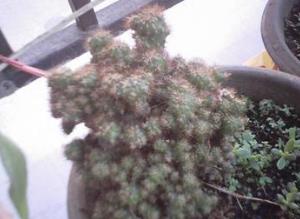
Watering mountain shadow fist should adhere to alternating dry and wet conditions, preferring dry over wet. There must not be an absolute fixed interval for watering; it should be flexibly controlled according to factors such as weather, temperature, light, and ventilation. Mountain shadow fist should have water and fertilizer withheld, otherwise it is prone to root rot, or to leggy growth and deformation, showing a "reversion" phenomenon, growing into a column shape and losing ornamental value. When overwintering in winter, move mountain shadow fist indoors promptly when the outdoor ambient temperature is below 5°C, place it in a sunny spot, and maintain room temperature between 5-10°C for safe overwintering. If the temperature drops suddenly, cover it with a plastic bag to keep it warm.
Third, how to make a fairy mountain cactus bonsai
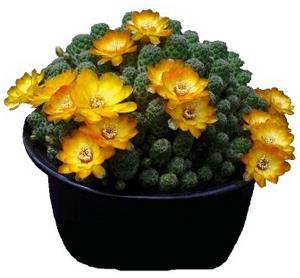
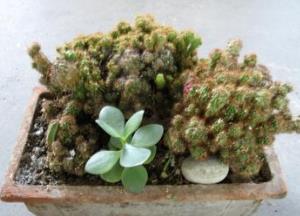
1. To make a medium-sized fairy mountain cactus bonsai, 7-9 cuttings of different lengths are needed. Plant 2-3 longer cuttings and 1-2 shorter cuttings at one end of the pot, and plant the remaining 3-4 cuttings at the other end of the pot. The cuttings should have a certain layering, achieving an effect of high and low interspersing, appropriate density, uneven heights, and shorter in front and taller behind. Leave a certain open space between the two groups of cuttings, like a patch of grass between two large mountains. To prevent the cuttings from tilting and falling over, bury a few pieces of water-absorbing stone or small bricks in appropriate positions.
2. To make a fairy mountain cactus bonsai, it is best to choose an oval or rectangular pot with a depth of about 6 cm. The size and depth of the pot should be directly related to the size and number of fairy mountain cacti planted. For making a fairy mountain cactus bonsai, "coarse code" fairy mountain cactus is preferred, especially tiger-head fairy mountain cactus. Tiger-head fairy mountain cactus is vigorous and has many wrinkles, much like the undulating peaks and ridges in nature.
Watering mountain shadow fist should adhere to alternating dry and wet conditions, preferring dry over wet. There must not be an absolute fixed interval for watering; it should be flexibly controlled according to factors such as weather, temperature, light, and ventilation. Mountain shadow fist should have water and fertilizer withheld, otherwise it is prone to root rot, or to leggy growth and deformation, showing a "reversion" phenomenon, growing into a column shape and losing ornamental value. When overwintering in winter, move mountain shadow fist indoors promptly when the outdoor ambient temperature is below 5°C, place it in a sunny spot, and maintain room temperature between 5-10°C for safe overwintering. If the temperature drops suddenly, cover it with a plastic bag to keep it warm.
Third, how to make a fairy mountain cactus bonsai
1. To make a medium-sized fairy mountain cactus bonsai, 7-9 cuttings of different lengths are needed. Plant 2-3 longer cuttings and 1-2 shorter cuttings at one end of the pot, and plant the remaining 3-4 cuttings at the other end of the pot. The cuttings should have a certain layering, achieving an effect of high and low interspersing, appropriate density, uneven heights, and shorter in front and taller behind. Leave a certain open space between the two groups of cuttings, like a patch of grass between two large mountains. To prevent the cuttings from tilting and falling over, bury a few pieces of water-absorbing stone or small bricks in appropriate positions.
2. To make a fairy mountain cactus bonsai, it is best to choose an oval or rectangular pot with a depth of about 6 cm. The size and depth of the pot should be directly related to the size and number of fairy mountain cacti planted. For making a fairy mountain cactus bonsai, "coarse code" fairy mountain cactus is preferred, especially tiger-head fairy mountain cactus. Tiger-head fairy mountain cactus is vigorous and has many wrinkles, much like the undulating peaks and ridges in nature.