What are the methods for preventing and controlling pests and diseases on Schefflera arboricola?
Schefflera arboricola (dwarf umbrella tree) is a common foliage plant for indoor display, and growing it indoors also helps purify the air. However, any plant can run into pest and disease problems. Below, let us take a look at the methods for preventing and controlling pests and diseases on Schefflera arboricola.
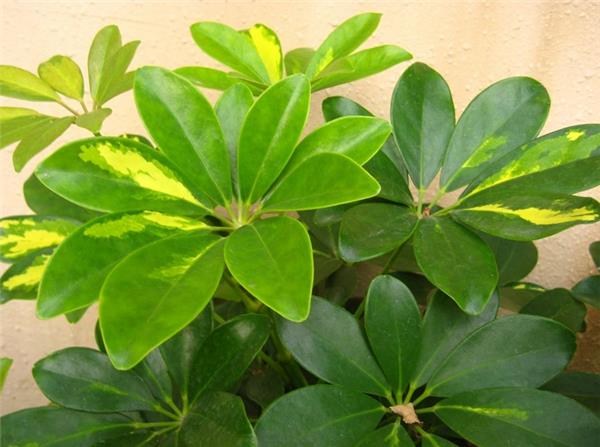
Methods for preventing and controlling pests and diseases on Schefflera arboricola
Leaf spot: it can be controlled with a 0.5%-0.6% Bordeaux mixture (made by mixing 0.5-0.6 parts quicklime, 0.5-0.6 parts copper sulfate, and 100 parts water), or 70% thiophanate-methyl wettable powder or 50% carbendazim wettable powder at 800-1000 times dilution, or 50% thiophanate wettable powder or 65% zineb wettable powder at 500-600 times dilution, and other such solutions. Spray the solution 1-2 times every 10-15 days.
Anthracnose: it can be controlled with 75% thiophanate-methyl wettable powder at 1000 times dilution, 75% chlorothalonil wettable powder at 600 times dilution, or 25% tantelin wettable powder at 500 times dilution, 25% benomyl emulsifiable concentrate at 900 times dilution, or 50% tuijunte at 800-1000 times dilution, or 50% tanfumei wettable powder at 500 times dilution, and other such solutions. Spray the solution once every 7-10 days, for 3-4 consecutive times.
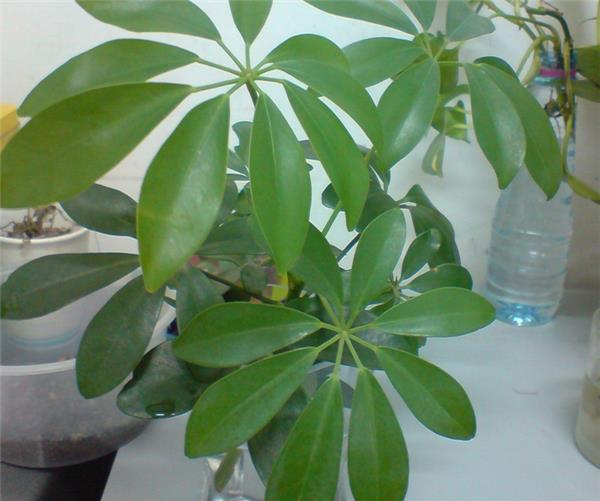
Scale insects: spray with jiebi zhi diluted 750-1000 times, focusing on the parts where scale insects occur, spraying until wet but not dripping. When scale insects are severe, spray again every 7-10 days for a more noticeable effect.
Red spider mites: during major outbreaks, spray 20% dicofol emulsifiable concentrate at 500-600 times dilution, 20% fenpropathrin emulsifiable concentrate at 2000 times dilution, 5% hexythiazox emulsifiable concentrate at 1500 times dilution, 50% monocrotophos emulsifiable concentrate at 1500 times dilution, 40% isocarbophos emulsifiable concentrate at 1500 times dilution, 40% omethoate emulsifiable concentrate at 1500 times dilution, 10% bifenthrin emulsifiable concentrate at 3000 times dilution, etc., which can greatly reduce pest population density. To prevent pests from developing resistance, pesticides should be used alternately or in combination.
Thrips: spray 80% dichlorvos at 10000 times dilution; 40% omethoate at 1500 times dilution for control.
Leaf miner: it can be controlled with 25% dimehypo aqueous solution at 400-600 times dilution, 2.5% deltamethrin emulsion at 3000-4000 times dilution, 5% chlorfluazuron emulsifiable concentrate at 3000 times dilution, 24% methomyl liquid at 2000 times dilution, 40.7% chlorpyrifos emulsifiable concentrate at 1000 times dilution, 5% lufenuron emulsifiable concentrate at 3000 times dilution, 25% chlorbenzuron suspension concentrate at 1000 times dilution, 20% fenvalerate at 8000 times dilution, 20% fenpropathrin emulsifiable concentrate at 2000 times dilution, etc. When spraying for control, note that different types of pesticides should be applied in rotation to avoid the development of resistance.
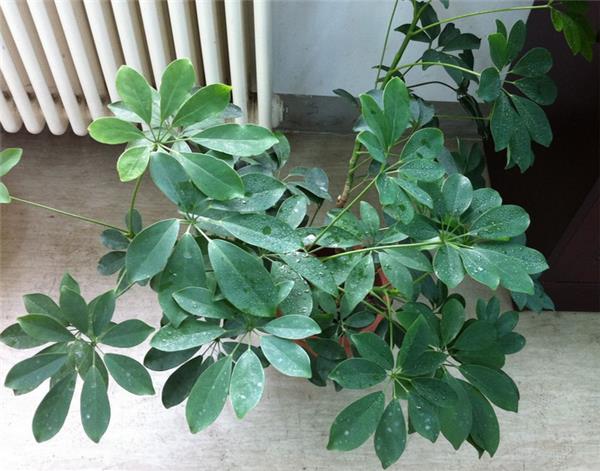
What should be noted when growing Schefflera arboricola?
1. The sap of Schefflera arboricola is toxic, but the toxicity is relatively mild. If it is accidentally touched, simply wash it off with water, and accidental ingestion will not be life-threatening.
2. Schefflera arboricola should avoid direct sunlight as much as possible; it is accustomed to living in a semi-shaded environment, and maintaining four hours of light per day is sufficient.
3. Water in moderation. If the soil is too dry, it easily drops leaves. When the weather is dry, use spraying to increase the humidity of the plant and the environment. In rainy seasons, water less to prevent waterlogging.
4. If it is a cutting-propagated plant, do not rush to repot it. Wait until the plant grows well and stably before repotting. Doing so can increase the plant's survival rate.
5. Schefflera arboricola is very sensitive to ethylene, so it cannot be grown together with plants or other items that produce ethylene, otherwise leaf drop will occur.
That is all for today's introduction to the methods for preventing and controlling pests and diseases on Schefflera arboricola. I hope the above content can be helpful to everyone.