What causes yellowing leaves on a desert rose?
The desert rose, with its mysterious name and gorgeous flowers, attracts everyone's enthusiasm for growing it. However, during cultivation, yellowing leaves on the desert rose are often encountered. Below, we will explain the causes of yellowing leaves on the desert rose.
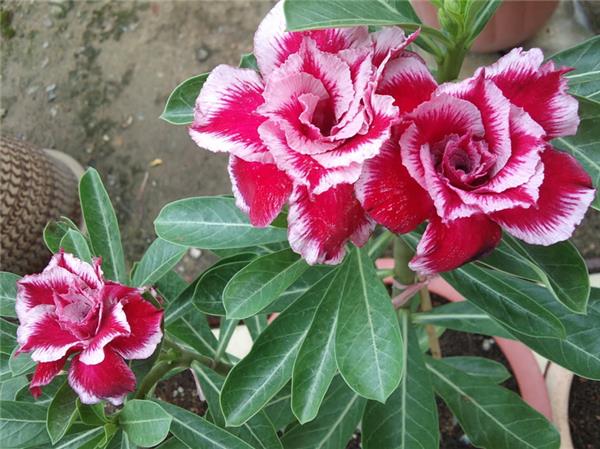
Causes of yellowing leaves on a desert rose
1: Not yet adapted to the environment
A newly purchased desert rose is in its adaptation period, and a small amount of yellow leaves is very common and perfectly normal; after a while, once it adapts on its own, it will be fine. If a large number of leaves turn yellow, or the plant is even close to dying, then it may be due to other reasons, so keep reading.
2: Root rot
Plant roots need to breathe. Keeping the soil loose matters; a flower pot with poor air permeability can easily cause root rot, and once the roots rot, the plant naturally cannot absorb enough nutrients. The solution is to cut away the rotted parts and loosen the soil. If the entire root system has rotted, then there is no saving it.
3: Overwatering
From the name "desert rose," you can tell that it is fairly drought-tolerant. Do not water too much each time, otherwise it easily causes root rot, which in turn makes the leaves turn yellow. After cutting away the rotted roots, control watering.
4: Temperature too low
In winter, when temperatures are low, the desert rose enters dormancy. Its leaves turning yellow, drying up, and even dropping are all ways to reduce water evaporation and nutrient consumption. This is a self-protective mechanism, so there is no need to worry. If you want the desert rose to remain vibrant in winter, then move it into a greenhouse.
5: Insufficient light
The desert rose is a sun-loving plant, and only sufficient light can ensure its normal growth. If you currently keep it in a shady spot, hurry and let it take a sunbath.
6: Poor ventilation
Poor ventilation will inevitably cause the plant's leaves to turn yellow, and in severe cases, the whole plant may rot and die. The solution is to take it out to "get some air," that is, move it to a well-ventilated location, such as a balcony, a window, and so on.
7: Overfertilizing
Overfertilizing, on the one hand, makes the soil less air-permeable; on the other hand, the concentration of the solution outside the cells becomes too high, causing root cells to lose water and die. The result in both cases is root rot, leading to death. Therefore, fertilize in the right amount, and remember never to apply too much.
8: Pests
The main pest of the desert rose is scale insects. When the infestation is severe, it causes all the leaves to drop, the plant's growing points to die, and even the plant to die. Once discovered, immediately wipe them off with a cotton swab dipped in water. You can also spray 1-2 times during the egg-laying and hatching periods with 40% omethoate emulsifiable concentrate at 1000-2000 times dilution, or 50% fenitrothion emulsifiable concentrate at 1000 times dilution.
9: Diseases
The desert rose is mainly harmed by leaf spot disease and root rot. When leaf spot disease occurs severely, it can cause large numbers of leaves to drop. It can be controlled with 25% carbendazim wettable powder at 500 times dilution or 50% thiophanate at 1000 times dilution. Root rot often causes the plant's roots to rot and the plant to die; it can be controlled by drenching with 50% thiophanate wettable powder at 500 times dilution or agricultural streptomycin at 1000 times dilution.
Next, let's look at how to grow the desert rose.
1. The desert rose is mainly propagated by sowing and cuttings. Sowing is best done in spring, using the spot sowing method to make management easier after the seedlings emerge. Before sowing, the substrate must be disinfected. After the seedlings emerge, be careful that the substrate in the sowing tray is not too wet, otherwise the roots may rot and cause large numbers of seedlings to die. Cuttings are best taken in the vigorous growing season. Cut the stem segments to about 10 cm, soak the lower ends in water, and dilute the sticky sap at the cut to prevent it from gumming up and affecting root formation. They can be inserted into a sand bed or directly into a disinfected growing substrate, and they will take root in about 15-30 days. When propagating, it is recommended to use the sowing method, because this way the plant's root crown can naturally swell and form a good plant shape. Cutting-propagated plants cannot do this, and their ornamental value is also greatly reduced.
2. In addition, during cultivation, the desert rose's branches tend to grow leggy, which affects the beauty of the plant shape. Grafting can be used to change its plant shape. At a certain height on the plant, cut off all the branches in a certain shape, then take the upper ends of the cut branches and use the cleft grafting method to graft them. After grafting, the plant's shape is attractive, and after flowering, the flowering branches are compact and highly ornamental.
3. The desert rose is fairly drought-tolerant, so do not water too much each time. If there is too much water, it very easily causes root rot, and the branches also grow leggy, making pruning rather troublesome. In summer, when temperatures are high, water according to the soil conditions. Generally, water once every two or three days, and there must be no standing water in the pot. In winter, when temperatures drop, the desert rose accordingly enters a semi-dormant period. At this time, appropriately control watering, pay attention to keeping the soil dry, and watering once a week is enough. Appropriate drought is very beneficial to the growth of the desert rose.
4. The desert rose relatively prefers phosphorus and potassium fertilizers, so supplement once about every month. During the vigorous summer growing period, sufficient fertilizer and water are needed so that the flowers it produces can be lush and vivid. In addition, along with repotting once a year, you can also appropriately apply some long-acting base fertilizer in the pot, such as decomposed soybean cake and bone meal. The desert rose relatively prefers phosphorus and potassium fertilizers, so supplement once about every month. During the vigorous summer growing period, sufficient fertilizer and water are needed so that the flowers it produces can be lush and vivid. In addition, along with repotting once a year, you can also appropriately apply some long-acting base fertilizer in the pot, such as decomposed soybean cake and bone meal.
5. Pruning the desert rose is also very important. If you do not pay attention to regular pruning and let it grow leggy, it easily loses its ornamental value. After the flowering period is the best time to prune, and you can make choices according to personal preference. Note: more branches mean more flowers. If you want more flowers, you need to find ways to keep more side shoots.
At the same time, the branches also grow leggy, making pruning rather troublesome. In summer, when temperatures are high, water according to the soil conditions. Generally, water once every two or three days, and there must be no standing water in the pot. In winter, when temperatures drop, the desert rose accordingly enters a semi-dormant period. At this time, appropriately control watering, pay attention to keeping the soil dry, and watering once a week is enough. Appropriate drought is very beneficial to the growth of the desert rose.4. The desert rose relatively prefers phosphorus and potassium fertilizers, so supplement once about every month. During the vigorous summer growing period, sufficient fertilizer and water are needed so that the flowers it produces can be lush and vivid. In addition, along with repotting once a year, you can also appropriately apply some long-acting base fertilizer in the pot, such as decomposed soybean cake and bone meal. The desert rose relatively prefers phosphorus and potassium fertilizers, so supplement once about every month. During the vigorous summer growing period, sufficient fertilizer and water are needed so that the flowers it produces can be lush and vivid. In addition, along with repotting once a year, you can also appropriately apply some long-acting base fertilizer in the pot, such as decomposed soybean cake and bone meal.
5. Pruning the desert rose is also very important. If you do not pay attention to regular pruning and let it grow leggy, it easily loses its ornamental value. After the flowering period is the best time to prune, and you can make choices according to personal preference. Note: more branches mean more flowers. If you want more flowers, you need to find ways to keep more side shoots.