How to Cultivate a Black Bone Tea Bonsai? A Detailed Guide to the Method
The black bone tea bonsai is a bonsai form that has risen in popularity in recent years. Because its growing range is relatively limited, its growth is slow, it is not easy to care for, and it requires artificial cultivation, rarity makes it precious, and thus it has drawn people's attention, becoming the latest ornamental favorite and collector's object.
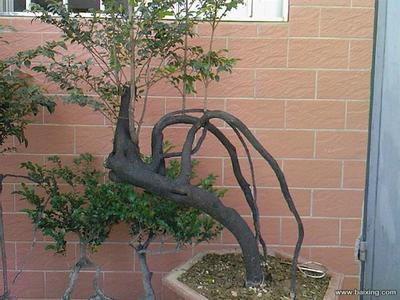
The black bone tea bonsai has small leaves, alternately arranged, heart-shaped, leathery, and dark green. New shoots and leaves are tender red. It is a shrub type. The bark and roots are black. The wood is hard. Its growth rate is slow, and its branches tend upward, often appearing in thicket form or with connected roots, and fine thicket-style stumps can often be found. Finished large tree-form works have only been seen in bonsai magazines from Taiwan, China. Below, the editor will take everyone to enjoy a set of black bone tea bonsai pictures and look at the cultivation methods for black bone tea.
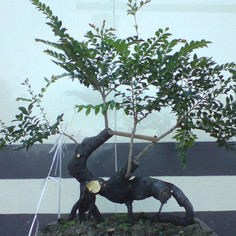
Cultivation Methods for Black Bone Tea Bonsai: The Stage of Selecting and Raising Stumps
Black bone tea grows slowly and is the slowest-growing tree species in Lingnan bonsai, growing even more slowly than boxwood. Therefore, when selecting stumps, special attention should be paid to choosing ones with accompanying graft knobs, preferably stumps with young branches. If the cut opening exceeds 3 cm, it will be very difficult to cultivate a matching branch knob. The best time to collect black bone tea is after the Spring Equinox and before Grain in Ear.
Black bone tea has strong sprouting ability and roots quickly, so the trunk, knobs, and roots can basically be cut into place in one go. After the stump is cut, soak it in clean water for 24 hours, then plant it in river sand, place it in half shade, and keep the trunk moist. After 20 days, black liquid secretion can be seen at the cut opening, and after a few days it sprouts. After 60 days, new roots can be seen, and the survival rate is extremely high.
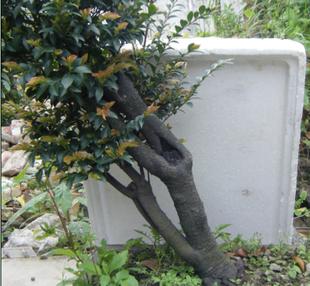
Cultivation Methods for Black Bone Tea Bonsai: Management During the Branch-Growing Stage
After the black bone tea survives, it can be moved to a sunny and ventilated place, and given light fertilizer water to encourage strong roots and vigorous branches. After the Autumn Equinox, knobs can be fixed according to shaping needs, and all unnecessary branches should be cut off so that nutrients are concentrated on the shaping branches. Once the root system of black bone tea is strong and vigorous, it likes fertilizer, so the proportion of fertilizer water can be appropriately increased, with water and fertilizer once every 7 days. Apply decomposed farmyard manure on the pot surface over the long term, so that nutrients slowly dissolve each time water is poured, which helps the stump absorb them.
Watering should achieve thorough drying and thorough wetting: do not water when not dry, and water thoroughly when watering. Stop fertilizing after Light Snow, completing the management of one growth cycle. It is worth noting that throughout the entire growth cycle, do not allow slow growth to appear because of a shortage of fertilizer water. With such management, in one growth cycle branches can be cultivated to a branch diameter of 0.6 cm, and in two growth cycles to a branch diameter of 1.2 cm, which generally can match the original stump knobs, meaning the first section can be achieved in two years.
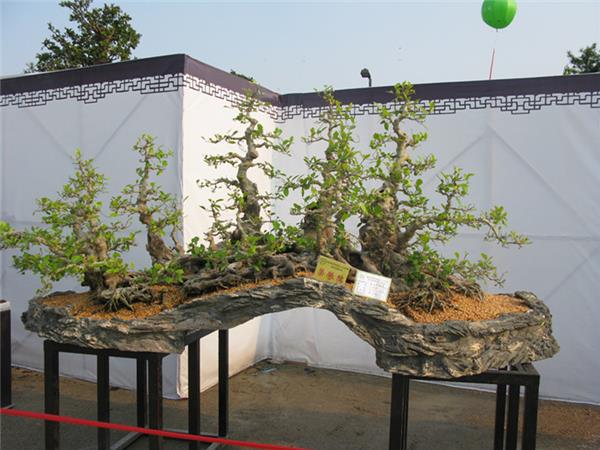
The black bone tea bonsai is evergreen in all four seasons and sprouts new shoots once each season. Therefore, pruning can be done in all four seasons; each pruning should be carried out only after the new shoots have matured, but spring and autumn are best. Black bone tea does not easily lose branches, so single-branch pruning can be carried out. After sprouting, select and keep strong buds, one main and one secondary, and use wire to bend the buds so that the branches grow horizontally. If the new sprouts are allowed to grow freely, they will all grow upward, and it will be very difficult to meet the requirement of horizontally spreading branches. This is something to note.
The black bone tea bonsai does not have many fibrous roots, so it can be repotted and have its soil changed once every 5 years. Even if it is the sandy soil used when raising the stump, as long as enough farmyard manure is applied, it is not too late to repot after 5 years. Repeat the management of the previous growth cycle each year until the work has basically taken shape.
Cultivation Methods for Black Bone Tea Bonsai: Management During the Forming Stage
Medium-sized stumps generally, after 5 years of branch-growing and maintenance, have newly cultivated branches that already have three sections, and can be repotted and have their soil changed around Qingming, then placed in a display pot for detailed shaping management. After Qingming, heavily prune the entire stump, remove leaves, lift the stump out, trim the root system, choose a suitable pot, and replant with a screened mixed soil of 3 parts sand and 7 parts mud. After normal growth resumes, return to the previous management.
The black bone tea bonsai grows slowly, so the method of combining pruning and wiring can be used to speed up the forming of the work. Pruning: heavy pruning before Qingming is best. Wiring: in the evening after fierce sun, when the branches are soft and ripe, wrap the branches with metal wire and bend them according to shaping needs. Pay attention to the rhythmic changes of the branches, the interchange of stiffness and softness, and the alternating use of long and short spans, so that the shaping branches have beautiful curves. Remove apical buds at any time to promote side buds, until the tree shape is full and the work is formed.
Black bone tea does not easily lose branches, so single-branch pruning can be carried out. After sprouting, select and keep strong buds, one main and one secondary, and use wire to bend the buds so that the branches grow horizontally. If the new sprouts are allowed to grow freely, they will all grow upward, and it will be very difficult to meet the requirement of horizontally spreading branches. This is something to note. The black bone tea bonsai does not have many fibrous roots, so it can be repotted and have its soil changed once every 5 years. Even if it is the sandy soil used when raising the stump, as long as enough farmyard manure is applied, it is not too late to repot after 5 years. Repeat the management of the previous growth cycle each year until the work has basically taken shape.
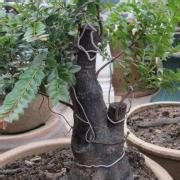
Cultivation Methods for Black Bone Tea Bonsai: Care After Forming
After the work is formed, it enters the viewing period. To keep the work from deforming, the amount of fertilizer water applied can be reduced, just enough to maintain normal growth of the work. Remove messy buds at any time. Once a year before Qingming, carry out a complete leaf change. 30 days later, when the new buds show red, is the best viewing time. Black bone tea tolerates shade. After one thorough watering, place it indoors and do not water for 20 days. When the soil turns white, water thoroughly once again. It can be placed indoors for 50 days before returning to normal outdoor management. Among Lingnan bonsai, it is one of the tree species that can be displayed indoors the longest. Black bone tea has relatively few diseases, with only a small amount of leaf-roller damage, which can be sprayed with a 0.2 percent emulsion of 80 percent dichlorvos.
Conclusion: The above is the cultivation method for the black bone tea bonsai and the appreciation of black bone tea pictures introduced by the editor. The black bone tea bonsai is a high-end, elegant, and classy collectible bonsai. Everyone must be very careful when cultivating black bone tea, so that your black bone tea is even more full of vitality.