How to Grow a Jade Plant? Detailed Guide to Cultivation Methods and Precautions
The jade plant, also known as the jade tree, million-year plant, or glass crassula, is a succulent subshrub in the genus Crassula of the family Crassulaceae. It has excellent ornamental value and is often used by people as an indoor decorative bonsai. Below we introduce the cultivation methods and precautions for jade plants.
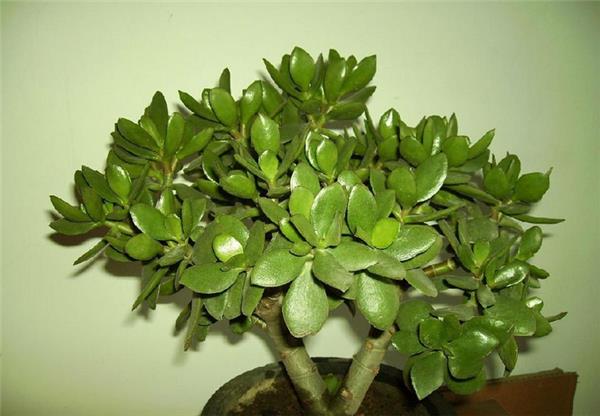
Cultivation Methods for Jade Plants
1. Potting soil requirements: The most suitable time for repotting and planting is early spring. The potting soil should be loose, fertile, and well-draining. You can use a mix of 2 parts leaf mold or peat soil, 2 parts garden soil, 3 parts coarse sand, and 1 part limestone gravel, or a growing medium of 3 parts each of leaf mold, garden soil, and coarse sand, plus 1 part each of bone meal and plant ash, thoroughly mixed as potting soil.
2. Temperature requirements: A temperature between 20-30 degrees is most favorable for jade plant growth. Spring and autumn are the most suitable growing seasons for jade plants. Jade plants are afraid of strong light. When temperatures are high in summer, be careful to place the plant in a shaded area to avoid direct sunlight. When the growing environment temperature exceeds 38 degrees, the growth rate will begin to slow down or even enter a brief dormancy. In winter, be careful to manage the temperature well, place the plant in a greenhouse, preferably in a spot with light. Room temperature should not drop below 7 degrees. Temperatures below 0 degrees can cause the plant to freeze to death. During the growing season, except for the need for shade during the high heat of summer, the jade plant should be placed in a spot with ample sunlight.
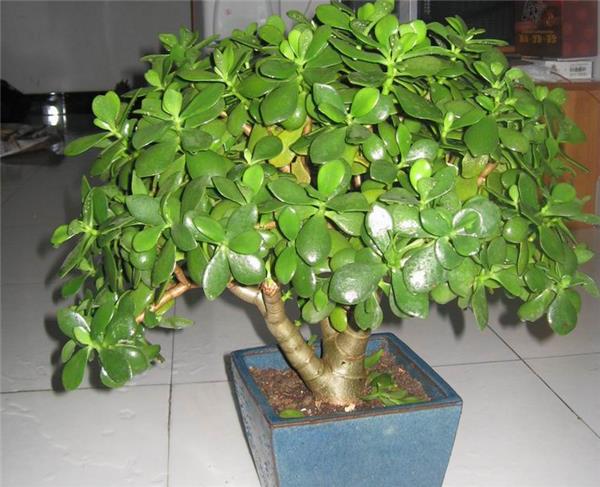
3. Watering requirements: During the growing season, the watering frequency should be controlled to once every two to three days. There should be no waterlogging, and the potting soil should also be prevented from becoming overly wet. When growing jade plants in summer, control the watering frequency well and strengthen ventilation to prevent leaf drop. In winter, reduce watering. The specific principle depends on the dryness or moisture of the potting soil. Slightly dry potting soil is preferable.
4. Fertilization requirements: During the growing season of the jade plant, appropriate fertilization can be applied. Generally, apply 2-3 times per month of decomposed dilute cake liquid fertilizer. Before changing the soil or planting, sufficient base fertilizer should be applied. Decomposed organic fertilizers such as chicken manure, pigeon manure, bone meal, human waste, and various cake fertilizers can all be added to the growing medium as base fertilizer. To maintain a full plant shape, fertilization and watering should not be excessive, to avoid causing leggy growth.
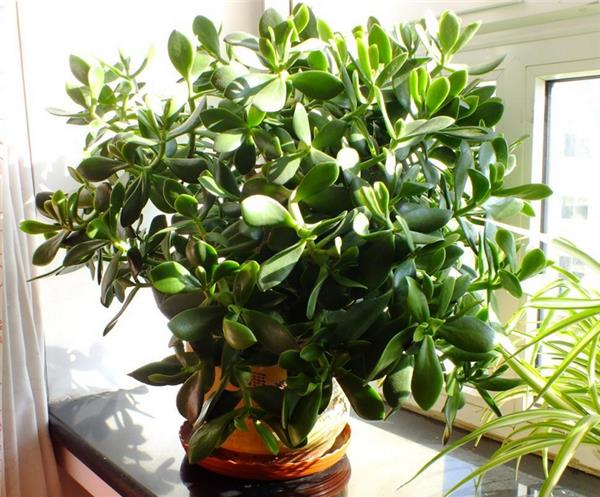
Precautions for Growing Jade Plants
1. The potting soil for jade plants should be well-draining, but not too loose, otherwise the plant may easily topple over when it grows larger. During the plum rain season, avoid outdoor rain exposure and water accumulation. During the semi-dormant period from July to August, watering must also be strictly controlled, otherwise root rot is likely. In winter, it is better to keep it dry rather than moist; the potting soil only needs to be slightly moist.
2. The branches and leaves of the jade plant contain a large amount of euphorbia resin. When human skin comes into contact with the sap flowing from the branches and leaves, it can cause skin redness, swelling, pain, and blistering. If it accidentally splashes into the eyes, it can cause blindness.
3. In summer, appropriate shading can be used to prevent heat and lower temperature; in other seasons, it should receive sufficient light. The potting soil should prefer dryness over moisture, and attention should be paid to rain protection. In winter, the potting soil should be relatively dry, and attention should be paid to ventilation to prevent leaf drop.
4. Move it indoors in mid-October and place it in a warm spot with ample light. The minimum overwintering temperature must not be lower than 5 degrees Celsius. Strictly control watering, and just keep the potting soil from drying out completely. Rotate the pot once every half month to avoid the branches and leaves leaning to one side and affecting appearance. If light is insufficient, even more attention should be paid to preventing root rot and leaf drop from damp heat.
5. Jade plants prefer loose sandy growing medium and are averse to overly wet soil. For small seedlings propagated by cuttings, transplant when the temperature is relatively high. The best time for potting is early summer. After the seedlings recover, do not water too much, and do not place them in a shaded area.
Pest and Disease Control for Jade Plant Cultivation
1. Jade plant leaf spot disease
Symptoms: This disease occurs on the leaves of jade plants and is prone to occur in weather with high humidity. The lesions initially appear as small brown spots, with a water-soaked, faded green margin, and expand in concentric rings, circular to elliptical, with brown edges and grayish-white centers. In the later stage, dark brown mold spots appear in the center of the lesions, becoming a dark brown mold layer under moist conditions.
Control methods: Promptly remove diseased and residual leaves; both in the early and late stages of the disease, spray with 0.5%-1% Bordeaux mixture (or 50% carbendazim 1000x solution).
2. Jade plant anthracnose
Symptoms: This disease also occurs on the leaves of jade plants and can spread to the leaf stalks in severe cases. The lesions initially appear as water-soaked small yellow spots, and after expansion become elliptical to irregular brown or yellow-brown, slightly showing concentric rings. In the later stage, the lesions merge into a dry and withered appearance and produce small black dots arranged in concentric rings. This disease is mainly caused by poor ventilation.
Control methods: Strengthen care, increase application of phosphorus and potassium fertilizers; in the early stage of the disease, spray with 0.3%-0.5% equal-amount Bordeaux mixture (or 60% zineb 800-900x solution, or 70% thiophanate 1500x solution).
3. Brown soft scale
Symptoms: When soft scale insects harm plants, they generally gather in groups on the leaf surface or tender leaves, piercing and sucking the plant sap, while excreting sticky fluid. Their excrement easily causes massive reproduction of sooty mold fungi, causing stems and leaves to turn black, affecting the plant's photosynthesis, resulting in weakened growth, yellowing leaves, and impairing ornamental value. In severe infestations, the branches and stems are covered with insect bodies, causing the plant to turn yellow and wither, affecting growth.
Control methods: If there are few affected plants, or the number of insects is not large, generally use a bamboo strip or similar object to scrape off the insect bodies.
or 70% thiophanate 1500x solution).3. Brown soft scale
Symptoms: When soft scale insects harm plants, they generally gather in groups on the leaf surface or tender leaves, piercing and sucking the plant sap, while excreting sticky fluid. Their excrement easily causes massive reproduction of sooty mold fungi, causing stems and leaves to turn black, affecting the plant's photosynthesis, resulting in weakened growth, yellowing leaves, and impairing ornamental value. In severe infestations, the branches and stems are covered with insect bodies, causing the plant to turn yellow and wither, affecting growth.
Control methods: If there are few affected plants, or the number of insects is not large, generally use a bamboo strip or similar object to scrape off the insect bodies.