What are the differences between Jade Plant (Crassula arborescens) and Jade Tree (Crassula ovata)? A quick guide to tell them apart
Many friends are not particularly familiar with the differences between Jade Plant and Jade Tree, and always mistake these two plants for each other. So, what are the differences between Jade Plant and Jade Tree? Let us take a look together.
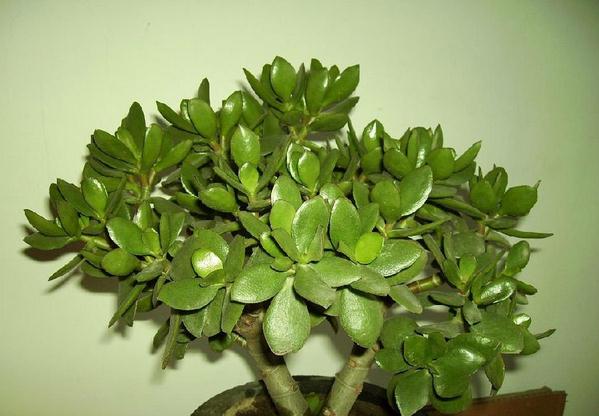
A brief introduction to Jade Plant
Jade Plant, also known as Eight Treasures, Winter Holly, and Succulent Evergreen, belongs to the Crassulaceae family and is a dicotyledonous plant. Its appearance is very similar to Jade Tree, but its true nature is quite different from Jade Tree. Jade Plant has thick, fleshy branches and leaves, stays evergreen all year round, has unusual leaf shapes, a stately plant form, and bears white flowers at the tips. It is a plant very suitable for growing in pots, and can be placed in the indoor living room as a decoration, or on the balcony, where it looks very elegant and graceful.
A brief introduction to Jade Tree
Jade Tree is a succulent, fleshy subshrub. The plant height is 1-3 m. The stem is fleshy, thick and sturdy, with grayish-white, light-colored bark, many branches, and brownish-green, darker-colored twigs. The leaves are fleshy, ovate, about 4 cm long and 3 cm wide, grayish-green, with a red tinge along the edges. The flowering period is in late spring and early summer, with tubular flowers 2 cm in diameter, white or pale pink.
The differences between Jade Plant and Jade Tree
Jade Plant resembles Jade Tree, and some people think Jade Plant is Jade Tree, but these are two different plants. In fact, it is very simple to see the differences between Jade Plant and Jade Tree: the edges of Jade Plant leaves have a red border, while the leaves of Jade Tree are green all over. So whether you can distinguish Jade Plant from Jade Tree depends on whether you have observed them carefully.
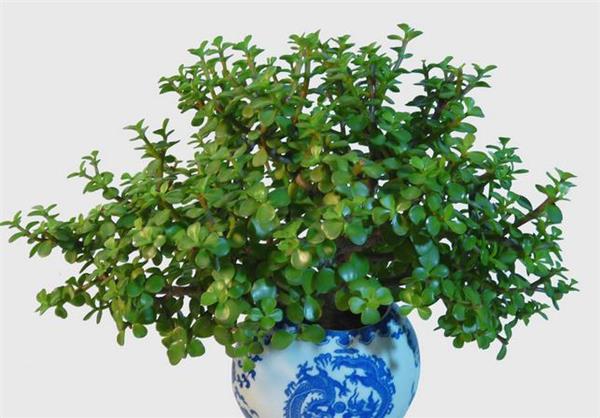
How to grow Jade Tree
The suitable temperature for Jade Tree growth is 20-30°C. Spring and autumn are the suitable growing seasons. In summer, when temperatures are high, it should be shaded or placed under tree shade to avoid direct strong sunlight. When the temperature exceeds 38°C, growth slows or the plant enters a brief dormancy. In winter, it should be moved into a greenhouse or placed in a sunny spot indoors, with room temperature kept at 7-10°C, and never lower than 5°C. If it drops below 0°C, it will freeze and die. During the growing season, except for shading needed during the hot summer, it should be placed in a spot with ample sunlight.
During the growing season, water Jade Tree once every 2-3 days, but do not let the potting soil become too wet, and especially do not let water accumulate. During the hot summer, watering must be strictly controlled and ventilation increased, otherwise leaf drop is likely to occur. In winter, watering should be reduced, and the potting soil should be kept slightly dry. During the growing season, topdressing should be applied, generally 2-3 times a month with diluted, decomposed cake liquid fertilizer. When changing soil or before planting, sufficient base fertilizer should be applied; decomposed organic fertilizers such as chicken manure, pigeon manure, bone meal, human waste and urine, and various cake fertilizers can all be mixed into the potting soil as base fertilizer. To keep the plant form full, fertilizer and water should not be excessive, so as to avoid leggy growth.
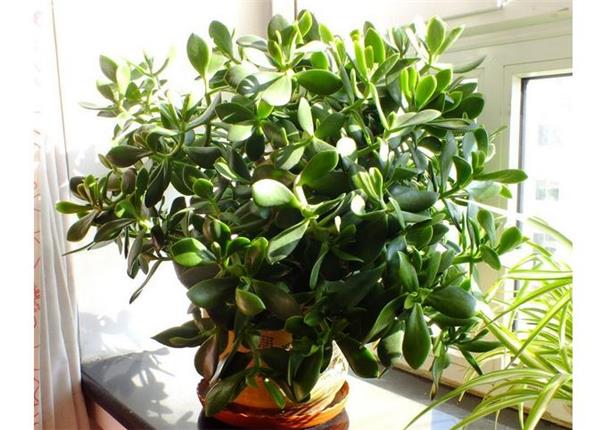
How to grow Jade Plant
Flowering management: If you want Jade Plant to bloom, you need to place it in a warm environment with ample light; this is the primary condition for flowering. Jade Plant is very drought-tolerant, so it is not advisable to water it too much normally. In the hot summer season, be careful to avoid sudden heavy watering after sun exposure, which can cause leaf drop; too much water accumulating at the roots can easily cause root rot and death.
Pruning and maintenance: Jade Plant has purple-brown branches and stems, simple and lustrous, with a graceful plant shape, layered and handsome leaves, and it also produces white flowers. However, attention should be paid to shaping and pruning: some old, weak leaves and withered, yellow branches and leaves should be properly pruned so that its plant form becomes more simple and elegant, with luxuriant branches and leaves, and evergreen throughout the four seasons.
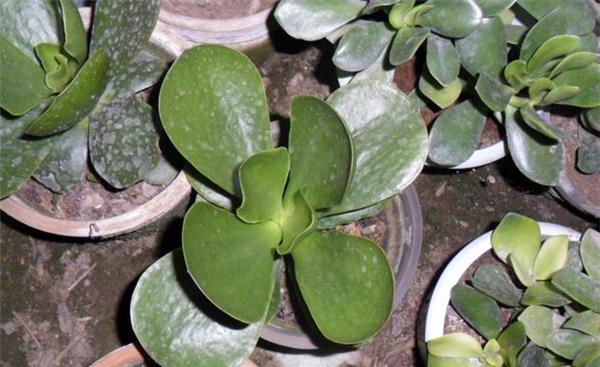
That is all for the related introduction to the differences between Jade Plant and Jade Tree. I believe that after reading this, everyone has gained some understanding of Jade Plant and Jade Tree. I hope the related knowledge introduced today can be helpful to everyone.