How to grow Mimosa pudica? Five cultivation tips you should not miss
Mimosa pudica (sensitive plant) is a lovely plant whose leaves fold up as soon as they are touched. Both its flowers and its leaves have ornamental value. Nowadays, many people like to grow potted plants at home, and Mimosa pudica is a good choice. Many people are fond of Mimosa pudica, but many do not know how to grow it. Here I will share some methods for growing Mimosa pudica: five tips you should not miss.
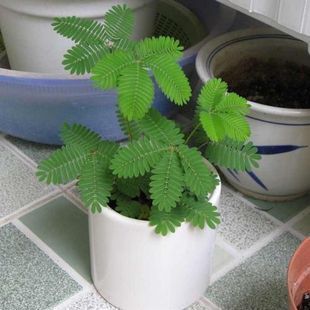
Mimosa pudica is a perennial herb or subshrub in the Fabaceae family. Because its leaves respond to heat and light and close immediately when touched by an external force, it is named "mimosa" (the shy plant). It is native to the tropical regions of South America, prefers warmth and humidity, and is not demanding about soil. The flowers are pink and shaped like pom-poms, cute and appealing. After flowering it produces pods, and the fruit is flat and round. The leaves are feathery compound leaves arranged alternately and in a palmate pattern. The flowers, leaves and pods of Mimosa pudica all have good ornamental value, and it is relatively easy to keep alive, making it suitable as a potted flower for balconies and indoors, and it can also be grown in courtyards and other places. Unlike ordinary plants, when it is touched by the outside world, its leaf stalk droops and its leaflets close. This action is understood by people as "shyness," hence it is called mimosa, zhixiu cao and paichou cao.
How to grow Mimosa pudica
1. Soil: Mimosa pudica is highly adaptable and not demanding about soil. It grows well in moist, fertile soil. Sow it in a growing mix prepared by sieving and mixing 2 parts leaf mold, 3 parts garden soil and 5 parts fine yellow sand.
2. Watering: Mimosa pudica likes moisture. During the summer growing season, water once a day.
3. Sunlight: Mimosa pudica likes ample light and tolerates partial shade slightly.
4. Temperature: As a potted ornamental flower, Mimosa pudica should be moved indoors to a sunny spot in winter. Maintaining a room temperature of 10-12°C is enough for it to overwinter safely.
5. Fertilizing: Mimosa pudica does not need much fertilizer during the growing season. Applying diluted liquid fertilizer 2-3 times is enough. Do not let it grow leggy, because Mimosa pudica is mainly grown as a fun foliage plant, and smaller is better.

1. Prevent cold damage. Mimosa pudica is suited to growing in a warm environment, with a suitable temperature between 20-28°C. If the temperature is too low, its growth will be hindered. Because winter temperatures are too low, water less to avoid cold damage to the roots and stems. Water at around the hottest time of the day. If the temperature is below 10°C, it is best to give it some protection.
2. Prevent pests and diseases. Mimosa pudica generally has few pests and diseases, and the most common pest is the slug. If pests are found, sprinkle some lime powder to deal with them.
3. When fertilizing, fertilize according to your own situation, and Mimosa pudica can be fertilized about once a month. If you think the potted Mimosa pudica looks good growing larger, you can skip fertilizing it.
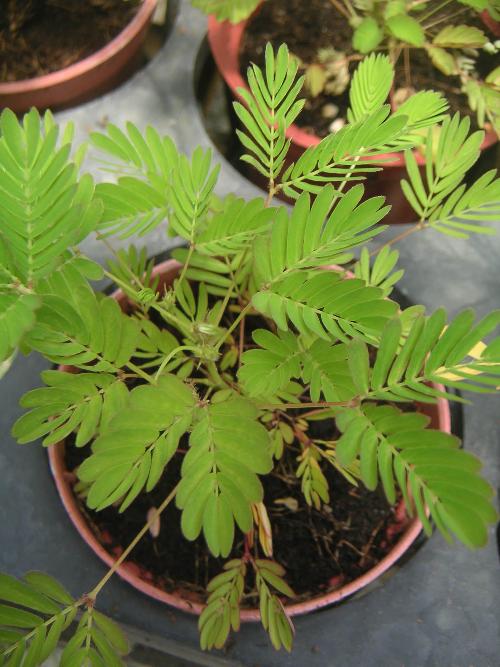
Mimosa pudica is usually propagated by sowing, and the sowing time is from late March to early April. Evenly scatter the seeds on fine soil, cover with about 1.5 cm of soil, and at a temperature of about 18°C, seedlings can emerge in about 10 days. When managing Mimosa pudica in the field, when the field planting spacing is 25-30 cm, loosen the soil, hoe weeds and water in a timely manner. When growing it indoors in pots, water once every three days in summer.
Mimosa pudica can be grown in ordinary soil, but it is best in loose, fertile soil. It does not need much fertilizer during its growing season. When fertilizing, applying diluted liquid fertilizer 2-3 times is enough. Do not use too much fertilizer. Do not let it grow leggy, because Mimosa pudica is mainly a fun foliage plant, and smaller is better. The planting technique for Mimosa pudica is relatively simple, and management is extensive. It is not demanding about climate, sunlight or soil, and likes a warm, humid environment.
Caring for Mimosa pudica
During the growing period, Mimosa pudica can be watered with decomposed diluted liquid fertilizer about once every 10 days. When Mimosa pudica is moved indoors as a potted ornamental flower, it is best to move it to a sunny spot indoors. At the same time, Mimosa pudica likes moisture, so water once a day in summer. The soil should be deep, fertile and moist. Furthermore, Mimosa pudica is a plant that is not cold-tolerant, so the indoor temperature in winter should be 18°C, otherwise it will wither and die on its own.
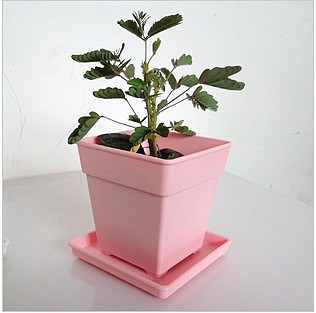
Reason one
Plants and animals are not the same. Plants have no nervous system and no muscles, and they do not perceive external stimuli, but why Mimosa pudica feels shy is indeed related to a nervous system-like mechanism. Mimosa pudica is supported by tiny net-like actin, and when it closes, the actin falls away, producing the closing movement. The actin contains muscle fibers, which is a very rare thing in plants.
This stress response in Mimosa pudica takes only 0.08 seconds before and after it occurs, meaning the transmission speed is as high as 10 cm/s, so the reaction can be said to be very fast. The time needed to return to its original state is about 5-10 minutes.
Reason two
If the leaves of Mimosa pudica are touched, they immediately fold up. The stronger the touch, the faster they close, until finally the whole leaf droops as if listless. The leaves and leaf stalks of Mimosa pudica have a special structure, with a pulvinus in the middle that is most sensitive to stimuli. Once touched, the stimulus is transmitted directly to the pulvinus at the base of the leaf stalk, causing the leaf to close.
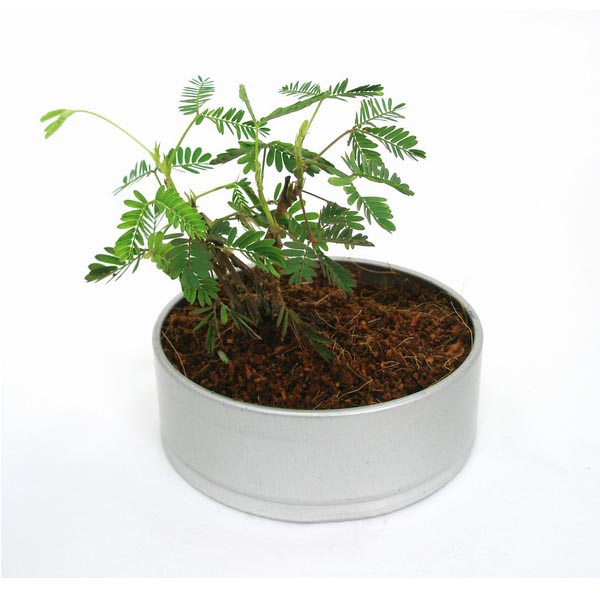
Mimosa pudica is supported by tiny net-like actin, and when it closes, the actin falls away, producing the closing movement. The actin contains muscle fibers, which is a very rare thing in plants.
This stress response in Mimosa pudica takes only 0.08 seconds before and after it occurs, meaning the transmission speed is as high as 10 cm/s, so the reaction can be said to be very fast. The time needed to return to its original state is about 5-10 minutes.
Reason two
If the leaves of Mimosa pudica are touched, they immediately fold up. The stronger the touch, the faster they close, until finally the whole leaf droops as if listless. The leaves and leaf stalks of Mimosa pudica have a special structure, with a pulvinus in the middle that is most sensitive to stimuli. Once touched, the stimulus is transmitted directly to the pulvinus at the base of the leaf stalk, causing the leaf to close.