What are the cultivation methods for Nepenthes ampullaria?
Pitcher plants are tropical carnivorous plants, named for their pitcher-like shape. So, how much do you know about the cultivation methods for Nepenthes ampullaria? Some of you may not be particularly familiar with this, so today I will give a brief introduction for everyone. Let's take a look together.
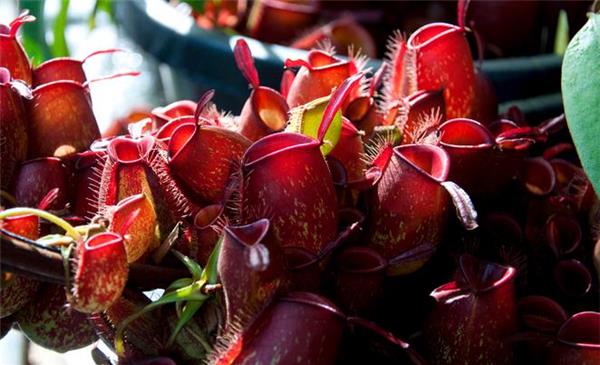
Introduction to pitcher plants
Pitcher plants are the collective name for all species in the genus Nepenthes. They belong to tropical carnivorous plants, with their native range mainly in the tropical regions of the Old World. They possess a unique organ for absorbing nutrients - the pitcher. The pitcher is cylindrical, slightly swollen in the lower part, with a lid on top of the pitcher mouth, and it is named for its resemblance to a pig cage.
The leaves of pitcher plants have a complex structure, divided into petiole, leaf blade and tendril. The tail end of the tendril expands and curls back to form a pitcher shape, which can capture insects. Pitcher plants have racemose inflorescences, bearing small green or purple flowers. The pitcher-shaped body at the tip of the leaf is the tool for catching insects. The inner surface of the pitcher lid can secrete fragrance to attract insects. The pitcher mouth is smooth, and insects will slip into the pitcher, drown in the liquid secreted at the bottom of the pitcher, and the insect bodies are decomposed and their nutrients gradually digested and absorbed.
Morphological characteristics of pitcher plants
Pitcher plants are perennial climbing plants, with woody or semi-woody stems, reaching a height of over 3 m, climbing on trees or growing along the ground. The leaves are generally oblong, with a tendril at the end to facilitate climbing. At the end of the tendril, a pitcher-shaped or funnel-shaped insect-trapping pitcher forms, with a pitcher lid. Pitcher plants only bloom after growing for many years. The flowers are generally racemose, occasionally paniculate, dioecious, small and plain, with a faint scent during the day, slightly fragrant; at night the scent becomes strong and turns foul. Their ornamental value cannot compare with that of the pitchers. The fruit is a capsule, which splits open when mature to release seeds.
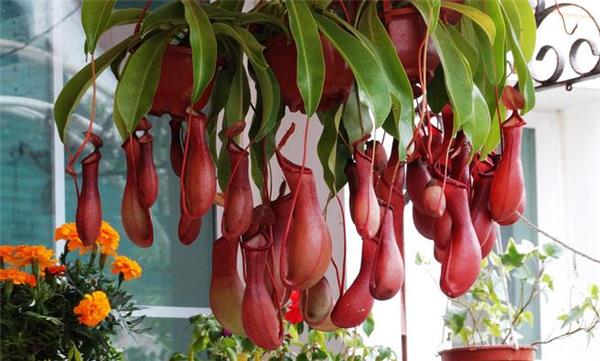
Cultivation methods for Nepenthes ampullaria
Soil: Loose, fertile and airy leaf mold or peat soil is best. For potted plants, a mixed substrate of peat soil, sphagnum moss, charcoal and fir bark shavings is commonly used.
Watering: Pitcher plants are relatively sensitive to moisture. Pitcher plants can only grow and develop normally under high humidity conditions. During the growing period, they need frequent misting, 4 to 5 times a day. If the temperature varies greatly or it is too dry, the formation of the leaf pitchers will be affected.
Sunlight: Pitcher plants are epiphytic plants, often growing under large trees or on the north side of rocks, and their natural conditions are semi-shaded. Under strong direct sunlight in summer, shading is necessary, otherwise the leaves are easily scorched, directly affecting the development of the leaf pitchers. However, under long-term dark conditions, the leaf pitchers form slowly and small, and the colors on the pitcher surface are dull.
Temperature: The suitable growth temperature for pitcher plants is 25-30°C, from March to September it is 21-30°C, and from September to March of the following year it is 18-24°C. In winter, the temperature should not be lower than 16°C; below 15°C the plant stops growing, and below 10°C the leaf edges suffer frost damage.
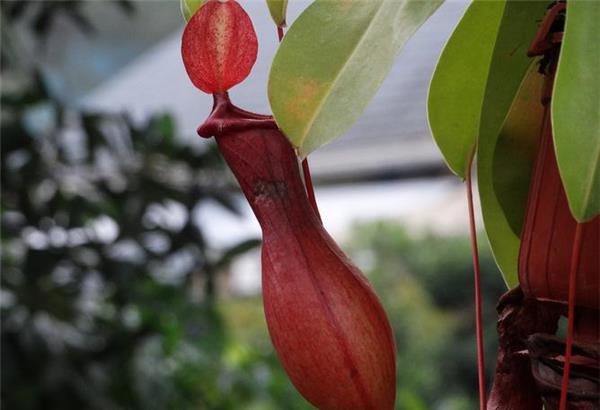
Fertilizing: Pitcher plants do not need special fertilizing, because pitcher plants can usually catch insects on their own to convert nutrients. If the pitcher plant has insects to eat, there is no need to fertilize.
Pests and diseases: Pitcher plants are often harmed by leaf spot disease and scale insects. For leaf spot disease, spray with a 1000-fold dilution of 50% zineb wettable powder. For scale insects, spray with a 2000-fold dilution of 40% dimethoate emulsifiable concentrate.
Pruning: The pitchers of pitcher plants are a type of modified leaf, so like the leaves of other plants, they also age and die. Generally speaking, under suitable conditions each pitcher can survive for several months. When it has already withered, you can cut it off to make the whole plant look more attractive, but this is purely for appearance and has nothing to do with the health of the plant.
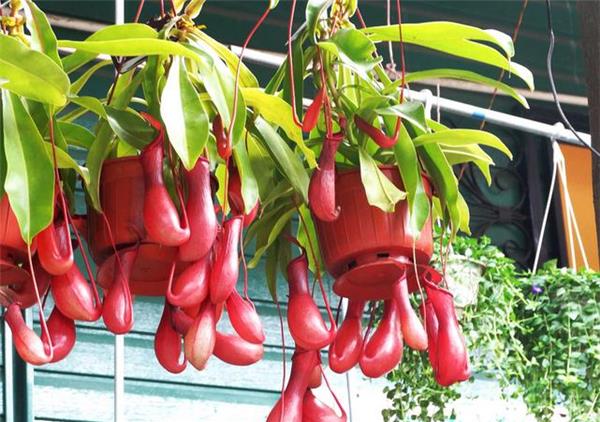
That is all for the introduction to the cultivation methods for Nepenthes ampullaria. I believe that after reading this, everyone has gained some understanding of the cultivation methods for Nepenthes ampullaria. I hope the related knowledge introduced today can be helpful to everyone.