How to Grow and Care for Green Elf (Syngonium)
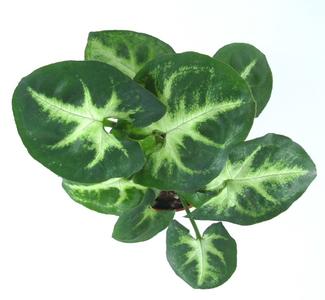
Green Elf is an evergreen plant. The green leaf surface has a light green pattern accenting its center. With a great many varieties, Green Elf has a fresh, elegant color and is especially suitable as an indoor potted ornamental. What is Green Elf like, and what do Green Elf plant pictures look like? Today, let's learn about this plant, Green Elf, together!
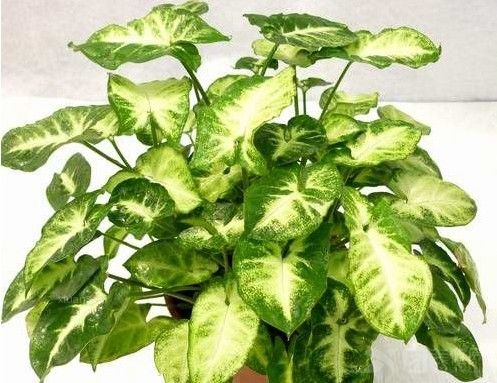
How to grow Green Elf
Form: A perennial evergreen herbaceous vine. When young, the stem is shorter and the leaves often grow in clusters; after maturity, the branches extend into trailing vines, and aerial roots often grow at the nodes. In the juvenile stage, new leaves are halberd-shaped; on mature plants, the leaves are 3-lobed or 5-9 lobed. The leaves often bear various white markings. There are many varieties; common garden cultivars include 'Emerald Gem', 'Arrowhead', 'White Butterfly', 'White Vein' and 'Pink Beauty'. Cultivated varieties in the same genus as Syngonium also include Syngonium podophyllum 'Golden' and Syngonium podophyllum 'White Beauty', all with changeable leaf shapes and fresh, elegant colors, very suitable as indoor potted ornamentals.
Habits: Native to the tropical rainforest regions of South America, it is robust by nature, likes moisture and has fairly strong shade tolerance. It also likes high temperatures, high humidity and semi-shaded environments, fears strong sunlight, is afraid of drought and avoids low temperatures. The suitable growing temperature is 18-25°C; it is not cold-tolerant, fears strong sunlight and is afraid of drought. Syngonium is not cold-tolerant. When it is brought indoors in late October, it should be placed in a sunny spot indoors, and the indoor temperature should not be lower than 10°C, otherwise the leaves will turn yellow. In the dry winter, special attention should be paid to keeping the indoor environment at relatively high humidity.
Points to Note
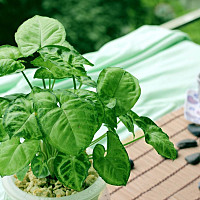
In ordinary care, avoid direct strong sunlight; give only bright, diffused light. For home growing, it can be placed near a window or on the north side of a house. This plant has relatively high water requirements. Throughout the year in water culture, follow the principle of keeping the water level in the bottle rather high than low, and spray water frequently to keep the surrounding environment moist. This is both good for growth and makes the leaves fresh and glossy, full of vitality.
Pothos is a large evergreen vine. Like spider plants and ivy, it has a very strong air-purifying ability. Pothos can absorb benzene, trichloroethylene, formaldehyde and other substances from the air, so placing pothos in a newly renovated home is simply ideal. According to environmental scientists, one pot of pothos in a room of 8-10 sq m is equivalent to an air purifier. It can be seen that pothos has quite a strong air-purifying ability.
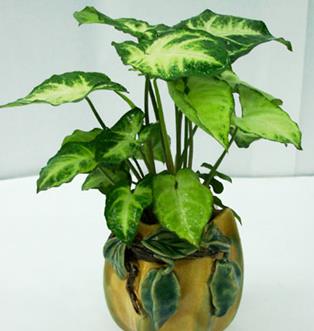
Pothos is one of the plants most loved by ordinary households; used for furniture display, it neither takes up space nor is difficult to care for.
1. Pothos is suitable for placement in the places where family members come into contact most. Next to the living room TV and on the living room table are both very good choices. Pothos is one of the very best indoor decorative plants, a climbing vine grown for its foliage. Its stems are slender and soft, and its leaves are delicate and elegant. Place a cachepot high on top of a cabinet and let its trailing stems hang downly, or after the trailing stems grow too long, loop and hang them into a ring, just like an emerald relief. This both makes full use of space and purifies the air, while also adding a lively, brightly colored green decoration to a dull cabinet surface, full of vitality and adding a warm touch of charm to the room. Morphological features: Pothos vines grow several meters long, with aerial roots at the nodes; as the plant ages, the stems thicken and the leaves grow larger and larger. The leaves are alternate, green, with a few leaves also slightly mottled with yellow, entire, heart-shaped. Turning back these places fully demonstrates its ornamental value.
2. Place it in the kitchen where there is the most cooking fumes. Placing it in the kitchen both achieves the goal of environmental protection and adds a bit of green to the kitchen, achieving two goals at once. Environmental scientists have found that one pot of pothos in a room of 8-10 sq m is equivalent to an air purifier and can effectively absorb harmful gases such as formaldehyde, benzene and trichloroethylene from the air. Pothos not only has strong vitality, but when placed indoors, its air-purifying ability is no less than that of ivy and spider plants. Newly laid flooring very easily produces harmful substances. Because pothos can simultaneously purify benzene, trichloroethylene and formaldehyde from the air, it is very suitable for placement in newly renovated rooms.
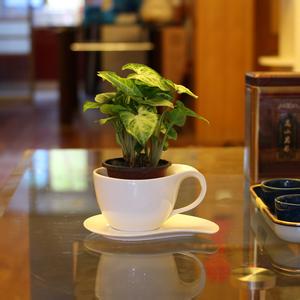
3. The windowsill is its special place. If you pay careful attention, we can find that the plants placed on the windowsills of ordinary homes are generally pothos, because its size is especially small and it fits just right on the windowsill, neither crushing the windowsill nor blocking the host's view of the beautiful scenery beyond the windowsill.
Such a combination can achieve the goals of environmental protection, adding vitality and decorating the home, reflecting a home style that combines home and nature.
Growing pothos requires attention to the following points:
(1) Temperature: In winter, pothos can safely overwinter above 10°C, and generally can grow normally above 20°C. Therefore, an ordinary home environment is relatively suitable for the growth of pothos.
(2) Light: Pothos is not strongly phototropic, so when growing it, it needs to be placed in a spot with better light in the city, and at noon it can be put in the sun for a while.
(3) Water: When growing pothos, do not water too much; you can spray water at the rooting area, which can reduce the rate of water evaporation.
(4) Fertilizer: When fertilizing the leaves of pothos, because ordinary inorganic fertilizers are difficult to absorb, a special fertilizer needs to be used.
Growing pothos requires attention to the following points:
(1) Temperature: In winter, pothos can safely overwinter above 10°C, and generally can grow normally above 20°C. Therefore, an ordinary home environment is relatively suitable for the growth of pothos.
(2) Light: Pothos is not strongly phototropic, so when growing it, it needs to be placed in a spot with better light in the city, and at noon it can be put in the sun for a while.
(3) Water: When growing pothos, do not water too much; you can spray water at the rooting area, which can reduce the rate of water evaporation.
(4) Fertilizer: When fertilizing the leaves of pothos, because ordinary inorganic fertilizers are difficult to absorb, a special fertilizer needs to be used.