A Complete Guide to Precautions and Daily Care Methods for Growing Strawberries in Pots
Building a home vegetable and fruit garden is not difficult. If you live in a villa or on the ground floor or top floor, and own a home with a small garden, that is of course best. If not, it does not matter; as long as you have a balcony or a windowsill with good light, you can likewise enjoy the pleasure of home gardening. For containers, you can use special growing boxes, flower pots, or discarded plastic boxes, washbasins, and so on.
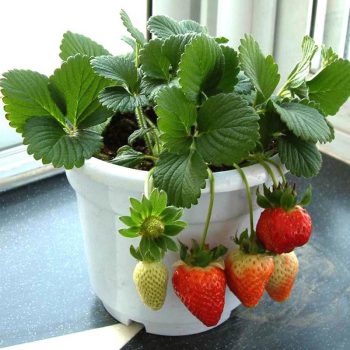
Potted strawberries are a newly bred variety, especially suitable for indoor ornamental cultivation. From an aesthetic point of view, strawberry leaves are deep green and the fruit is bright red; if they can be planted in plain, natural ceramic or earthenware pots, the effect will be all the more harmonious.
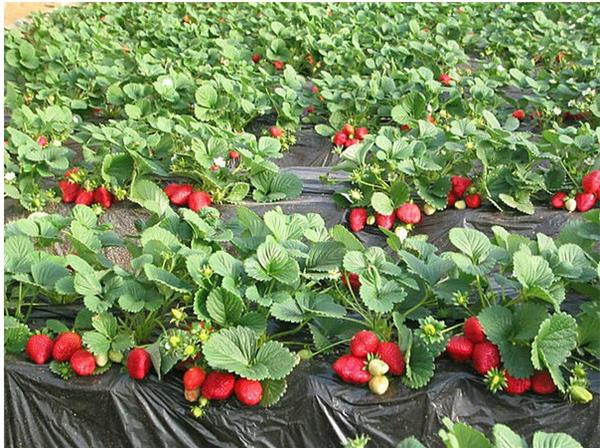
Sowing and raising potted strawberries requires a growing medium with good water retention (such as the soil used for hanging basket flowers). The germination temperature is 20-25. After sowing, it is best to cover to retain moisture; keeping it dark helps germination, and seedlings emerge in about 5 days. At this point, light should be gradually increased, which helps the seedlings grow strong quickly. Strawberries like ample light, and it is best to give them more than half a day of light each day. At ordinary times, place them in a well-ventilated spot. Strawberries are not drought-tolerant; if the potting soil is too dry, brown spots will appear on the leaves, and fruiting will also be affected. Therefore, once the surface of the potting soil is dry, water thoroughly, watering until water flows out from the bottom of the pot. Apply a liquid fertilizer with a nitrogen, phosphorus, and potassium ratio of 5:10:5 about once every 2 weeks. Note that after strawberries bloom, the fertilizer should be applied around the plants.
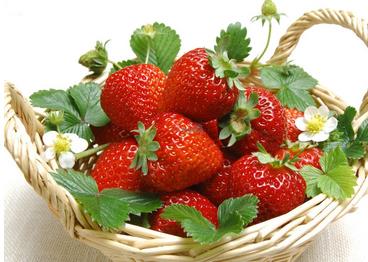
Once the fruit of potted strawberries ripens, the oval red berries are beautiful and alluring; pick them and place them on a white porcelain plate or in a crystal glass container, and they are simply a work of art.
Advantages of potted strawberries:
Strawberry fruit has a fresh, refreshing fragrance and taste, bright red color, and an elegant, beautiful shape. After being potted, the plant is petite and the fruiting ornamental period is long (from New Year's Day to May). White flowers, green leaves, and red fruit set each other off; placed indoors (a clay pot can be covered with a white plastic pot for a more pleasing look), the ornamental effect is just like that of flowers, and the fruit can be eaten as well, achieving two benefits at once.
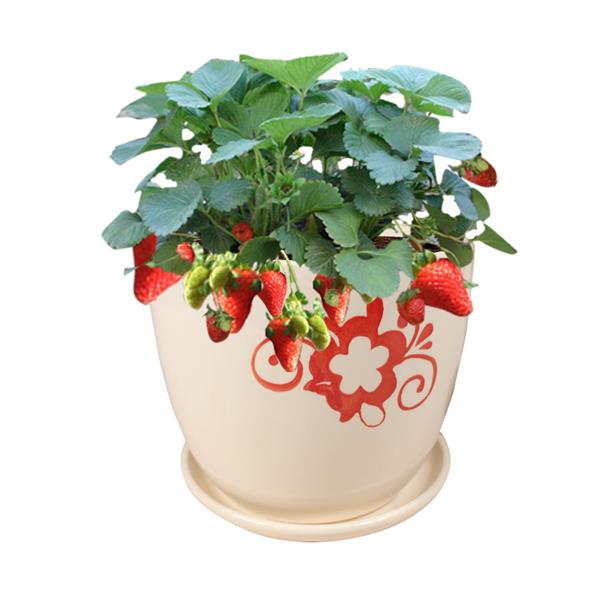
Growing potted strawberries:
Step 1: Material preparation. Materials needed: seedlings, garden soil, peat, chicken manure, soybean cake, container, gardening shovel, spray bottle.
a. Seedlings: All strawberry varieties are suitable for potting. Ideal home varieties include everbearing strawberry, European everbearing red, and Baogong Zaosheng. Seedlings can be purchased from flower markets, strawberry bases, seedling stations, and local vegetable and flower research institutions.
b. Soil: Strawberries are fertilizer-loving plants. When preparing nutrient soil, apply sufficient organic fertilizer and use chemical fertilizer as little as possible. The nutrient soil should preferably be made by mixing half fertile vegetable garden soil and half peat soil, with chicken manure added.
c. Container: Choose a growing container according to the available space, and place it on a windowsill or indoors. Strawberries have well-developed roots, so the container depth should be about 20cm. A flower pot with a diameter of 20cm is sufficient, with one plant per pot; if planting more, large rectangular pots or round pots can be used, with multiple plants per pot. Ceramic pots are generally used for cultivation, as they have good aeration, drain easily, and come in many styles.
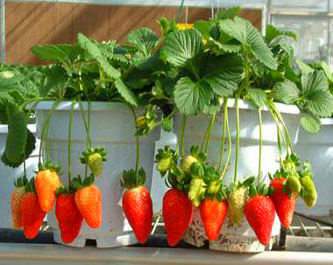
Step 2: Planting
a. Before planting, first fill the pot with nutrient soil, leaving the soil surface 3-4 cm below the rim of the pot; water thoroughly, and plant after letting it sit for 2 days.
b. Before planting, select healthy, vigorous seedlings with well-grown roots, cut off damaged roots, old leaves, and runners, and leave 2-3 small leaves. Dig a hole in the pot suitable for the depth of the strawberry roots.
c. When planting, place the strawberry roots vertically and spread them out in the hole, then press the soil flat; the planting depth should be such that the crown is not buried.
d. After planting, water moderately, and cover the pot with a plastic bag to reduce water evaporation, keep the temperature and humidity in the pot stable, and favor strawberry growth.
Step 3: Daily management
a. Temperature management: The suitable temperature for strawberry plant growth is 15-30°C, the suitable temperature for root growth is 15-20°C, and the suitable temperature during the flowering and fruiting period is 15-20°C.
b. Water management: After planting, strawberries should be watered lightly and frequently to keep the soil in the pot moist, not too dry or too wet. Home growers easily overlook air humidity management; during strawberry growth, air humidity should not be too high. On the premise of suitable temperature, after watering, open windows appropriately for ventilation to reduce humidity.
c. Fertilization management: Potted strawberries should mainly be given organic fertilizer water. Water with decomposed soybean cake water once every 7 days; the concentration should not be too high.
d. Pruning: During cultivation, old leaves that turn yellow should be removed directly; strawberries produce runners during growth, and during the flowering and fruiting period the runners should be removed promptly. Small plants will grow on the runners and can be cut off and planted directly.
Step 4: Repotting
Strawberries decline after fruiting for two years, so after 2 years of planting, strawberries need to be replaced with new seedlings, or repotted from a small pot to a large pot. When repotting, refill the pot with nutrient soil, then plant the seedlings, water, and manage as above.
Precautions:
a. Watering should be done in the morning or evening.
b. During flowering, air humidity should not be too high, as it affects fruit set and fruit quality.
c. Potted strawberries can be planted all year round, but the survival rate is highest when transplanted in autumn, from September to October.
d. In winter in the north, the pots should be moved indoors to raise the temperature; in summer high temperatures, the pots should be moved to a cool place to lower the temperature.
Step 4: Repotting
Strawberries decline after fruiting for two years, so after 2 years of planting, strawberries need to be replaced with new seedlings, or repotted from a small pot to a large pot. When repotting, refill the pot with nutrient soil, then plant the seedlings, water, and manage as above.
Precautions:
a. Watering should be done in the morning or evening.
b. During flowering, air humidity should not be too high, as it affects fruit set and fruit quality.
c. Potted strawberries can be planted all year round, but the survival rate is highest when transplanted in autumn, from September to October.
d. In winter in the north, the pots should be moved indoors to raise the temperature; in summer high temperatures, the pots should be moved to a cool place to lower the temperature.