What are the characteristics of the yellow water lily? A detailed guide
The yellow water lily, also known as the golden lotus and the spatterdock, belongs to the genus Nuphar in the family Nymphaeaceae. Let us now take a look at the characteristics of the yellow water lily.
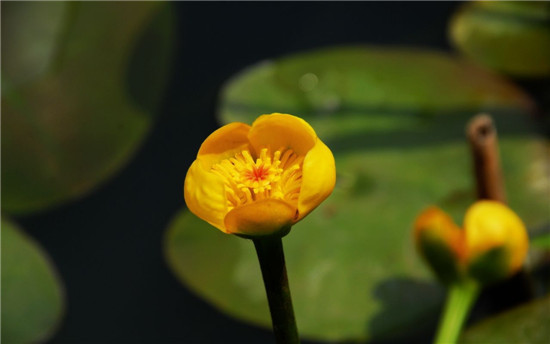
The yellow water lily has a flower form extremely similar to that of the water lily, though its flowers are smaller than those of the water lily. Its color is also different from that of the water lily: the flowers of the yellow water lily are yellow. In summer, large stretches of yellow water lilies bloom in ponds, offering extremely high ornamental value.
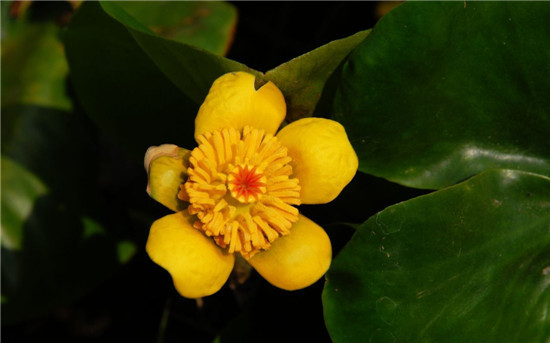
The yellow water lily is a floating-leaf aquatic plant. Its rhizome is thick and fleshy, lying horizontally. The yellow water lily blooms all year round; its flowers are yellow and covered with long white soft hairs. Its leaves are nearly round, with a V-shaped notch at the base, about 10-12 cm long. Its fruit is urn-shaped, about 2 cm.
When the fruit of the yellow water lily matures, it splits open to reveal the white inner pericarp, which is the so-called yellow water lily seed. The seeds of the yellow water lily will germinate as long as they are at a suitable temperature. Seeds are an important mechanism for the dispersal of the yellow water lily, while its underground stem is its most advantageous means of expanding its territory and occupying ground once it reaches a new place.
Reproductive characteristics
In addition to the underground stem continuously producing new buds and branches through vegetative reproduction, seeds play an even more important role in reproduction and dispersal. After the fruit matures it splits open, revealing the white inner pericarp, and the seeds are wrapped within this inner pericarp; this white inner pericarp is spongy in texture and slightly sticky, which can help the seeds float on the water surface for a period of time, and only in the end are the seeds fully released and sink to the bottom. The seeds will germinate as long as they are at a suitable temperature, with no problem of dormancy. Seeds are an important mechanism for the dispersal of the yellow water lily, while the underground stem is its most advantageous means of expanding its territory and occupying ground once it reaches a new place.
Accounts in ancient texts
As for the Tang dynasty poet Du Fu's poem "Parting from the Wu Gorge, Presented to My Elder Brother Nanqing: Forty Poems on the Western Ranch of the Rang River": "Moss and bamboo have always been what I love, duckweed and fleabane have no fixed dwelling." The "duckweed and fleabane" in the poem is a combined term for "duckweed" and "fleabane," which belong to two different things and have no direct connection to the "yellow water lily" referred to in this article. Plants of the duckweed kind drift uncertainly on the water surface, while "fleabane" is a plant of the genus Erigeron in the family Asteraceae, whose fruits bear a pappus and drift with the wind after maturing; thus the two characters "duckweed and fleabane" came to be used as a metaphor for wandering and migrating without a fixed dwelling. The "yellow water lily" discussed in this article, however, is not a plant that drifts uncertainly; its roots are fixed in the mud at the bottom of the water.
Garden and engineering applications
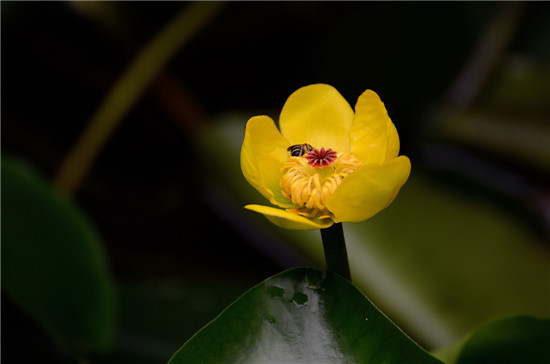
The yellow water lily is a plant for viewing both flowers and foliage, and can serve as the main material for embellishing open garden waterscapes, planted in combination with lotus, water lily, floating heart, cattail, yellow flag iris and other plants to form a brilliantly colorful landscape. In courtyard waterscapes, the yellow water lily, with its small and brightly colored flowers, can be combined with rockery stones and ponds for scenery, and can also be grown as a household potted plant for ornament.
The yellow water lily is a native plant variety with strong pollution tolerance, especially suitable for growing in environments with deep, fertile silt; therefore, in lake environmental ecological restoration projects it can be configured and applied as a pioneer plant variety. The yellow water lily has a well-developed root system and good adaptability to sewage, so when constructing artificial wetlands it can be applied in the enhanced treatment process at the end of the wetland system, which can improve the purification effect.
The above is the full content of my summary of what the characteristics of the yellow water lily are. I hope this article can help everyone. Please also continue to follow us.