What plant is Aeginetia indica? A detailed look at this wild plant
Aeginetia indica is an annual parasitic herb, reaching up to 35 cm tall. Let's take a look at this unusual plant together.
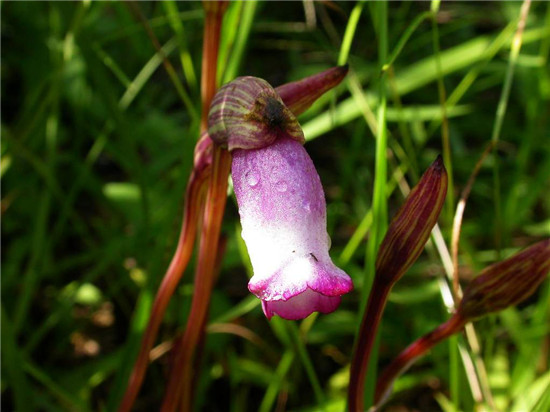
Aeginetia indica is an unusual plant with no green leaves, and because of this, it cannot obtain nutrients through photosynthesis on its own. To survive, it has no choice but to parasitize other plants, which is why some people call it the "vampire among plants." Plants similar to Aeginetia indica are called "parasitic plants," and the object being parasitized is called the "host."
Generally speaking, Aeginetia indica mostly parasitizes the roots of sugarcane, Miscanthus floridulus, and grasses at low altitudes. Aeginetia indica grows 15-30 cm tall; its calyx is fleshy and shaped like a spathe, while its corolla is tubular and perpendicular to the pedicel, shaped just like a tobacco pipe, which is why it is also called "foreigner's tobacco pipe" and is extremely easy to identify. Some also call it "golden key," "teaspoon grass," or "taro Aeginetia grass." The flowering period is between August and October.
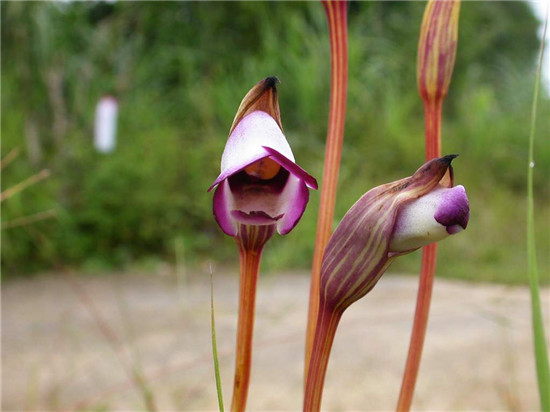
Aeginetia indica is an annual parasitic herb, reaching up to 35 cm tall. The stem is single or branched from the base, yellow-brown or purplish-red, with a few scale-like leaves scattered at the base of the stem. Flowers are solitary, pale purplish-red, with long stalks; the calyx is spathe-like, obliquely split on one side, 2-3 cm long, pointed at the lower end; the corolla is tubular, broad and curved inward, 2-6 cm long. About 2.5 cm in diameter, with 5 lobes at the tip, spreading outward; 4 stamens, 2 long; 1 pistil, ovary superior, stigma shield-shaped. The capsule is ovoid, 1-1.5 cm long. Seeds are small, numerous, round, with pitted reticulate markings. The flowering period is September-October.
The parasitic plant Aeginetia indica belongs to the Orobanchaceae family and is an annual parasitic herb. The entire Orobanchaceae family consists of parasitic plants, and this species is the most commonly seen in the south. The stem branches at the base but does not branch above ground. Leaves are reduced to scales, and the whole plant is flesh-colored. Flowers bloom at the tips of branches, the calyx is spathe-like, the corolla is two-lipped, purplish-red, yellow-white. The underground roots often attach to parasitic plants of the grass family. The whole plant is used medicinally, with effects of clearing heat and detoxifying, and reducing swelling.
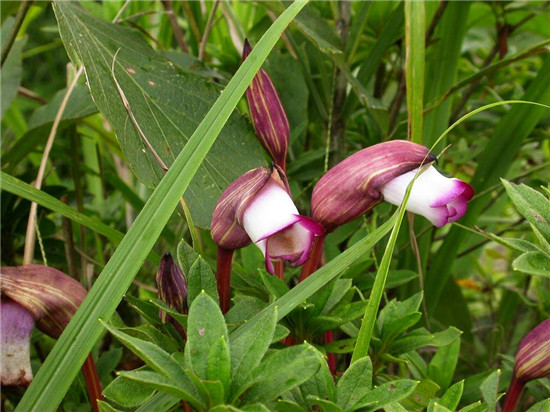
Every outing brings unexpected surprises. Pay careful attention to nature, and there are carefully prepared little gifts everywhere. Among a large patch of silvergrass, this flower that had never been seen before was a stunning sight. In the deep autumn dusk among the mountain fields, Aeginetia indica seems especially shy and delicate, hanging its head and retreating into the silvergrass thicket, as if deeply afraid that reckless humans will discover her traces and trample her elegance.
An elderly woman walking by, accompanied by two dogs, passed by. Astonished by this treasure she had never witnessed before, she was overjoyed and admired the richness of nature, regretting her own neglect of this gorgeous world. Moved, she could not resist the lure of the Aeginetia indica blossoms; leaning on her cane, she bent down and casually picked the frail flower.
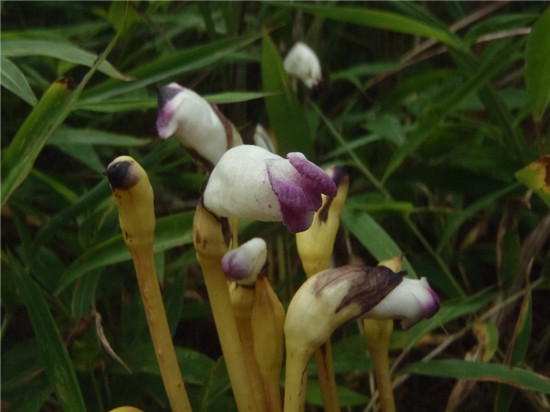
Watching this, my heart could not help but sink, and I could not stop blaming myself for telling this selfish old woman, never expecting that my own kindness would bring about a funeral for the flowers. Perhaps the old woman who passes by here every day, in her indifference toward nature, is actually showing the greatest kindness to all living beings.
The above is the complete content of the plant introduction to Aeginetia indica that I have summarized for everyone. I hope this article can help you. Please also continue to follow us.