What are the characteristics of Yellow Flag Iris flowers? A detailed explanation of morphological features and habits
Yellow Flag Iris, also known as Water Flag, is native to Europe and western Asia. It likes wet conditions and often grows by water or in shallow water. Next, let us take a look at the characteristics of Yellow Flag Iris!
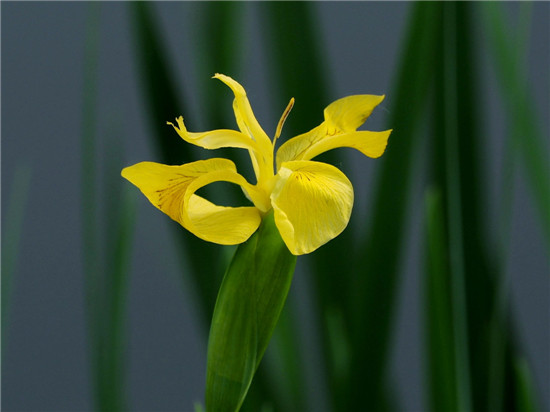
Yellow Flag Iris is a perennial herbaceous plant. Its rhizome is relatively thick and sturdy, generally reaching a diameter of 2.5 cm; the nodes are relatively obvious and yellow-brown; the fibrous roots are yellowish-white. Its basal leaves are grayish-green, broadly sword-shaped, up to 60 cm long and 1-3 cm wide; the leaf tips are relatively pointed.
The flower language of Yellow Flag Iris is "the blessing of the faithful." That is, the happiness of believers and the trust of admiration; because iris varieties differ, in Germany it also represents marriage, is regarded as a sacred herb, and has even been given humanized qualities.
The flower stem of Yellow Flag Iris is sturdy, 60-70 cm tall, 4-6 mm in diameter, with obvious longitudinal ridges, branched in the upper part; the cauline leaves are shorter and narrower than the basal leaves; there are 3-4 bracts, membranous, green, lanceolate, 6.5-8.5 cm long, 1.5-2 cm wide, with acuminate tips.
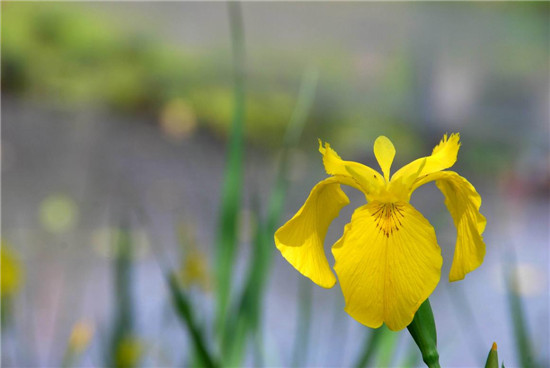
The flowers are yellow, 10-11 cm in diameter; the pedicel is 5-5.5 cm long; the perianth tube is 1.5 cm long, the outer perianth segments are ovate or obovate, about 7 cm long and 4.5-5 cm wide, the claw is narrowly cuneate, the center is sunken and groove-like, with dark brown stripes; the inner perianth segments are smaller, oblanceolate, upright, 2.7 cm long and about 5 mm wide.
The stamens are about 3 cm long, the filaments are yellowish-white, and the anthers are dark purple; the style branches are pale yellow, about 4.5 cm long and about 1.2 cm wide, with semicircular apical lobes and sparse teeth along the edges; the ovary is green, trigonous-columnar, about 2.5 cm long and about 5 mm in diameter.
The effects and uses of Yellow Flag Iris
1. Yellow Flag Iris has a dignified form and a pleasant fragrance, and is relatively simple to cultivate and manage. Since ancient times it has been deeply loved by people. It is a good choice for indoor potted plants and also a beautiful feature for embellishing courtyards and rockeries. Modern people generally plant it on both sides of water features for ornamental purposes. In addition, the leaves and inflorescences of Yellow Flag Iris can also be used as flower arrangement materials, with good results.
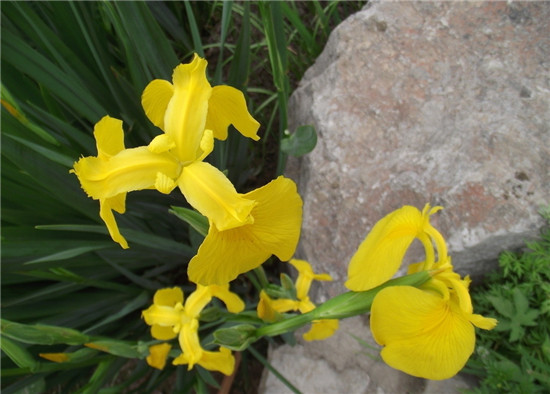
2. The rhizomes and leaves of Yellow Flag Iris can all be used as medicinal materials, but because there are many kinds of iris, their medicinal effects are also quite different; Yellow Flag Iris tastes relatively bitter and astringent, but has the good effects of opening the orifices and transforming phlegm, promoting qi and expelling phlegm, detoxifying, and killing insects.
3. The flower diameter and fragrance of Yellow Flag Iris are relatively rich, and it can strengthen the body and improve health, and can also treat conditions such as abdominal distension and abdominal pain, and loss of appetite. According to ancient books, in ancient times the rhizome of iris was generally used as a good medicinal material for improving hearing and eyesight, and for removing dampness and detoxifying.
Propagation: Division and sowing are commonly used for propagation. Division can be carried out in early spring, autumn, and after flowering. When dividing the rhizome, each segment should carry 2-3 buds. Generally, divide once every 2-3 years. For sowing, the seeds mature in summer; sow immediately after collection, and they should not be stored dry. Seedlings need 3 years to begin flowering.
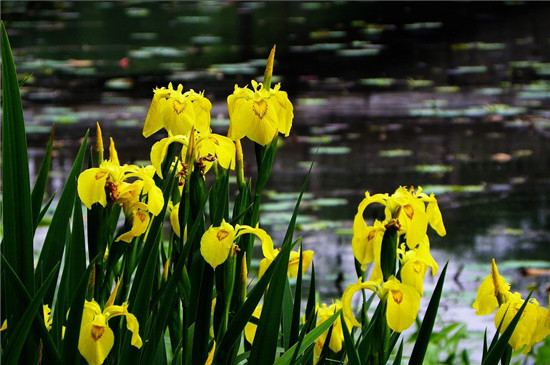
Cultivation: It is suitable for planting in shallow water by lakesides or ponds, and can also be potted in water vats. The soil should be fertile. During the growing period, pay attention to water moisture conditions and water level adjustment. After flowering, the underground rhizome gradually enters a dormant period, but it should not be dry. In winter it can be slightly drier, with the water level kept below the rhizome, while the roots still have sufficient moisture.
Pests and diseases: Common ones include southern blight and iris rust; spray with 50% thiophanate-methyl 500-fold solution and 25% carboxin emulsifiable concentrate 400-fold solution respectively.
Application: Yellow Flag Iris flowers from April to May, with large and beautiful bright yellow flowers, and there are also variegated-leaf and double-flowered varieties, with relatively high ornamental value. It is especially suitable for planting in wet places, by lakesides, and beside ponds, creating a uniquely elegant landscape. It can also be used as a cut flower.
The above is all the content I have summarized for everyone on the characteristics of the Yellow Flag Iris flower. I hope this article can help everyone. Please also continue to follow us.