What are the effects and uses of Arundo donax root?
Arundo donax root, also known as luditou or loutigan, is a perennial herbaceous plant. It grows beside streams and around houses on relatively moist and deep soil. Next, let us take a look at the effects and uses of Arundo donax root.
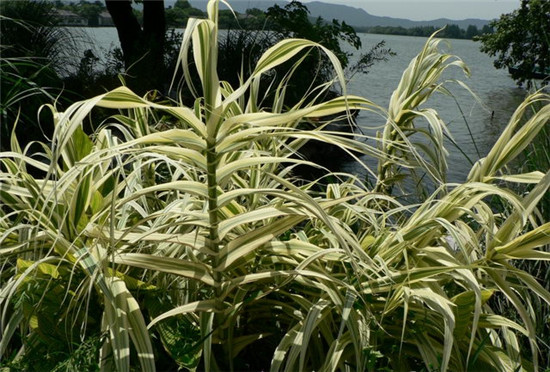
[Synonyms] Luditou, loutigan, green bamboo.
[Source] The rhizome of Arundo donax, a plant in the grass family.
[Usage and dosage] Oral use: decocted in water, 0.5 to 1 liang, or made into a paste.
[Cautions] Use with caution in those with a weak constitution and no heat signs.
[Nature and flavor] Cold in nature; bitter, sweet, and bland in flavor; non-toxic; strongly cooling.
[Collection] In summer, pull up the whole plant, cut off the rhizome, wash it clean, remove the fibrous roots, and slice it or dry the whole pieces in the sun.
[Medicinal material] The dried rhizome is curved, flat, and round-strip shaped, yellowish-brown, with longitudinal wrinkles; one end is slightly thicker and enlarged, with bamboo shoot bud protrusions of varying sizes, and fibrous root break scars around the base; it has nodes, and on the nodes are remnants of pale yellow leaf sheaths, or it may be entirely wrapped by leaf sheaths. The texture is hard and not easy to break. Those that are tender in texture, dry, and have short stems are considered better.
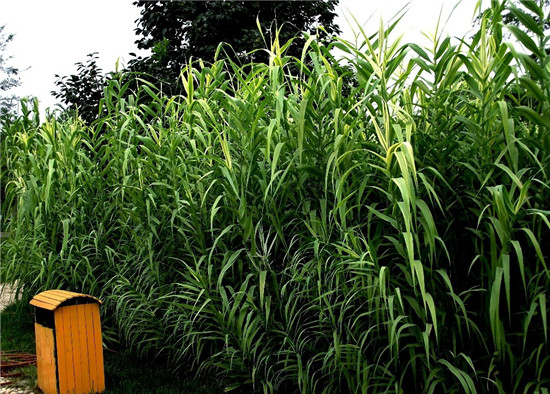
Arundo donax, a perennial herb. It has rhizomes and thick fibrous roots. The culms are erect, 2-6 m tall, 1-1.5 cm in diameter, often branched. The leaf sheaths are longer than the internodes, hairless, or with long soft hairs at the collar; the ligule is membranous, truncate, about 1.5 mm long, with short fine hairs at the tip; the leaf blades are flat, 30-60 cm long and 2-5 cm wide, slightly rough on the surface and margins when young.
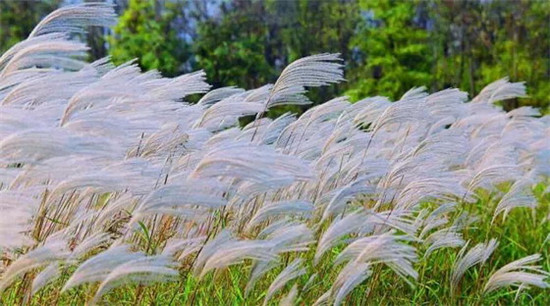
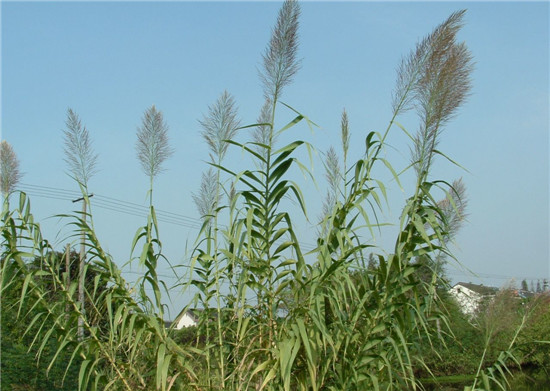
The panicle is relatively dense, 30-60 cm long, with densely arranged branches ascending obliquely; the spikelets contain 2-4 florets; the glumes are lanceolate, 8-10 mm long, with 3-5 veins; the lemma also has 3-5 veins, with the midrib extending into a short awn 1-2 mm long, densely covered on the back below the middle with white soft hairs slightly shorter than the lemma body, the callus about 0.5 mm long, with short soft hairs on both sides above, the first lemma 8-10 mm long; the palea is about half as long as the lemma. Flowering period is October to December. It grows beside streams and around houses on relatively moist and deep soil.
The rhizome is curved, flat, and round-strip shaped, 10-18 cm long and 2-2.5 cm thick, yellowish-brown, with longitudinal wrinkles; one end is slightly thicker and enlarged, with bamboo shoot bud protrusions of varying sizes, and fibrous root break scars around the base; it has nodes, and on the nodes are remnants of pale yellow leaf sheaths, or it may be entirely wrapped by leaf sheaths. The texture is hard and not easy to break. Those that are tender in texture, dry, and have short stems are considered better.
It prefers a warm and humid climate. It has no strict requirements for soil, but loam with deep soil layers and good drainage should be chosen for cultivation. Cultivation technique: use the division propagation method. From September to October, dig up the whole clump and divide it into several stools, each stool having 2-3 culms; open holes at a row spacing of 60 cm x 50 cm, about 25 cm deep, and plant 1 stool per hole; before planting, cut off the upper ends of the culms; after planting, cover with soil, press firm, and water. Field management: in the winter of the same year, pay attention to watering during drought. In the second spring, apply human and livestock manure water; thereafter, remove weeds 1-2 times each year, and in winter earth up around the stools.
What effects does Arundo donax root have? The defatted ethanol extract of Arundo donax rhizome has hypotensive and antispasmodic effects, and can antagonize spasms caused by histamine, 5-hydroxytryptamine, and acetylcholine. Bufotenidine extracted from the rhizome has an anti-acetylcholine effect, stronger on skeletal muscle than on smooth muscle, causes uterine excitement, and can release histamine. It is non-toxic to sheep, and the rhizome can be used for edema.
Effects on the cardiovascular system
Experiments have shown that Arundo donax root has an inhibitory effect on the hearts of mammals and can dilate abdominal blood vessels (while skin and muscle blood vessels contract), and large doses cause a drop in blood pressure, so it is considered to have a weak acetylcholine-like effect.
Effects on smooth muscle
Arundo donax root has a contractile effect on the isolated uterus of rabbits, guinea pigs, and rats, and can also contract the uterus of cats in situ, and has a mild antagonistic effect on adrenaline-induced uterine contraction. It has a contractile effect on the isolated small intestine of rabbits and guinea pigs.
Effects on 5-hydroxytryptamine
Arundo donax root has a blocking effect on yohimbine, but the two also have the same blocking effect on histamine-induced contraction. Another report states that gramine can raise the level of 5-hydroxytryptamine in the brain of normal mice or mice after use, and can counteract the 5-hydroxytryptamine-depleting effect of reserpine.
Other effects
The gramine in Arundo donax root has a weak acetylcholine-like or anti-adrenaline effect and can reduce the influence of adrenaline on blood pressure and smooth muscle. It does not affect rabbit blood glucose levels. It has no effect on cholinesterase. It has an excitatory effect on the mammalian central nervous system, deepening and accelerating respiration, and even causing clonic spasms, while large amounts lead to paralysis.
The above is the full content of the effects and uses of Arundo donax root that I have summarized for everyone. I hope this article can help everyone. Please also continue to follow us.