What plant is Murdannia triquetra? This article introduces you to Murdannia triquetra
Murdannia triquetra is a plant of the Commelinaceae family, containing nutrients such as protein, fat, carbohydrates, vitamins and minerals. Let us now take a detailed look at this plant!
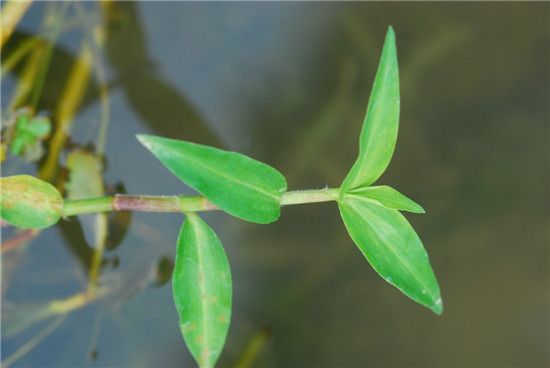
Murdannia triquetra is one of the main weeds in rice paddies, also known as meat grass. It has long and creeping rhizomes; the rhizomes have leaf sheaths, the internodes are about 6 cm long, and the nodes bear slender fibrous roots. The stem is fleshy, prostrate in the lower part, rooting at the nodes, ascending in the upper part, usually much branched, up to 40 cm long, with internodes 8 cm long, densely covered with a row of white bristles that is continuous with a row of hairs on the next leaf sheath.
The leaves are sessile, with cilia only on the lower part of the leaf blade and a row of hairs at the seam where the leaf sheath closes; this row joins with that on the previous node to form a series, and the leaf is hairless here. The leaf blade is bamboo-leaf-shaped, flat or slightly folded, 2-6 cm long and 0.5-0.8 cm wide, with a gradually pointed but blunt tip.
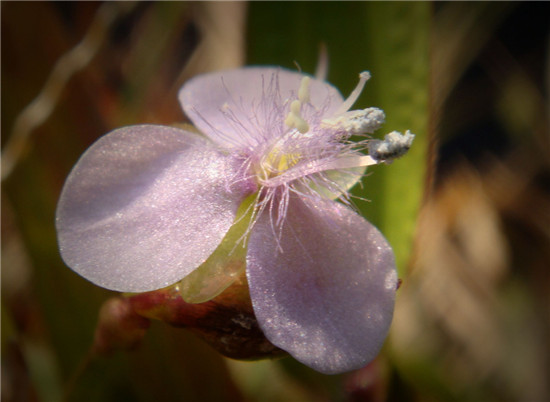
The inflorescence usually has only a single flower, both terminal and axillary; the peduncle is 1-4 cm long, longer in terminal flowers and shorter in axillary ones. There is a linear bract in the middle of the peduncle, and sometimes a flower is produced in the axil of the bract. The sepals are green, narrowly oblong, slightly boat-shaped, 0.4-0.6 cm long, hairless, and persistent in the fruiting stage.
The petals are pink, purplish-red or blue-purple, obovate, slightly longer than the sepals. The filaments are densely covered with long barbed hairs. The capsule is ovate and three-angled, 0.5-0.7 cm long and 0.3-0.4 cm in diameter, with blunt or shortly acute ends, each locule containing 3 seeds, sometimes only 1-2. The seeds are short-columnar, slightly flattened, and red-gray.
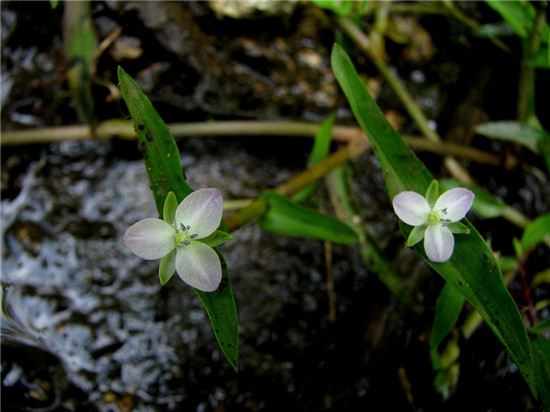
The seed dormancy period is relatively short, and dormancy is already broken in early spring. The starting temperature for seed germination is relatively low, about 10°C, and a germination peak forms at 15-20°C. The humidity range for seed germination is relatively wide, and mass occurrence can happen when the soil moisture content is 15%-20%.
Therefore, in wheat fields, on field ridges and beside ditches, germination begins in March, enters the germination peak in April-May, and at the same time branches and underground rhizomes grow. In rice paddies, reproduction mainly relies on the regrowth of surviving plants after wheat field plowing and on young plants from field ridges and ditch edges flowing into the field with irrigation water; seedlings are very few. Because its regenerative capacity is extremely strong, an occurrence peak quickly forms in rice paddies.
In the south, Murdannia triquetra grows all year round and behaves as a perennial weed, with overwintering plants flowering in May. In the Yangtze River basin, it mainly overwinters and reproduces by seeds and behaves as an annual weed, flowering from late August to mid-September, setting fruit from mid-to-late September, and the seeds maturing from late September to early-to-mid October; after maturing, the capsules split open naturally and drop into the field, entering dormancy, with a whole growth period of about 200 days or more.
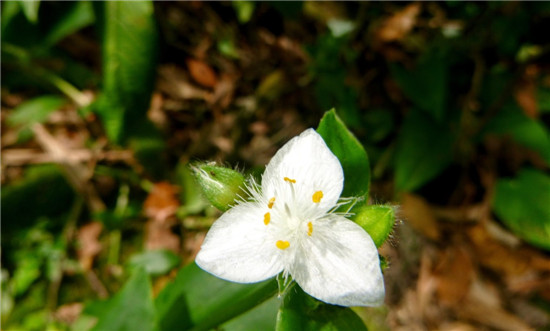
Dietary therapeutic effects of Murdannia triquetra:
This herb is sweet in taste and neutral in nature. It enters the liver and spleen meridians. Its effects are clearing heat, promoting urination, reducing swelling and detoxifying. It mainly treats lung heat with panting and coughing, red and white dysentery, difficult urination, sore and swollen throat, and boils, carbuncles and furuncles.
Instructions for preparing Murdannia triquetra:
1. To treat high fever with panting and coughing due to pneumonia: 5 to 8 qian of fresh Murdannia triquetra. Add an appropriate amount of water, decoct, mix with honey and take, twice a day.
2. To treat intestinal heat with red and white dysentery: 1 liang of fresh Murdannia triquetra. Wash clean, decoct into a soup, mix with a little brown sugar and take orally.
3. To treat difficult urination: 1 to 2 liang of fresh Murdannia triquetra. Add an appropriate amount of water, decoct, mix with rock sugar and take orally, twice a day.
4. To treat mouth ulcers and rotten tongue: 2 liang of fresh Murdannia triquetra, crush to extract the juice, add one cup of boiled water, rinse the mouth for about 5 to 6 minutes, several times a day.
5. To treat boils: 3 liang of fresh Murdannia triquetra and 5 qian of rock sugar. Stew and take, and apply the medicinal residue to the affected area.
6. To treat corns: mash fresh Murdannia triquetra with winter honey and apply to the affected area, changing 2 to 3 times a day.
7. To treat finger inflammation before pus forms: a handful of fresh Murdannia triquetra stems and leaves, and a little vinegar lees. Mash together and apply externally.
The above is the full content of my summary of what Murdannia triquetra is and what plant Murdannia triquetra is. I hope this article can help everyone. Please also continue to follow us.