How to Plant and Care for Ixiolirion (Ixiolirion tataricum)
Ixiolirion is a perennial herbaceous plant of the genus Ixiolirion in the family Amaryllidaceae. Its flowers are large and beautiful. Let us take a look at how to plant it.
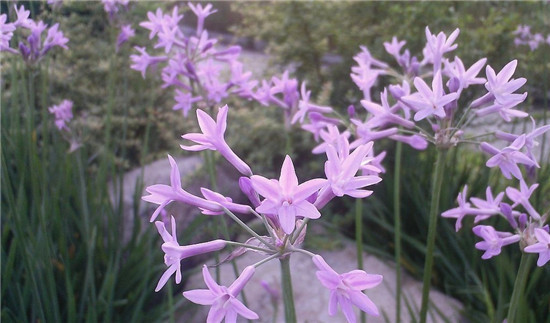
Ixiolirion is a perennial herb. The bulb is ovoid, 1.5-2.5 cm long, up to 2.5 cm in diameter, covered with a brown bulb tunic marked with pale longitudinal stripes. The leaves are usually 3-8 in number, clustered at the base of the stem, narrowly linear. The flowering stem emerges in spring, 10-40 cm tall, with 1-3 smaller leaves on the lower part; at the top is an umbel made up of 3-6 flowers, or a raceme shortened into an umbel-like form, subtended by a spathe-like involucre. The involucral bracts are membranous, 2-3 in number, white or green, lanceolate, up to 3.5 cm long, with a tapering, awn-like tip. Besides the inflorescence at the top of the flowering stem, sometimes 1-3 flowers also emerge from the leaf axils on the lower part.
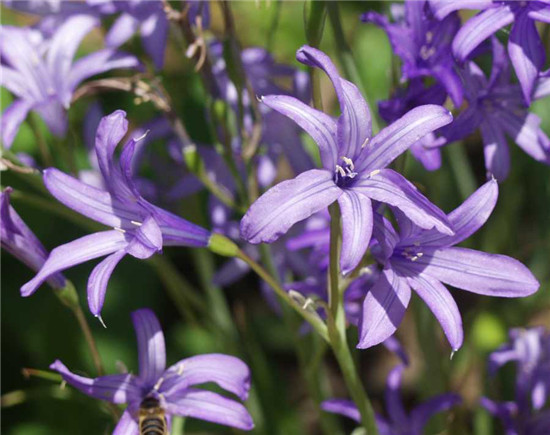
The flower stalks vary in length; the bracteoles are small and membranous; the perianth is blue-purple to deep blue-purple; the tepals are free, oblanceolate or narrower, 2-3.5 cm long, 3-7 mm wide, nearly acute at the tip, with 3-5 ribs in the center; the stamens are inserted at the base of the tepals, in 2 whorls, the 3 inner ones longer and the 3 outer ones shorter, the filaments hairless, nearly thread-like, the anthers basifixed; the ovary is inferior, nearly clavate, 3-locular, with a 3-lobed stigma. The fruit is a capsule; the seeds are small and black. The flowering period is May to June.
The national flower of France is Iris pallida of the family Iridaceae. It is large and beautiful, graceful and elegant, and very similar to the lily. Iris and lily belong to two completely different families. Although at a glance both seem to have six "petals," the iris flower actually has only three petals; the other three surrounding parts are sepals that protect the bud. It is just that these three petal-like sepals look so much like petals that they often pass for the real thing and are hard to tell apart. In addition, half of the iris "petals" curve upward and half curl downward, whereas lily petals all point upward. Some irises also have three long, tongue-shaped petals deep in the center of the flower, transformed from the pistil. Because Europeans often call the iris flower a "lily," many people assume that the national flower of France is the lily. In modern Chinese, fleur-de-lis is often translated as "golden lily," but the correct translation should still be "iris flower."
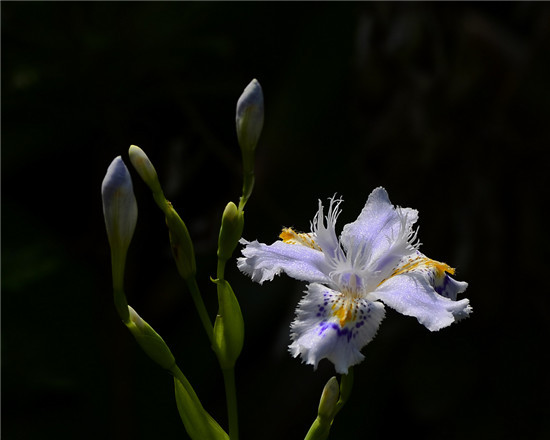
Iris Growing Methods
Division and sowing are mostly used. Division can be done after flowering in spring or in autumn, generally replanting once every 2-4 years of growth. When dividing the rhizomes, make sure each piece has 2-3 adventitious buds. Seeds should be sown immediately after they mature; seedlings take 2-3 years to flower. A planting distance of 45-60 cm and a planting depth of 7-8 cm are suitable. Forcing culture is also possible.
1. Planting: ground planting, also called pot planting. It is often grown in the open ground. Well-drained, moderately moist soil is suitable. Before planting, apply decomposed compost; oil cake, plant ash and the like can also be used as a base fertilizer. As for planting depth, on well-drained loose soil the top of the rhizome should be 5 cm below the ground, while on clay soil the top of the rhizome should be slightly above the ground, to favor the plant's growth.
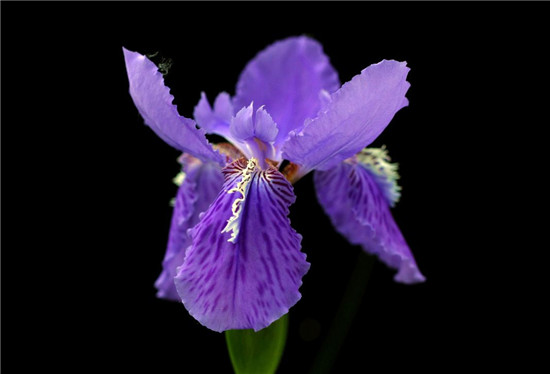
2. Temperature and light: Iris likes full sunlight and also tolerates slight shade. It can be grown in the open ground. It is highly adaptable, and generally vigorous growth is achieved with normal care.
3. Watering and fertilizing: A base fertilizer can be applied before planting; fertilize once every autumn, and apply chemical fertilizer as a top dressing during the growing period. Watering depends on the situation; for open-ground cultivation, water once a week during the growing period, and gradually reduce the amount of watering as the temperature drops. In colder regions in winter, cover the clumps with manure or leaves and the like to protect them from the cold.
The above is the full content of how to plant Ixiolirion and how to grow Ixiolirion that I have summarized for everyone. I hope this article can help you. Please also keep following us.