How to Grow Yucca gloriosa and How It Differs from Yucca filamentosa
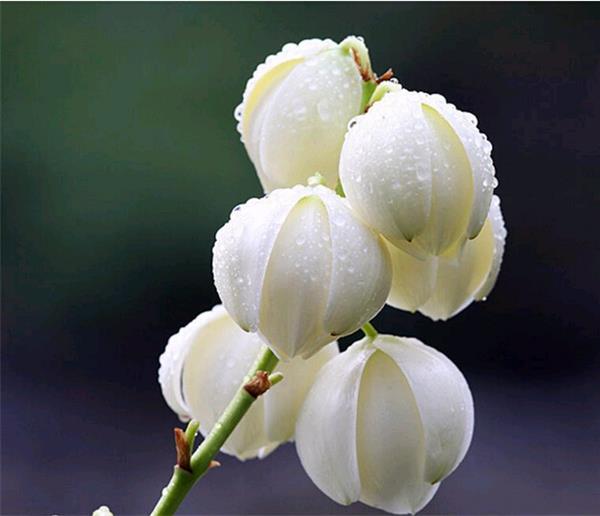
Yucca gloriosa is a plant we often see in daily life, frequently planted as roadside landscaping greenery. Many people greatly admire its blooms, with each small, pure white flower shaped like a little cup. Today, the editor will introduce how to grow Yucca gloriosa and the difference between Yucca gloriosa and Yucca filamentosa.
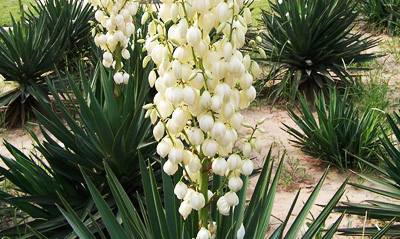
Yucca gloriosa is a perennial evergreen shrub. The stem is unbranched or only rarely branched. The leaves are sword-shaped, with sharp, hard tips, densely arranged in a spiral on the stem; the leaf texture is rather hard, with smooth edges or a few white threads when old, and covered with a white powder. The panicle reaches 80-120 cm tall. The flowers are cup-shaped and drooping, with 6 petals, milky white. The flowering period runs from mid-May to mid-June, or from early August to early November; from the first flower opening to the last one dropping takes more than 20 days. The flowers open progressively from bottom to top, and a single plant can produce 300-400 flowers. The capsule is elliptical-ovate. The fleshy roots are thick and sturdy, and tend to produce suckers.
How to Grow Yucca gloriosa
Yucca gloriosa is native to eastern and southeastern Africa. It has strong adaptability, tolerates cold and drought, enjoys full sun but also tolerates partial shade, and is not demanding about soil.
Cultivation and management: After Yucca gloriosa is planted, management is simple; you only need to trim dead branches and withered leaves at any time, and promptly cut off the flower stalks after blooming. When a Yucca gloriosa grown for many years has stems that are too tall or leaning, which reduces its ornamental value, it should be cut back and renewed. During the growing season, apply topdressing irregularly according to the plant's condition, and water according to the soil condition.
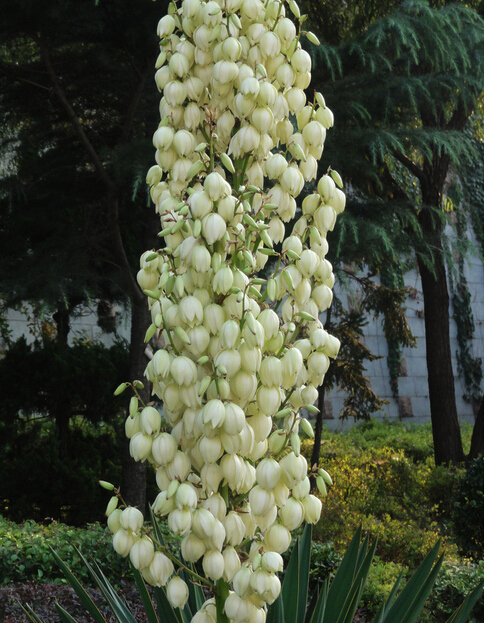
Yucca filamentosa has a fleshy fibrous root system. When young, the stem is extremely short, and the leaves often grow in a clump brushing against the ground. As the stem ages and extends, it becomes small-tree-like, about 2 m tall; the stem bark is dark brown, fibrous, and very rarely branched. The leaves are sword-shaped, 30 cm to 60 cm long and about 3 cm wide, thickly leathery, upright and hard, tapering to a needle-like point at the tip; the leaf surface is grayish green, both sides slightly covered with white powder, and the edges bear separated white fibrous threads, hence it is also called "margined Yucca filamentosa." A large panicle emerges from the leaf clump, with a thick, sturdy main stalk about 3 cm to 5 cm in diameter, yellow-green, soft in texture; each plant can produce 1 to 2 stalks, often rising more than half above the leaf clump. The flowers grow laterally around the pedicel, with short stalks; the corolla is cup-shaped, creamy yellow, drooping, with 6 petals, opening one by one from bottom to top. The capsule is elliptical-ovate; in the north, because temperatures drop after flowering, it often does not set seed, and the main stalk of the inflorescence also dries up. The flowering period is from September to October, lasting about 1 month. The variety Yucca filamentosa 'Variegata' has yellow or white stripes on the leaf surface. Yucca filamentosa 'Aureomarginata' has yellow leaf margins, slightly rounded tips that are still finely pointed, and a slight red flush at the base.
The Growth Habits of Yucca gloriosa
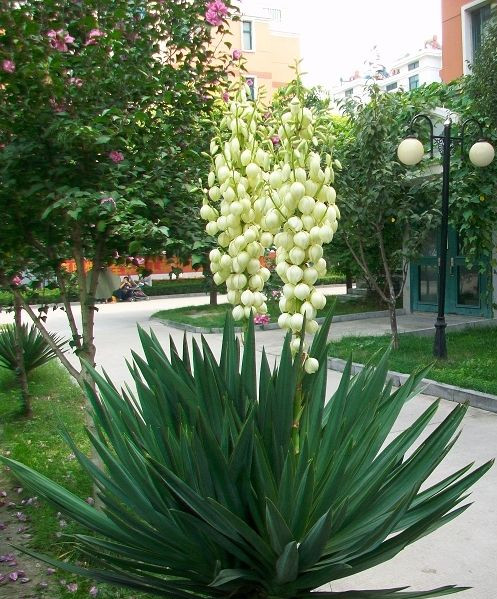
Yucca gloriosa stays deep green year-round; both its flowers and leaves are beautiful, and its tree form is unusual. Several plants form a clump, varying in height; the leaf shape is like a sword, and when in bloom the flower stalks rise tall and upright, the flowers are pure white, and the numerous white flowers droop like bells. With graceful posture, a long flowering period, and a pleasant delicate fragrance, it is a fine ornamental garden tree and also a good material for fresh cut flowers. It is often planted in the center of flower beds, in front of buildings, in lawns, beside pools, on terraced slopes, by buildings, along roadsides, and in hedges.
The leaf fiber is white, strong, and resistant to water and moisture; called "white hemp palm," it can be used for cables and ropes. The leaves can also be used to extract steroid hormones.
Yucca gloriosa can be propagated by division. Plants grown for many years will produce small offsets from the roots. When the small offsets have grown a little, cut them away from the mother plant. Those with roots can be planted directly; those without roots can be used as cuttings: apply sulfur powder to the cut, then plant in sterilized plain sandy soil and place in a shady spot. After about 50 days they will root, and can then be moved to a sunny place for cultivation.
The Characteristics of Yucca gloriosa
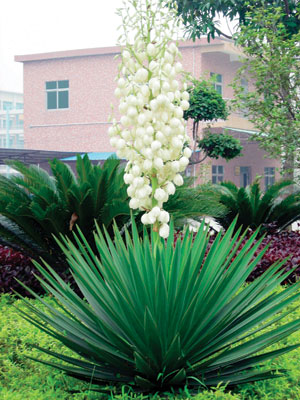
It prefers a warm, humid environment with plenty of sunlight; it tolerates cold, shade, drought, and is also fairly tolerant of moisture, and is not demanding about soil. It has strong resistance to and absorption capacity for harmful gases such as SO2, HCl, HF, and others. Tests show that under an environment with a daily average sulfur dioxide concentration of 0.15 mL/cubic meter, many trees such as pine and cypress, Photinia, winter jasmine, and Paulownia all show severe symptoms of damage, while Yucca filamentosa remains upright and vigorous. Yucca filamentosa also has a fairly strong ability to absorb hydrogen fluoride; according to measurements, 1 kg of dry leaves can absorb 266 mg of fluorine.
It prefers a warm, humid environment with plenty of sunlight; it also tolerates shade, resists pollution, has strong sprouting ability, and strong adaptability. After flowering, the top stops growing, and lateral buds emerge beside it from the leaf scars. It is robust by nature, tolerating cold, drought, moisture, and poor soil, and is not demanding about soil or fertilizer. It grows vigorously and is not demanding about soil or fertilizer, but prefers well-drained sandy soil. It can resist pollution. It has strong resistance to harmful gases such as SO2, HCl, HF, and others, and can grow in all soils except saline-alkali land. It has thick fleshy roots, and the stem readily produces adventitious buds, easily growing suckers, expanding the plant, and having very strong renewal ability.
Plant it in a small flower pot and place it on a small table.
The Characteristics of Yucca gloriosa
It prefers a warm, humid environment with plenty of sunlight; it tolerates cold, shade, drought, and is also fairly tolerant of moisture, and is not demanding about soil. It has strong resistance to and absorption capacity for harmful gases such as SO2, HCl, HF, and others. Tests show that under an environment with a daily average sulfur dioxide concentration of 0.15 mL/cubic meter, many trees such as pine and cypress, Photinia, winter jasmine, and Paulownia all show severe symptoms of damage, while Yucca filamentosa remains upright and vigorous. Yucca filamentosa also has a fairly strong ability to absorb hydrogen fluoride; according to measurements, 1 kg of dry leaves can absorb 266 mg of fluorine.
It prefers a warm, humid environment with plenty of sunlight; it also tolerates shade, resists pollution, has strong sprouting ability, and strong adaptability. After flowering, the top stops growing, and lateral buds emerge beside it from the leaf scars. It is robust by nature, tolerating cold, drought, moisture, and poor soil, and is not demanding about soil or fertilizer. It grows vigorously and is not demanding about soil or fertilizer, but prefers well-drained sandy soil. It can resist pollution. It has strong resistance to harmful gases such as SO2, HCl, HF, and others, and can grow in all soils except saline-alkali land. It has thick fleshy roots, and the stem readily produces adventitious buds, easily growing suckers, expanding the plant, and having very strong renewal ability.