What is the difference between spearmint and peppermint?
Spearmint, also known as green mint, fragrant mint, and fish mint, is an upright perennial herbaceous plant in the Lamiaceae family. Next, let us take a look at the difference between spearmint and peppermint.
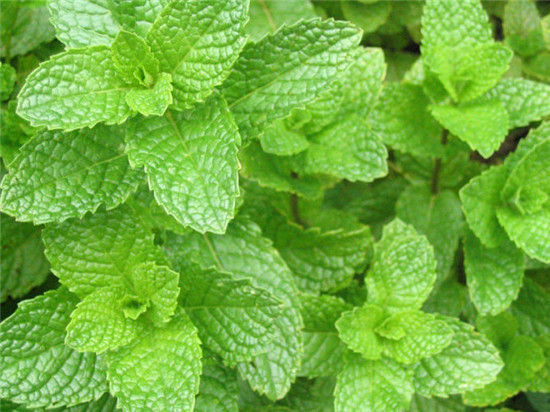
Spearmint leaves are ovate-oblong or oblong-lanceolate, opposite, with glandular dots on the underside, pointed at the tip, broadly wedge-shaped or rounded at the base, with irregular sharp serrations, hairless or nearly hairless on both surfaces, and with no petiole or nearly none. Flowers purple or white, in verticillasters, many flowers densely borne at the top in spikes, bracteoles linear. The lobes are nearly equal in size, the upper lobe slightly notched at the tip. Ovary brownish, hairless.
Spearmint, a perennial aromatic herb, 30-130 cm tall. Much branched, hairless. Leaves opposite; petiole 1-2 mm long; leaf blade lanceolate, lanceolate-ovate, or oblong-lanceolate, 3-7 cm long, 1-2 cm wide, sharply pointed at the tip, rounded-obtuse to wedge-shaped at the base, margin with sparse irregular serrations, tooth tips protruding forward, bright green, with glandular scales on both surfaces, hairless or slightly short-hairy beneath.
Verticillasters densely aggregated into terminal spikes, 4-10 cm long, the lower several whorls sometimes separated; bracts linear, 2.6-3.6 mm long, longer than the calyx; calyx bell-shaped, about 2 mm long, with 13 ribbed veins, slightly two-lipped, upper lip with 3 teeth, 0.6 mm long, the middle tooth slightly shorter, lower lip short, with 2 teeth, about 0.8 mm long, calyx teeth margins slightly ciliate.
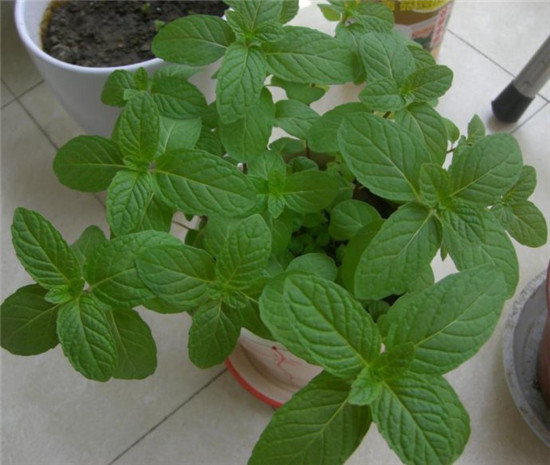
Corolla pale purple, about 4 mm long, two-lipped, upper lip broader, slightly concave at the tip, lower lip 3-lobed and narrower, upper lip slightly short-hairy on the outside, corolla tube smooth inside and out; stamens 4, nearly equal, 4-4.5 mm long, anthers 2-celled, purple, later turning brown. Nutlets ovate, 0.7 mm long, 0.5 mm wide, black, with fine pits. Flowers July-September, fruiting September-October.
Spearmint oil or green mint oil, whose main component is carvone, and which also contains limonene, phellandrene, and others, is mainly used as a flavoring in candy and toothpaste, and is also used medicinally. The leaves, tender branches, or the whole plant are also used as medicine, to treat cold and fever, cough, consumptive cough, common cold, headache, sore throat, nervous headache, gastrointestinal bloating, traumatic bruising and pain, red and burning eyes, nosebleed, dark sores, general numbness, and children's sores and boils.
Cross-section of the spearmint stem: epidermis 1 layer, covered with cuticular warts, sometimes with hairs. The four corners have distinct ridge crests, with several to ten or more rows of collenchyma cells toward the inside, the inner edge being several rows of parenchyma cells with large intercellular spaces. Casparian dots clearly visible. Vascular bundles are more developed at the four corners, with several small vascular bundles between adjacent corners. Phloem narrow. Cambium forming a ring. Pith composed of parenchyma cells, often with cavities in the center. Cells in various parts of the stem sometimes contain needle-cluster-shaped or fan-shaped hesperidin crystals.
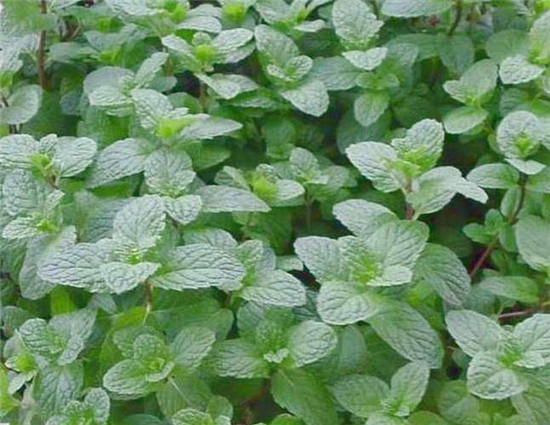
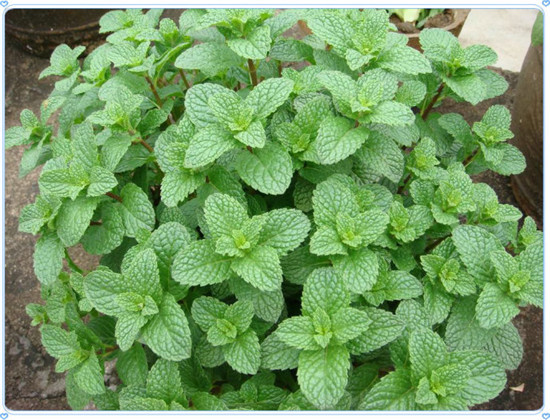
On the surface, peppermint leaves are lighter in color, with paler veins, a more pointed shape, and are relatively thin. Spearmint leaves, by contrast, are darker in color, with more obvious veins, a rounder leaf shape, and are relatively thick. In terms of composition, the main component of peppermint is menthol, with a pungent cooling aroma; while the main components of spearmint are carvone and limonene, with a clear, sweet, soft fragrance and a slight coolness. In traditional Chinese medicine, the two cannot be used interchangeably.
The above is the full content of my summary of the difference between spearmint and peppermint. I hope this article can help everyone. Please also continue to follow us.