Cultivation Methods and Key Technical Points for Baby Blue Eyes
Baby Blue Eyes (Nemophila menziesii) is an annual herbaceous flower belonging to the genus Nemophila in the family Hydrophyllaceae. The most commonly seen flower color is clear blue. Let us now take a look at the cultivation methods for Baby Blue Eyes.
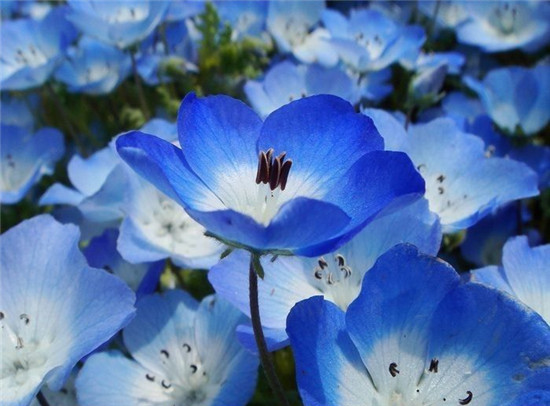
Baby Blue Eyes also has white flowers with small black dots scattered at the center, or white flowers with purple blotches at the tips of each petal's outer edge, and even flowers with black petals (the black portion varies, ranging from deep purple to black, not entirely black) with white rims on the outer edges. The uniqueness of its flower colors can be said to be unmatched by any other.
Baby Blue Eyes has strong cold resistance and can overwinter even in areas with frost, making it suitable for pot and flower bed planting. In Japan, Baby Blue Eyes is no stranger to the people there, and it is widely grown by locals. In terms of flower color, flower shape, and plant form, it is an excellent potted plant.
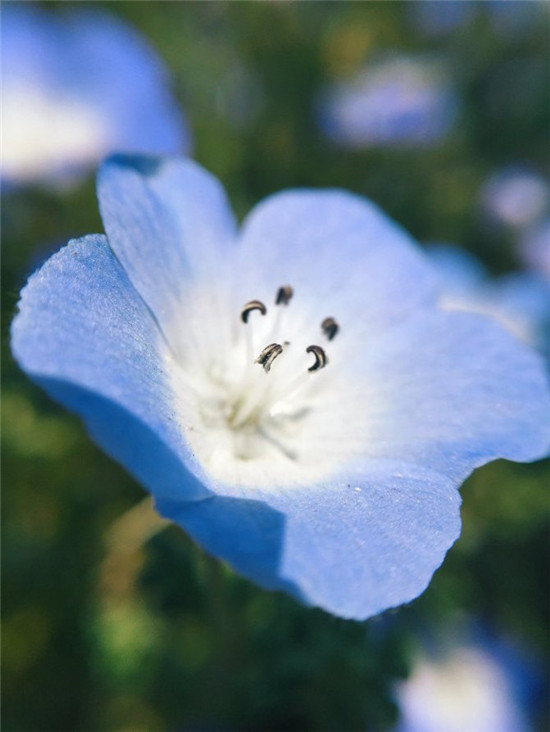
Baby Blue Eyes is an annual herbaceous flower belonging to the genus Nemophila in the family Hydrophyllaceae. It has 5 petals, with a flower diameter of about 1-3 cm. The most commonly seen flower color is clear blue. There are also white flowers with small black dots scattered at the center, or white flowers with purple blotches at the tips of each petal's outer edge, and even flowers with black petals (the black portion varies, ranging from deep purple to black, not entirely black) with white rims on the outer edges. The uniqueness of its flower colors can be said to be unmatched by any other.
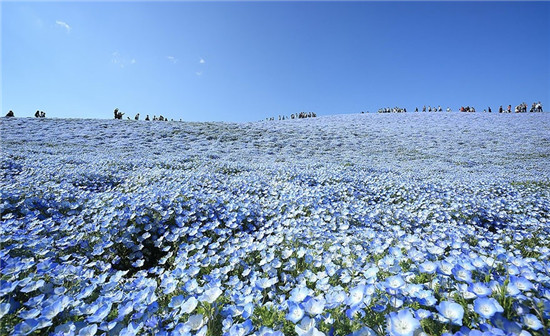
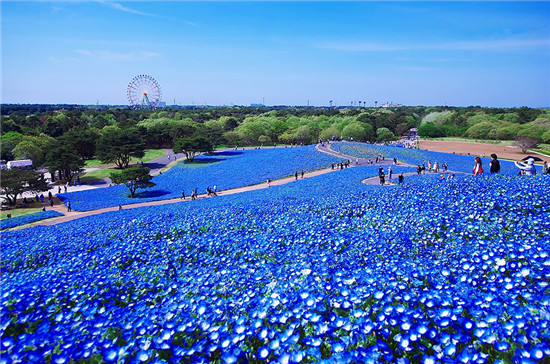
Baby Blue Eyes grows to about 30 cm tall, with clear purple-blue flowers and white centers. It has strong cold resistance and can overwinter even in areas with frost, making it suitable for pot and flower bed planting. In Japan, Baby Blue Eyes is no stranger to the people there, and it is widely grown by locals. In terms of flower color, flower shape, and plant form, it is an excellent potted plant.
In the plains of Taiwan, China, due to the hot summer climate, its growth vigor is relatively poor, which affects flowering. September to October is the best sowing period, with flowering in April to May of the following year. The suitable germination temperature is about 15-22°C, and the growing temperature is 5-28°C. It is more suitable for planting in cool weather. If you want to sow in spring, then in the transition from late spring to early summer when the weather gradually becomes hotter, place it in a shaded, cool, and well-ventilated spot with bright light, pay attention to watering, and avoid excessive drought. Then you can also see it bloom in summer.
Cultivation Techniques for Baby Blue Eyes
1. Sunlight
The orchid plant needs to receive partial light. Especially before and after the flowering period, appropriate light can promote the flowering of Baby Blue Eyes, making the flowers more vibrant and long-lasting. Generally, it should be placed in a spot indoors with scattered light, and do not let direct sunlight hit it.
Under natural conditions, Baby Blue Eyes mostly grows epiphytically on the branches and trunks of tall trees in tropical rainforests, sheltered by tree shade. It should avoid direct sunlight, otherwise it will cause large-area leaf scorching, but it also cannot tolerate overly shady indoor conditions, which will lead to slow growth and be unfavorable for nutrient storage and flowering. It is best to place it on a north- or east-facing balcony or beside a windowsill so that it receives scattered light, which will make it grow robustly with fewer diseases.
2. Temperature
When growing Baby Blue Eyes at home, the first thing to ensure is temperature. Baby Blue Eyes likes a high-temperature and high-humidity environment. During the growing period, the minimum temperature should be kept above 15°C, and the suitable growing temperature for Baby Blue Eyes is 16°C to 30°C. Attention should be paid to increasing the temperature in autumn and winter, at the turn of winter and spring, and when winter temperatures are low. Generally, in rooms with heating equipment in winter, this temperature is not difficult to reach, but be careful not to place the flowers directly on the radiator or too close to it. When summer temperatures are on the high side, cooling is needed, and attention should be paid to ventilation. If the temperature is higher than 32°C, Baby Blue Eyes usually enters a semi-dormant state, and continuous high temperatures should be avoided. Around the Spring Festival is the full flowering period, and appropriate cooling can extend the viewing time. During flowering, the nighttime temperature is best controlled between 13°C and 16°C, but it must not be lower than 13°C.
3. Water
Baby Blue Eyes is not drought-tolerant, and due to its epiphytic nature, it also fears waterlogging and dampness. During high-temperature summer periods, it is sufficient to keep the material moist. You can use spraying to lower the temperature and increase humidity (but do not let water remain in the leaf center, as it easily causes crown rot). You can also place a moist towel beside the flower pot to increase humidity, but be sure to note: the roots must not be excessively damp and dark for a long time, especially being surrounded by liquid water for a long time makes them extremely prone to rot. For example, in summer, the daily watering amount should be such that it can naturally air-dry by the end of the day, alternating between dry and wet, which will greatly reduce the incidence of root rot and diseases. In winter, water less, just keeping the material slightly moist.
Sowing Season for Baby Blue Eyes
1. Outdoor planting: An annual herbaceous flower with weak cold resistance. In the south, sowing begins around late February to early March; in the north, around late March and early April. Biennials and perennials have strong cold resistance, so Baby Blue Eyes seeds should germinate at lower temperatures. The higher the temperature, the less likely the seeds are to germinate. In the south, sow around late September to early October; in the north, around late August to early September.
2. For greenhouse and home indoor planting, the influence of seasonal climate conditions is relatively small, so there is no strict seasonal restriction on the sowing period, and it is often determined by the desired flowering period.
Sowing Conditions for Baby Blue Eyes
1. Growing medium: The medium should be loose, breathable, have good water retention, moderate pH, low nutrient content, and be disease-free.
2. Germination temperature: Suitable temperature for seed germination: 20-25°C. The day-night temperature difference should preferably be controlled at 4-8°C.
3. Water: Without appropriate moisture, the seed germination rate will be limited to a certain extent. Therefore, before sowing, one should first fully understand the humidity requirements for seed germination.
4. Light: Light is also very important for seed germination.
The above is the complete content of the cultivation methods and cultivation techniques for Baby Blue Eyes that I have summarized for everyone. I hope this article can help you. Please also continue to follow us.
Baby Blue Eyes seeds should germinate at lower temperatures. The higher the temperature, the less likely the seeds are to germinate. In the south, sow around late September to early October; in the north, around late August to early September.2. For greenhouse and home indoor planting, the influence of seasonal climate conditions is relatively small, so there is no strict seasonal restriction on the sowing period, and it is often determined by the desired flowering period.
Sowing Conditions for Baby Blue Eyes
1. Growing medium: The medium should be loose, breathable, have good water retention, moderate pH, low nutrient content, and be disease-free.
2. Germination temperature: Suitable temperature for seed germination: 20-25°C. The day-night temperature difference should preferably be controlled at 4-8°C.
3. Water: Without appropriate moisture, the seed germination rate will be limited to a certain extent. Therefore, before sowing, one should first fully understand the humidity requirements for seed germination.
4. Light: Light is also very important for seed germination.
The above is the complete content of the cultivation methods and cultivation techniques for Baby Blue Eyes that I have summarized for everyone. I hope this article can help you. Please also continue to follow us.