What are the uses and benefits of clover?
Clover is commonly seen in our daily lives, and we generally call it "three-leaf grass". Next, let us take a look at the uses of clover.
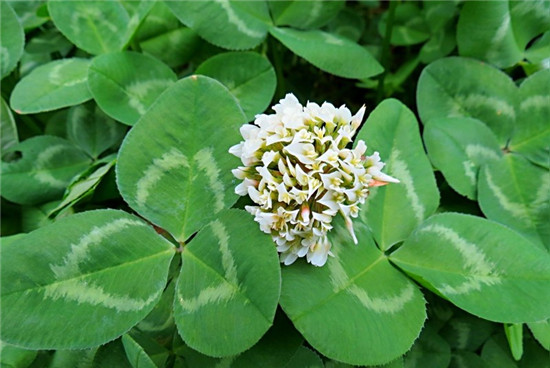
Clover, also known as three-leaf grass, is made up of three leaves and is also called sweet clover. It is a perennial herbaceous plant. It generally grows to about 60 cm tall, is an important forage crop with broad cultivation significance, and is also an important green manure and soil and water conservation plant. It likes a humid and cool climate, tolerates moisture but not drought, and can grow well in slightly acidic or saline-alkaline soil.
Short-lived perennial herb, with a growth period of up to 5 years, 10-30 cm tall. The main root is short, and the lateral roots and fibrous roots are well developed. The stems are creeping and trailing, slightly ascending above, rooting at the nodes, and the whole plant is hairless. Palmately trifoliolate; stipules ovate-lanceolate, membranous, sheathing at the base and clasping the stem, with the free portion sharply pointed; petioles relatively long, 10-30 cm long; leaflets obovate to nearly circular, 8-20 (-30) mm long, 8-16 (-25) mm wide, apex retuse to obtuse-rounded, base cuneate and gradually narrowing to the petiolule, midvein raised on the lower surface, lateral veins about 13 pairs, spreading at a 50° angle to the midvein, raised on both sides, forked near the leaf margin and extending to the tips of the serrations.
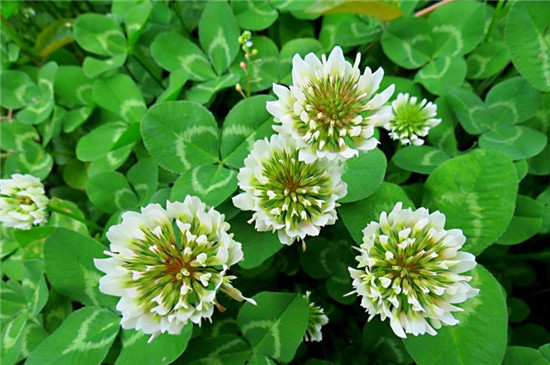
Petiolules 1.5 mm long, slightly pubescent. Inflorescence spherical, terminal, 15-40 mm in diameter; peduncle very long, nearly 1 times longer than the petiole, with 20-50 (-80) flowers, dense; no involucre; bracts lanceolate, membranous, taper-pointed; flowers 7-12 mm long; pedicels slightly longer than or equal to the calyx, drooping immediately after flowering; calyx campanulate, with 10 veins, calyx teeth 5, lanceolate, slightly unequal in length, shorter than the calyx tube, calyx throat open, hairless; corolla white, creamy yellow, or pale red, fragrant. Standard elliptic, nearly 1 times longer than the wings and keel, keel slightly shorter than the wings; ovary linear-oblong, style slightly longer than the ovary, ovules 3-4. Legume oblong; seeds usually 3. Seeds broadly ovate. Flowering and fruiting period May-October.
Clover is a good plant for soil and water conservation, rich in nutrients such as protein, calcium, and phosphorus, and is praised as an excellent forage grass. Its seeds contain about 11% oil, and the whole plant can be used medicinally, with the effects of clearing heat, detoxifying, and cooling the blood. At the same time, the leaves and flowers of clover are also very beautiful and have a certain ornamental value. Its leaves and flowering period can both last for a long time, and it is tolerant of trampling, so it is generally used as turf on both sides of streets, on embankments and slopes for soil conservation, and on various landscaping lawns.
Clover is divided by color into white clover and red clover. White clover is an annual or perennial plant, with small, delicately fragrant flowers gathered into head-like or spike-like inflorescences. It contains one or two seeds, grows in warm regions of countries around the world, and also plays a role in improving the soil, adding 55-180 kg of nitrogen per hectare, which is beneficial to the good growth of summer crops.
Red clover is biennial or short-lived perennial, with ovate head-like inflorescences, pale purple. Also known as red clover, red flower grass, and red clover, it is rich in biochanin A and can play a role in relieving cough and stopping asthma.
The above is the full content of my summary of what uses clover has and what uses clover has. I hope this article can help everyone. Please also continue to follow us.