How to Grow California Poppy? A Detailed Guide to Planting Methods
California poppy is native to California, USA. It is relatively cold-tolerant and prefers a cool, dry climate. This perennial herbaceous flower is often grown as an annual or biennial. Next, let's take a look at how to grow California poppy.
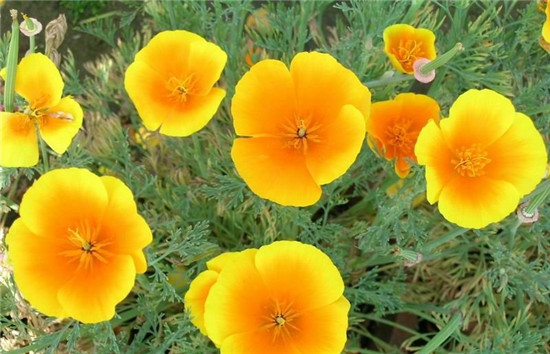
California poppy belongs to the genus Eschscholzia in the Papaveraceae family, also known as ginseng flower and golden flower. It is a perennial herb, often grown as an annual or biennial. Native to California, USA, it is the state flower of that state. It grows 20-40cm tall, covered with a white powdery bloom, with leaves mostly ternately pinnately lobed and long petioles; flowers are solitary at the branch tips, with 4 fan-shaped petals in yellow, orange-yellow and white, having a silky sheen, flower diameter 4-6cm, shallow bowl-shaped, blooming from May to June.
California poppy was originally a perennial herb, but is grown as an annual or biennial. The plant height is 30 to 80 cm, much branched, hairless, succulent, spreading, the whole plant appearing covered with a white powdery bloom and grayish-green in color. Leaves are alternate, multi-ternately pinnately lobed, with linear or elliptical lobes, and the entire leaf has a long petiole. Flowers are solitary at the branch tips, flower diameter about 5 to 7 cm, with long pedicels.
The receptacle is prominent, with 2 sepals joined into a pointed helmet shape, which fall off as the petals unfold; there are 4 petals that drop off easily, decussately opposite, fan-shaped, with finely undulate margins, bright yellow, dark orange-yellow at the base, and glossy. Cultivated varieties include orange-yellow, golden yellow, orange-red, pale purplish-red, flesh-colored, and creamy white. The petals often have crinkles, and there are also double-flowered varieties.
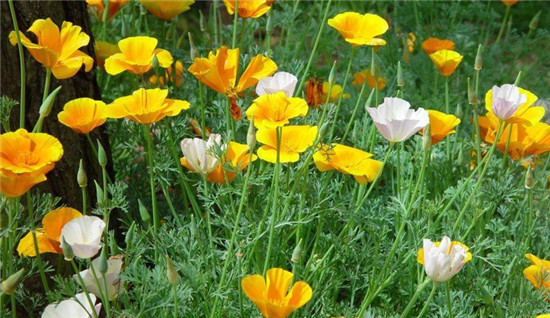
The flowering period is from April to May. The fruit is a ribbed capsule, slender, 7 to 10 cm long, shaped like a rapeseed pod. The seeds are spherical, or slightly elliptical. Flowers in the same genus as this species also include tufted California poppy and curved-leaf California poppy.
How to Grow California Poppy
1. Humidity management: It prefers a relatively dry air environment. Prolonged rainy days make it susceptible to infection by pathogens. It is afraid of rain, so keep the leaves dry at night. The optimal relative air humidity is 40-60%.
2. Temperature management: It prefers a cool climate, dislikes intense heat, and is tolerant of frost and cold. It is not very demanding about winter temperatures; as long as it is not exposed to frost, it can overwinter safely; it dies when temperatures exceed 30°C in late spring and early summer, and the most suitable growing temperature is 15-25°C.
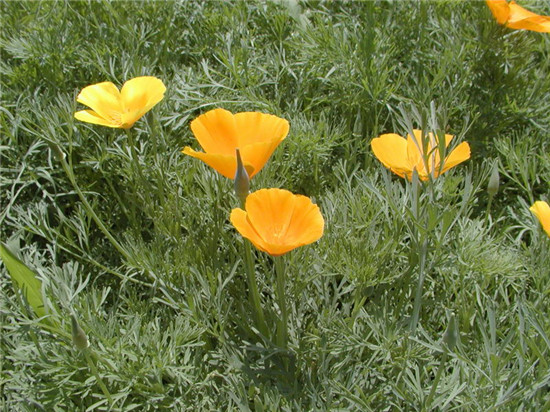
3. Light management: In the three seasons of late autumn, winter, and early spring, since temperatures are not very high, it should be given direct sunlight to facilitate photosynthesis and the formation of flower buds, flowering, and seed setting. In summer, if high-temperature weather occurs, it needs to be shaded from about 50% of sunlight.
4. Fertilizer and water management: California poppy has relatively high fertilizer and water requirements, but it is afraid of indiscriminate fertilizing, concentrated fertilizer, and one-sided application of nitrogen, phosphorus, or potassium fertilizers. It requires following the two fertilizing (watering) principles of "apply dilute fertilizer frequently, small amounts with more frequent applications, complete nutrition" and "alternate dry and wet, dry means thoroughly dry, do not water if not dry, water thoroughly when watering," and after fertilizing, keep the leaves and flowers dry at night.
Precautions for California Poppy Care
① California poppy has a relatively long taproot and does not tolerate transplanting. Before sowing, apply some decomposed bean cake as a base fertilizer, and sow the seeds directly in the pot.
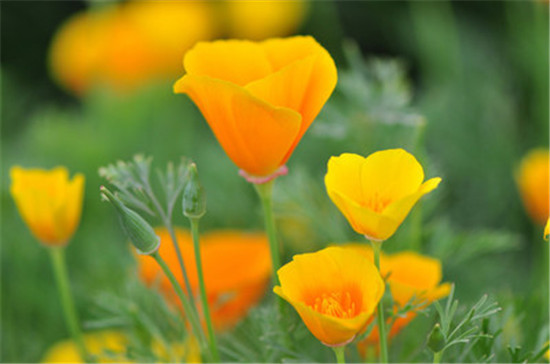
② California poppy has fleshy roots and is afraid of waterlogging. In rainy seasons, the area around the root crown easily turns black and rots, so when growing in open ground, attention must be paid to timely drainage in summer; when grown in pots, watering should be moderate.
③ During the peak growing season and before flowering, watering should also not be excessive. Apply decomposed dilute bean cake fertilizer water once a month to keep the plants growing well.
④ During the growing period, damage from whiteflies is relatively common, so attention should be paid to prevention first, combining prevention and control.
⑤ After the fruit skin turns yellow, it should be harvested promptly in the early morning, otherwise the seeds scatter very easily. When drying the capsules, be sure to cover the container with glass, because after drying, the fruit skin bursts open very violently, ejecting the seeds out of the container, which is not conducive to seed collection.
The above is all the content I have summarized for you on how to grow California poppy. I hope this article can help everyone. Please also continue to follow us.