What are the plant characteristics of Zinnia? Detailed explanation of morphological features and growth habits
Zinnia belongs to the Asteraceae family and is native to Mexico. It is a well-known ornamental plant. Let us take a look at the characteristics of Zinnia.
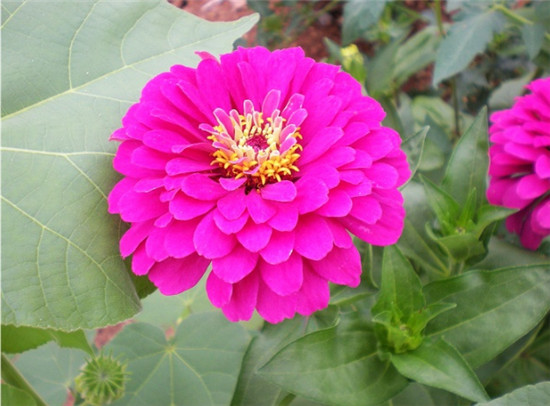
The lateral branches of Zinnia are forked. It blooms in summer and autumn, with solitary flower heads at the top of the branches. The flower diameter is about 10 cm, the petal colors are diverse, the flowering period is long, and the flower forms are highly varied, basically all double-flowered types. It is robust, drought-tolerant, loves sunlight, and prefers fertile, deep soil. It dislikes extreme heat. It grows poorly in summer under rainy conditions with poor drainage. It is the national flower of the United Arab Emirates. The flowers are large and brightly colored, bloom early, have a long flowering period, and the plant form is attractive, making it a common material for flower beds and flower borders; dwarf varieties can be potted. Tall-stemmed varieties are suitable for cut flower production.
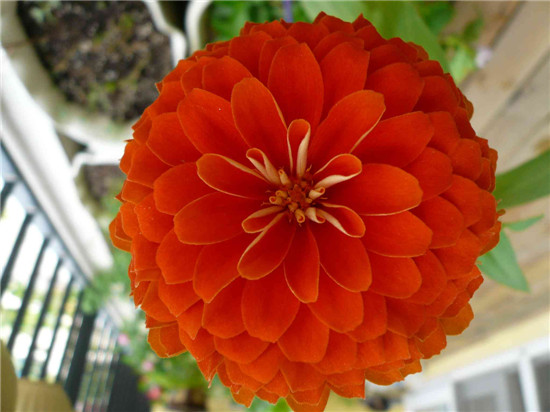
Although it is named "grass," Zinnia has extremely brilliantly colored flowers. In appearance, the stems of Zinnia are upright and stout, with a rough surface; the flower type is mainly double-flowered, and the colors include white, yellow, pink, green, red, orange, and many others. It is also called "Jiejiegao" and "Bubudenggao," named for the flowers themselves, which are formed of layer upon layer of petals.
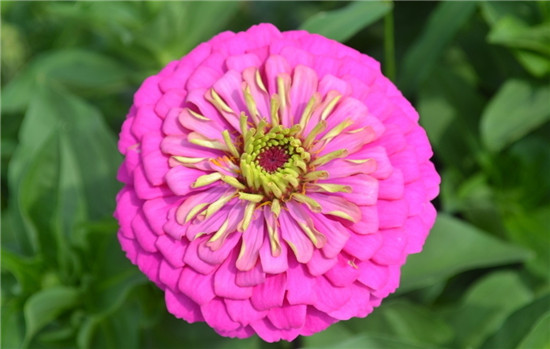
For those who pursue a European style, Zinnia can be chosen when arranging the home. The European style pursues an elegant sense of luxury. In such a gorgeous space, using Zinnia as a foil not only brings a natural atmosphere but also makes people feel as if they are in a paradise, between heaven and earth.
In indoor decorative layout, the center of gravity must remain stable to give people a sense of security. People are generally accustomed to symmetrical and balanced arrangements. This kind of arrangement has more rules than variation. If a natural-style asymmetrical balance is used, it appears fresh, lively, and more full of interest. Zinnias of various colors can be placed at will on both sides of the living room in different colors during home arrangement. Asymmetry brings a strong modern feel and creates a modern home style.
Zinnia is an annual herb, with a plant height of 40-100 cm, and it has bristles. It is strongly upright, the stems are covered with short hairs, the leaves are opposite, sessile, with short prickly hairs, ovate to elliptic, with the leaf base clasping the stem, entire, 4-10 cm long and 2.5-5 cm wide. The flower heads are terminal, 5-15 cm in diameter, with long peduncles. The ligulate flowers are in many whorls, obovate, nearly flat-disk-shaped, with the apex slightly rolled backward, in colors such as yellow, red, white, and purple; the tubular flowers have 5 lobes at the apex, yellow or orange-yellow, the style is two-cleft or has markings, or the petal base has colored spots. The flowering period is from June to October.
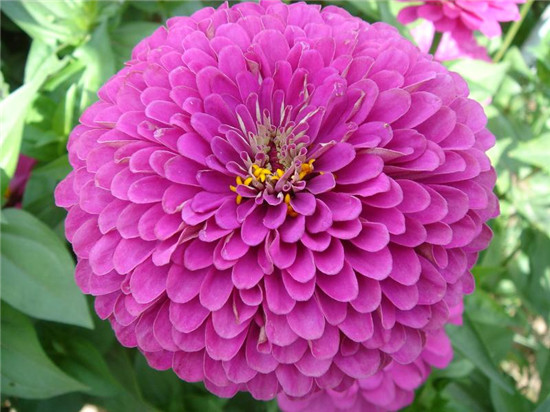
Cultivated varieties can be divided into three types: large-wheel type, medium-wheel type, and small-wheel type. The achenes formed by the ligulate flowers are broadly ovate to bottle-shaped, pointed at the apex, slightly concave in the middle; the fruits formed by the tubular flowers are elliptical, relatively flat, and smaller in shape. They are achenes, and the 1000-seed weight is 5-9 grams, with a lifespan of 3 years. The flowering period is from June to September, and the fruit ripening period is from August to October.
There are many variety types, generally divided into: large-flowered tall-stem type with a plant height of 90-120 cm and few branches, medium-flowered medium-stem type with a plant height of 50-60 cm and more branches, and small-flowered clustered type with a plant height of only 40 cm and many branches. By flower type, they are often large-flowered double type, button type, ostrich-feather type, dahlia type, variegated type, and low-growing type.
The above is all the content of the plant characteristics of Zinnia that I have summarized for everyone. I hope this article can help everyone. Please also continue to follow us.