How to Grow Pink Rain Lilies? A Detailed Guide to Cultivation Methods and Tips
Pink rain lily (Zephyranthes carinata) is a plant in the Amaryllidaceae family, genus Zephyranthes. The flower is borne singly at the tip of the flower stem, and the flower is rose-red or pink. Next, let us take a look at the propagation methods for pink rain lilies.
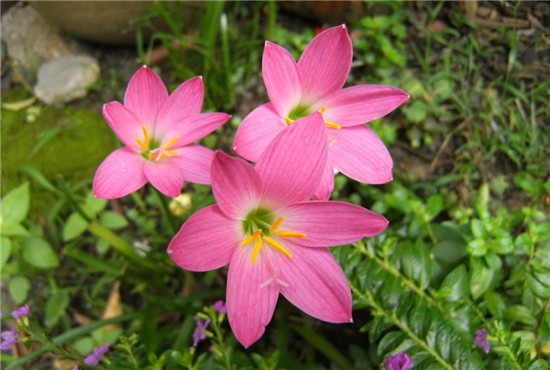
Pink rain lily is also called pink rainflower, pink zephyr lily, and rain lily. It originated in Mexico and is now widely cultivated around the world. It is suitable for planting in clumps in flower beds, flower borders, and lawns, and can also be potted for indoor ornamental viewing. It is a semi-shade groundcover flower widely used in gardens.
Pink rain lily prefers warmth, moisture, and ample sunlight, and also tolerates semi-shade and damp conditions. It tolerates cold, semi-shade, and damp conditions. Its cold tolerance is somewhat poor. It is suitable for well-drained, humus-rich sandy loam.
Pink rain lily grows robustly and is simple to maintain and manage. When planted in the ground in gardens, choose a sunny, warm, wind-sheltered location and apply 3-4 topdressings during the growth and flowering period, and it will have lush leaves and abundant flowers. When cultivated in the open field in the middle and lower reaches of the Yangtze River, after heavy frost in severe winter, the old leaves wither, but the bulbs can remain in the ground to overwinter and bloom as usual the following year. Pink rain lily has a low, compact clump and abundant flowers, with a flowering period from June to September.
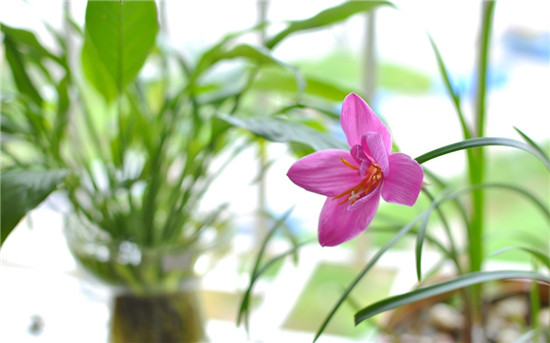
For potting soil, mix 2 parts loam, 1 part leaf mold and peat, add a small amount of fine sand, and add a small amount of bone meal and decomposed compost. During the growing period, there must be sufficient sunlight and water. After one batch of flowers fades, pause watering for 7-8 weeks, then resume watering. With such alternating dry and wet intervals, it can bloom 2-3 times a year.
Pink rain lily has a low, compact clump and abundant flowers, with a flowering period from June to September. Apart from the flowers, its appearance is very much like chives, with oily green leaves that are flat and linear, curving and drooping in the air, almost touching the ground. It blooms in spring and summer, with pink flowers. It is suitable for planting in clumps in flower beds, flower borders, and lawns, and can also be potted for indoor ornamental viewing. It is a semi-shade groundcover flower widely used in gardens. Among the same varieties, there is also the white rain lily.
Pink rain lily is propagated by seeds, and can be planted by division or by bulbs throughout the year, but spring is best. Simply dig up the bulbs, plant 3-5 bulbs at each spot, and water to maintain appropriate moisture, and they will readily survive. When digging up the bulbs, be careful not to damage them. If there are too many leaves and flower stems, cut off the upper parts and plant only the intact bulbs with 6-8 cm of leaves. If the bulbs have already sprouted flower buds, after dividing them and watering thoroughly, pink rain lilies can still bloom.
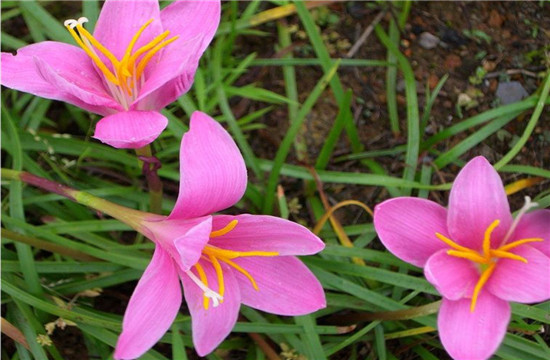
When planting pink rain lilies in gardens, choose a sunny, warm, wind-sheltered location and apply 3-4 topdressings during the growth and flowering period, and they will have lush leaves and abundant flowers. When cultivated in the open field in the middle and lower reaches of the Yangtze River, after heavy frost in severe winter, the old leaves wither, but the bulbs can remain in the ground to overwinter and bloom as usual the following year. For potting soil, mix 2 parts loam, 1 part leaf mold and peat, add a small amount of fine sand, and add a small amount of bone meal and decomposed compost. Pink rain lilies must have sufficient sunlight and water during the growing period. After one batch of flowers fades, pause watering for 7-8 weeks, then resume watering. With such alternating dry and wet intervals, they can bloom 2-3 times a year.
Organic fertilizer can be used, applied once every 2-3 months. Increasing phosphorus and potassium fertilizer proportionally can promote bulb enlargement and good flowering in pink rain lilies. When the plants become crowded in clumps, division must be carried out. It is naturally robust, tolerates drought and high temperatures, and is easy to cultivate. The suitable growing temperature is 22-30 degrees. The planting depth should be such that the top of the bulb is slightly exposed, and divide the bulbs once every 2-3 years. After one batch of flowers fades, water should be withheld for 50-60 days, then normal watering resumed. Such alternating dry and wet conditions can promote repeated flowering in pink rain lilies, and they can bloom 2-3 times a year.
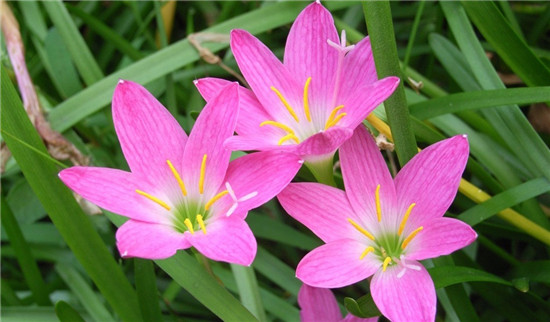
The above is the full content of the cultivation methods and cultivation tips for pink rain lilies that I have summarized for everyone. I hope this article can help you. Please also continue to follow us.