Introduction to the Growth Habits and Growing Characteristics of Autumn Zephyr Lily
Autumn Zephyr Lily (Zephyranthes candida) is a perennial bulbous flowering plant grown for ornamental purposes, with evergreen leaves. As its name suggests, its leaves look like scallions - as delicate and green as scallions, and as elegantly upright as scallions. Now let us take a look at the growth habits of Autumn Zephyr Lily.
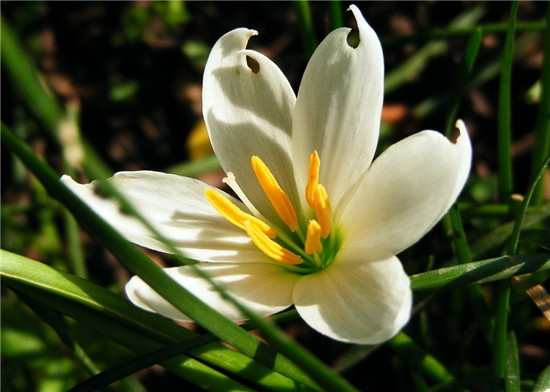
Autumn Zephyr Lily is native to the Americas and is the most common ground cover plant in the Jiangnan region. Plain-looking as it is, people see it as no different from grass; only when the flowering season arrives and it blooms quietly does it move and astonish everyone who sees it. The plant is low and neat, with abundant flowers and a long flowering period. It is often used as edging material for flower beds, and is also suitable for clump planting in green spaces. It is best used as ground cover in semi-shaded areas under trees, or planted beside garden paths.
The flower language of Autumn Zephyr Lily represents first love and pure love. There are only two kinds of pure love in this world: one is first love, and the other is the love spent with a partner who, even in old age, still shares hardships together, respects each other as equals, and stays by your side day and night. Because of its pure white color, Autumn Zephyr Lily has been given the flower language of pure love.
It prefers full sunlight, tolerates semi-shade and low humidity, and favors fertile, slightly clayey soil with good drainage. It is relatively cold-tolerant; in the Yangtze River basin it can remain evergreen, and it can survive for a fairly long time below 0°C. At around -10°C, it will not freeze for a short time, but may freeze to death if exposed for too long.
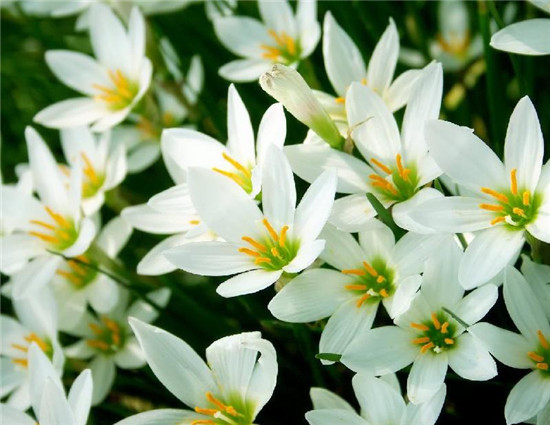
Autumn Zephyr Lily can also be grown in a water tank, producing bright, fresh leaves. By August, the plant height has reached over 30 cm, and at this point it can send out dozens of flower stems; by late September, white flowers open. What is admirable is that these flowers are all located below the water surface; through the clear water, they set off the crystal-clear, pure white Autumn Zephyr Lily flowers at varying heights.
The specific method for growing Autumn Zephyr Lily in water is: prepare several glass fish tanks 90 cm long, 50 cm high and 35 cm wide. In early April, in a white plastic bag or shallow porcelain basin 4 cm to 5 cm high, either oblong or round, filled with soil, arrange plump Autumn Zephyr Lily bulbs at a spacing of 2 cm to 3 cm between plants and rows. The roots should be spread out, press the roots down with clay, fill with soil until level with the top of the bulbs, gently firm the soil, cover the surface with a 0.5 cm layer of coarse sand, and finally separate the bulbs with pebbles. After planting, sink the basin into a water trough or pool, sway it gently from side to side, rinse off the floating mud clinging to the surface, then place it into a fish tank already filled with water. Do not fill the fish tank too full; 4/5 of the tank height is appropriate. To add interest, some small tropical fish can also be kept in the tank.
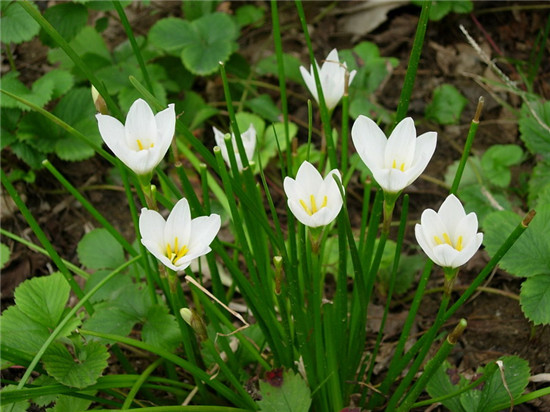
As Autumn Zephyr Lily gradually becomes familiar to people, this plant is widely used in garden landscape combinations and roadside green belts. The fragrance of Autumn Zephyr Lily is not as delicate and fragrant as that of orchids; if it is a single plant, that tiny bit of scent may not even be noticeable. But if a row or a patch of Autumn Zephyr Lily grows together, when a breeze passes, that faint, elusive fragrance drifts through the air - one could say it is a subtle fragrance floating in the air that belongs uniquely to Autumn Zephyr Lily. Besides its graceful form and fresh, lovely color, Autumn Zephyr Lily also has its own unique medicinal uses. According to medical books, Autumn Zephyr Lily is sweet in taste and neutral in nature, and the whole plant contains alkaloids.
In folk practice, if the whole plant of Autumn Zephyr Lily is used as medicine, it has the functions of calming the liver and extinguishing wind, and dispersing heat and detoxifying. It can also be used to treat conditions such as acute infantile convulsions and epilepsy. If used externally, it can treat red, swollen boils and sores. But medical books also warn that the whole plant of Autumn Zephyr Lily contains lycorine, while the petals contain alkaloids such as rutin, pretazettine, haemanthamine and nerrinine. If one consumes Autumn Zephyr Lily without authorization, or accidentally eats the bulbs, it may cause drowsiness, vomiting, diarrhea and weakness. Therefore, when using Autumn Zephyr Lily medicinally, it must be used under a doctor's guidance.
The above is the full content of the growth habits and growing characteristics of Autumn Zephyr Lily that I have summarized for everyone. I hope this article can help you. Please also continue to follow us.