How to grow the spider lily (Hymenocallis) plant? A detailed guide to cultivation methods
The spider lily (Hymenocallis) is a rather distinctive flowering plant, with handsome foliage and unusual flowers. Below I will introduce the cultivation methods for the spider lily.
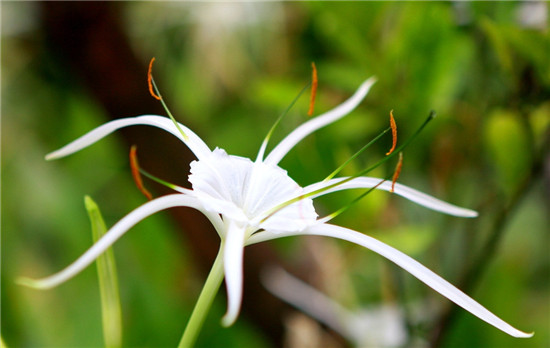
The spider lily, also known as the Peruvian daffodil, American spider lily, spider lily, and spider, is native to southern and central America. It is not cold-hardy and prefers a warm, humid environment. It adapts to a wide range of soils and is suitable for cultivation in clayey soil. The name "spider lily" probably comes from the characteristics of its flowers: the petals are slender and spread wide apart, much like a spider's long legs, while the central part of the flower can be seen as the spider's body. Like many orchids, the spider lily's Latin name also comes from Greek.
The spider lily has several leaves that are dark green and sword-shaped; the flower stem is flattened, the flowers are white and lack a flower stalk; the perianth tube is cylindrical; the flowering period is late summer to early autumn, and the flowers are generally fairly large, with thick petals covered in a waxy layer, generally yellow-green to yellow, and dotted with some brown or purple-brown spots. The inflorescence of the spider lily is a raceme, often bearing many flowers. Its leaves generally grow on both sides of the stem in a very neat arrangement.
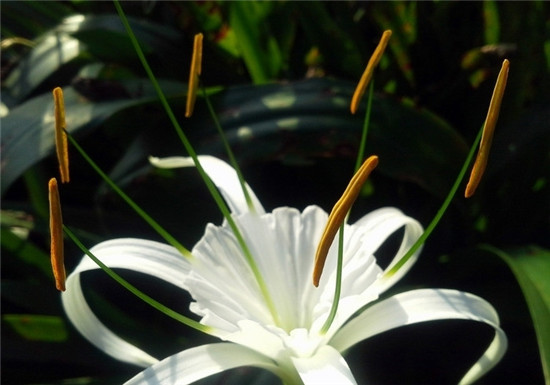
The spider lily likes light, warmth and humidity, and is not cold-hardy; it prefers fertile soil. In warm regions, with just a little care in winter, it can grow and bloom year after year; in the north it is mostly grown in pots, with an overwintering temperature of 15°C. During the growing period, water and fertilizer must be adequate. When planted in the open ground, dig up the bulbs in autumn and store them dry indoors.
Introduction: Native to southern and central America. Not cold-hardy; prefers a warm, humid environment. It adapts to a wide range of soils and is suitable for cultivation in clayey soil.
Propagation: Mainly by division. Each year in March, lift the mother plant out and cut off the side offsets for potting.
Cultivation: Potting is done in March; outdoor planting is best in early May and must be after the frost. During the growing period, keep the soil moist and apply fertilizer once a month. In summer, when the light is intense, place it in a semi-shaded spot. In winter, store the pseudobulbs indoors, requiring 17-20°C, using dry sawdust for storage. The overwintering temperature should not be lower than 15°C.
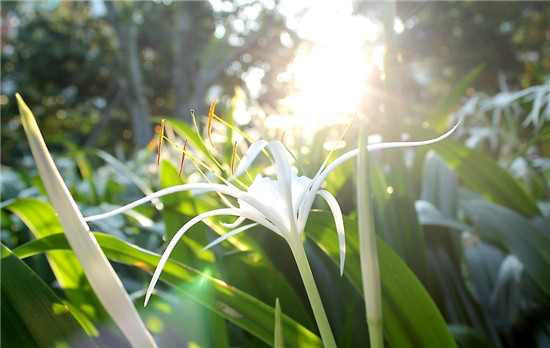
Pests and diseases: The main diseases are leaf spot and leaf scorch. When only a small amount is found, remove and destroy the diseased leaves. In severe cases, spray with a 500-fold dilution of 75% mancozeb wettable powder for control.
Uses: The spider lily has handsome foliage; its flowering period is June-July, the flowers are white with a distinctive shape, standing elegantly upright. It is suitable for potted display. In warm regions, it can be used for courtyard landscaping or as material for flower borders and flower beds.
Cultivation methods for the spider lily
1. Soil: The spider lily is not demanding about soil; it can be potted in leaf mold or planted in clayey soil.
2. Watering: After the spider lily is moved outside in spring, gradually increase the amount of watering as the temperature rises. In midsummer, it is best to spray once in the morning and then water thoroughly in the afternoon, keeping the soil constantly moist and the ambient humidity relatively high. After it is moved indoors in winter, watering should be controlled; as long as the potting soil is kept slightly moist, it can get through the cold winter.
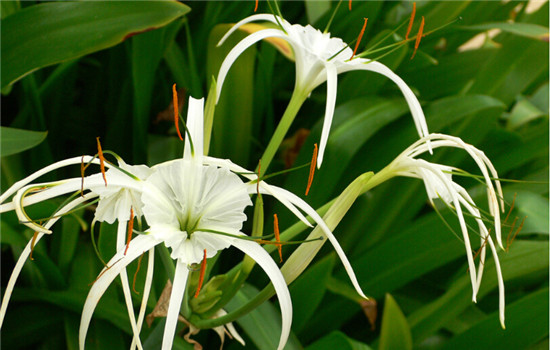
3. Sunlight: The spider lily prefers a semi-shaded environment and dislikes intense direct sunlight. When the light is too strong in summer, it should be shaded appropriately or the pot moved to a semi-shaded spot.
4. Temperature: The spider lily likes warmth and is not cold-tolerant, so the overwintering temperature for potted plants should be above 15°C.
5. Fertilizing: During the growing period, fertilize the spider lily once every half month. After it enters the flowering period, apply manure once every 7-10 days; if phosphorus and potassium fertilizer can be supplemented appropriately, the flowers will bloom even more vigorously.
6. Pests: The main diseases of the spider lily are leaf spot and leaf scorch. When only a small amount is found, remove and destroy the diseased leaves. In severe cases, spray with a 500-fold dilution of 75% mancozeb wettable powder for control.
The above is the complete content of my summary on how to grow the spider lily plant. I hope this article can help everyone. Please also continue to follow us.