Planting Methods and Propagation Techniques for Wedelia trilobata
Wedelia trilobata, also known by the aliases three-lobed wedelia, Dichondra repens flower and Chuandilong. Next, let us take a look at the propagation of Wedelia trilobata.
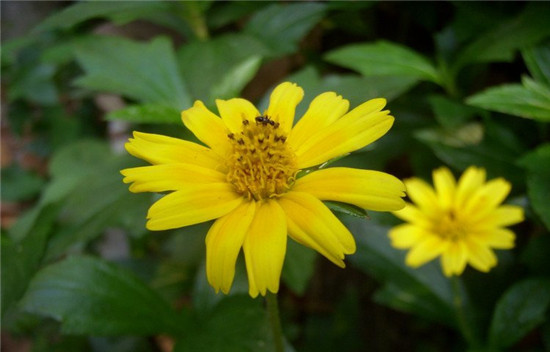
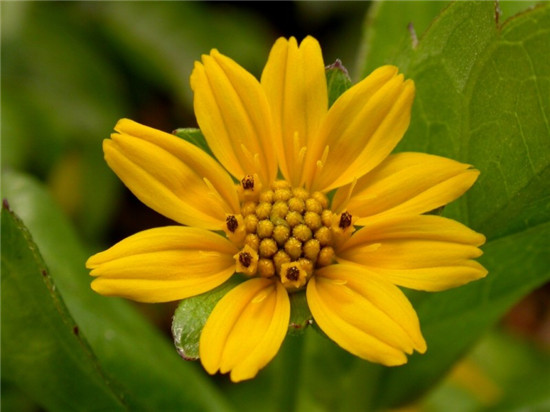
The flowers of Wedelia trilobata have two types of florets: tubular florets and false ligulate florets. Among them, the appendage structure (fleshy spine-like structures) in the petals of the tubular florets may to some extent affect normal pollination; there is no obstacle to pollinators, and the main pollinators are Polistes cornutus and Zizeeria maha. Pollen viability and stigma receptivity are poor, the seed-setting rate is very low, and the seed germination rate under normal conditions is low.
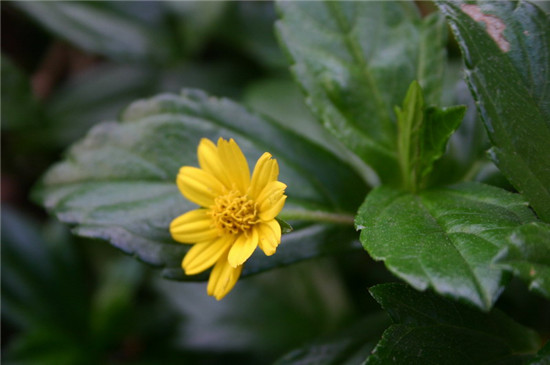
The stems creep and spread horizontally along the ground; when cultivated on high ground they are pendulous, and when cultivated as ground cover they are prostrate. The entire plant is densely covered with stiff short hairs, and roots readily form at the nodes. No stipules; leaves opposite, elliptic to obovate, base cuneate, apex three-lobed acute or obtuse, lower part slightly 3-lobed, upper part with shallow serrate margins, thick in texture, with short bristles, leaf surface glossy, both surfaces rough, palmate veins 3, distinctly sunken.
The capitula are yellow and axillary, with long peduncles; the elongated stems of the double-flowered Wedelia are angular and covered with coarse hairs. Its leaves are ovate, arranged decussately opposite, about 5-14 cm long and about 4-8 cm wide, with serrate leaf margins; although the leaves feel papery to the touch, they still feel rather thick because both upper and lower surfaces are covered with flat-lying stiff hairs; the petiole is quite long, generally 1.2 cm long, sometimes growing to 2.5 cm.
Propagation and Cultivation of Wedelia trilobata
Chuandilong is Wedelia trilobata. Wedelia trilobata, also known by the aliases three-lobed wedelia, Dichondra repens flower and Chuandilong. Asteraceae, Latin name: Wedelia trilobata. Perennial herbaceous plant, native to tropical America. Commonly propagated by cuttings and division.
It is robust in growth and greens up quickly; it can not only stabilize soil and water but also suppress weed growth, with excellent results; however, it does not tolerate trampling and easily harbors snakes and rodents.
Propagation is easy; picking stems and leaves for cuttings will allow them to survive. Mainly propagated by cuttings; the method is to use branches and stems as cuttings; apart from the cold season, it can be propagated at other times.
Autumn sowing is often carried out after mid-to-late September: substrate disinfection. Disinfect the substrate used for sowing; the best method is to heat it in a pot. The cutting substrate is the nutrient soil, river sand, peat soil and other materials used for cuttings.
For home cuttings, it is difficult to obtain an ideal cutting substrate due to limited conditions. It is recommended to use a ready-mixed and sterilized cutting substrate; medium-coarse river sand can also be used, but it should be rinsed several times with clean water before use. Do not use sea sand or river sand from saline-alkali areas; they are not suitable for the growth of flowering plants.
Cultivation Techniques for Wedelia trilobata
Sowing: autumn sowing is often carried out after mid-to-late September: substrate disinfection. Disinfect the substrate used for sowing; the best method is to heat it in a pot, which can scald all pests and diseases to death.
Germination promotion: soak the seeds in warm hot water (at a temperature similar to face-washing water) for 3-10 hours, until the seeds absorb water and swell. For very common seeds that germinate easily, this step can be skipped.
For tiny seeds that are difficult to pick up with hands or other tools, you can moisten one end of a toothpick with water, stick the seeds one by one onto the surface of the substrate, cover with substrate 1 cm thick, then place the sowing pot into water, with the water depth at 1/2-2/3 of the pot height, allowing the water to slowly soak upward (this method is called the "pot immersion method").
For larger seeds that can be picked up with hands or other tools, place the seeds directly into the substrate and sow them in spots at a spacing of 3 x 3 cm. After sowing, cover with substrate to a thickness 2-3 times that of the seeds. After sowing, use a sprayer or a fine-hole watering can to moisten the sowing substrate; afterward, water again when the pot soil is slightly dry, still taking care not to water too forcefully, so as to avoid washing the seeds up.
The above is all the content I have summarized for everyone on the planting of Wedelia trilobata and the propagation of Wedelia trilobata. I hope this article can help everyone. Please also continue to follow us.