Propagation and Cultivation Methods for Sphagneticola trilobata
Sphagneticola trilobata, also known as Sphagneticola trilobata, dijinhua, and chuandilong. Next, let us take a look at the propagation of Sphagneticola trilobata.
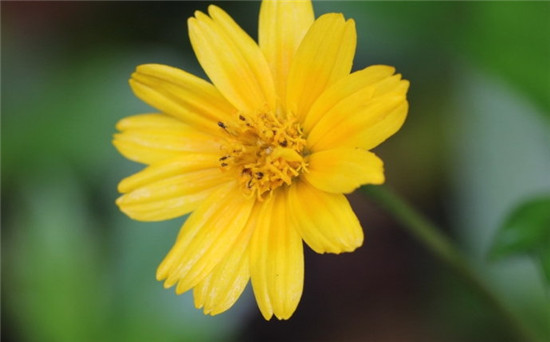
Sphagneticola trilobata is a perennial herb native to tropical America. It is commonly propagated by cuttings and division. It is robust in nature, prefers temperate to tropical climates, and is not tolerant of frost. The flower is solitary and terminal, with a long pedicel, yellow in color, and blooms year-round. It is often used for flower beds and garden landscaping, and can be planted in clumps.
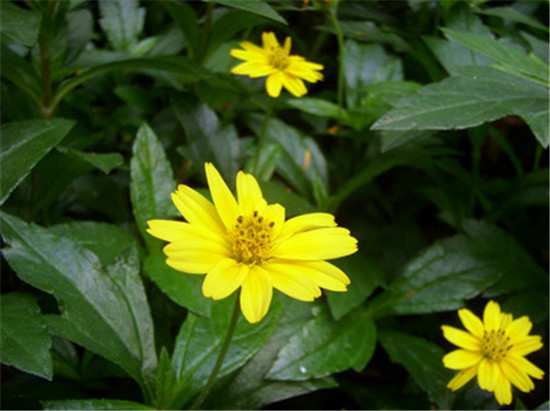
The stem lies prostrate on the ground and bears short hairs. The leaves are opposite, glossy, and thick, and the flowers are bright yellow and axillary, with long stalks. It is used for ground cover, with stems and leaves as green as a carpet and serrated edges. The capitulum is yellow and about 2.5 cm in diameter, mostly used for ground cover. It is a perennial herbaceous flower with persistent roots, blooming continuously throughout the year, and is an excellent ground cover plant. When planted on high ground, it becomes pendulous. The stem is creeping and can reach more than 2 m in length. The flower color is bright yellow, and the foliage is fresh green. It is usually grown mainly for its foliage, with flowers as a secondary feature. It is a sun-loving plant and requires strong light. The optimum growing temperature is 18-30°C.
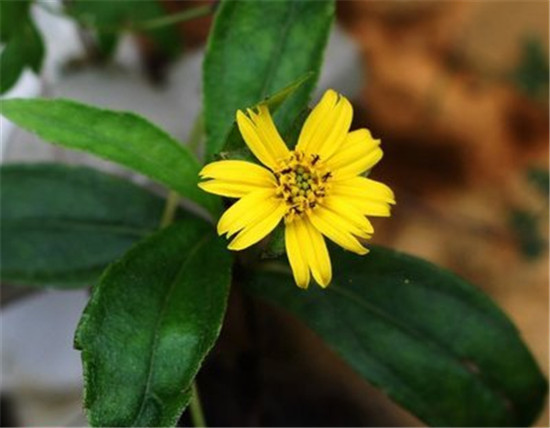
Flower: The capitulum is yellow, solitary at the top of the stem; the ray florets are short and broad, only a few in number, bright yellow and axillary, with long stalks. The flowering period is extremely long, with flowers almost all year round.
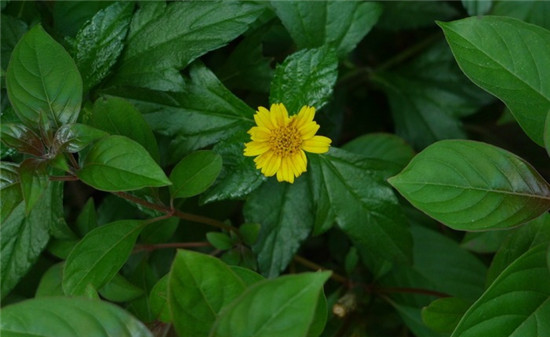
Fruit: The achene is ribbed, with hard pappus at the tip.
The bracts are ovate and covered with coarse bristles. Around the edge are 7 to 9 ray petals, with a short, broad, few-numbered, female corolla. In the center are tubular florets, bisexual, tube-shaped, with five-toothed lobes and a pointed style. After the flowers fade, the corolla looks like a small lotus seedpod. The achene is 3~4-angled, with bristles at the tip.
Sphagneticola trilobata is very robust and greens up quickly. It not only stabilizes soil and water but also suppresses weed growth with excellent results. However, it is not tolerant of trampling and easily harbors snakes and rodents.
Propagation is easy; simply take stem and leaf cuttings and they will root. It is mainly propagated by cuttings; the method is to use branches and stems as cuttings; except in cold seasons, it can be propagated at other times. Autumn sowing is often carried out after mid-to-late September: disinfect the substrate. To disinfect the substrate used for sowing, the best method is to heat it in a wok.
The cutting substrate is the nutrient soil, river sand, peat soil, or other materials used for cuttings. For home cuttings, it is difficult to obtain an ideal cutting substrate due to limited conditions. It is recommended to use the ready-mixed and sterilized cutting substrate provided by this site; medium-coarse river sand can also be used, but it should be rinsed several times with clean water before use. Do not use sea sand or river sand from saline-alkali areas; they are not suitable for the growth of ornamental plants.
For tiny seeds that are difficult to pick up with hands or other tools, you can moisten one end of a toothpick with water, stick the seeds one by one onto the surface of the substrate, cover with substrate 1 cm thick, then place the sowing pot into water, with the water depth at 1/2 to 2/3 of the pot height, and let the water slowly soak upward (this method is called the "pot soaking method").
For larger seeds that can be picked up with hands or other tools, place the seeds directly into the substrate and sow them at a spacing of 3 x 3 cm. After sowing, cover with substrate to a thickness of 2 to 3 times the seed size. After sowing, use a sprayer or a fine-holed watering can to moisten the sowing substrate. Later, when the potting soil is slightly dry, water again, but still be careful not to water too forcefully, so as not to wash the seeds away.
The above is my complete summary of the propagation of Sphagneticola trilobata and the cultivation of Sphagneticola trilobata. I hope this article can help everyone. Please also continue to follow us.