How much does the latest price of a Xifu crabapple tree cost per plant?
The Xifu crabapple (Malus micromalus) has an elegant flower form and blooms in profusion like brocade. Since ancient times it has been a famous flower enjoyed by both refined and popular tastes, long known as the "immortal among flowers," the "imperial consort of flowers," and the "noble one of flowers." Men of letters through the dynasties wrote many widely praised verses in admiration of the crabapple. Lu You wrote in a poem: "Though dazzling, it has no vulgar bearing; the Taihuang is truly rich and noble," describing the crabapple's gorgeous beauty and elegance. In another poem Lu You wrote: "Scarlet red and parrot green achieve the utmost heavenly skill; layered calyxes and double footstalks dazzle the morning sun," describing the crabapple's vivid red flowers and green leaves and its profusion of blooms vying in splendor with the morning sun. Liu Zicui of the Song Dynasty wrote: "With a secluded posture and gentle manner it plays in the spring sunshine; the plum lends it charm, the willow lends it lightness. Through nights of rain its fragrance still remains; dyed all over with rouge, it cannot be painted," describing the crabapple as like a demure and gentle maiden.
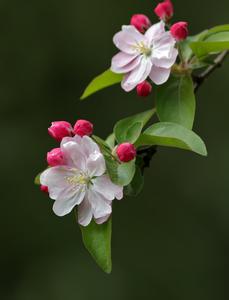
Xifu crabapple -- price
The Xifu crabapple is mainly used as a garden plant for people to admire, and is also often used as a tree species for soil and water conservation and greening. Its flowers can also be used to extract aromatic oil; the flowers and fruit are used medicinally, able to regulate qi and invigorate blood, and to regulate menstruation and strengthen the spleen; the fruit is edible and can also be made into jam. Therefore the Xifu crabapple, which has a certain value, is relatively cost-effective on the market. Generally the price of Xifu crabapple seedlings is around 10 yuan per plant, while the price of potted Xifu crabapples can reach one hundred yuan. The market price of Xifu crabapple generally depends on its own growth conditions.
Xifu crabapple -- introduction
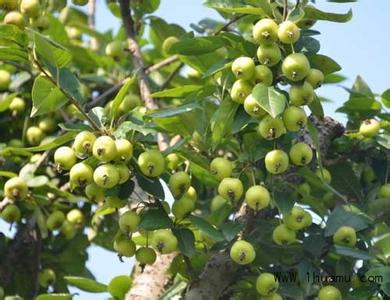
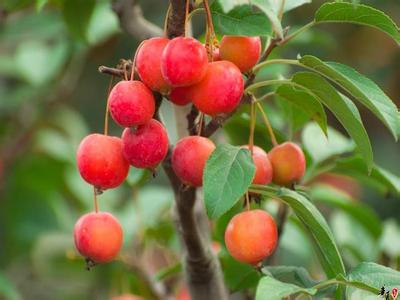
The Xifu crabapple is a plant of the genus Malus in the rose family (Rosaceae). Its leaves are elliptical to long elliptical, 5-8 cm long and 2-3 cm wide, with the tip gradually pointed or rounded and blunt; the inflorescence is nearly umbellate, bearing 5-8 flowers; the fruit is nearly spherical, 1.5-2 cm in diameter, yellow, not sunken at the base, with the calyx lobes persistent; the fruit stalk is slender, 3-4 cm long, slightly thickened at the tip. It is the best product among shrubs and a relatively popular product in greening projects.
Xifu crabapple -- habits
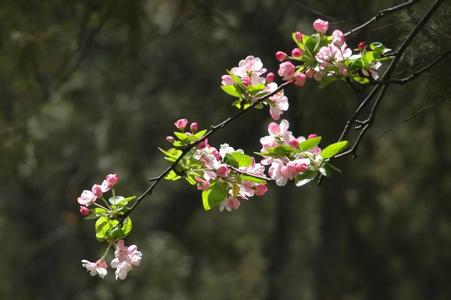
The Xifu crabapple likes to grow in places with sufficient light. It belongs to the sun-loving, cold-resistant plants. The planting site must avoid waterlogging and excessively humid air, but on the whole it does not have high requirements for soil quality and moisture. It grows best in fertile, loose, and well-drained sandy loam. The flowering period is April-May each year, and the fruiting period is September. It also has a certain resistance to harmful gases in the air.
Xifu crabapple -- propagation
Grafting method: Use seedlings grown from seed as rootstock, and carry out twig grafting or bud grafting. In spring, when the sap flows and the plant sprouts, carry out twig grafting; in autumn (between July and September) bud grafting can be done. For twig grafting, methods such as cut grafting and cleft grafting can be used. For the scion, select well-developed 1-year-old branches and take their middle section (with 2 or more plump buds). After grafting, cover the scion with fine soil. For bud grafting, the "T" method is mostly used. About 10 days after grafting, if the bud is fresh and the petiole falls off at a touch, this is proof that the graft has taken, and after a few days the binding material can be removed. When the seedling height reaches 80 cm-100 cm, train the scaffold branches, and thereafter only prune overly dense branches, inward-growing branches, and overlapping branches to maintain a rounded crown.
Division method: Carry out before sprouting in early spring or after leaf fall in autumn and winter. Dig out the suckers sprouting from the root collar, divide and cut them into several individual plants, or take 2-3 rooted suckers as a clump for transplanting. After division and planting, water thoroughly in time, pay attention to preserving soil moisture, provide shade when necessary, and water during drought. Before long, new branches will grow from the broken openings of the remaining roots. After leaf fall in autumn or before sprouting in early spring, dig them out and transplant them, and they become an independent new plant.
The flower language of the Xifu crabapple flower
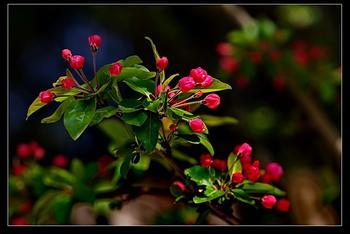
The flower language and symbolic meaning of the Xifu crabapple: unrequited love
The flower color is gorgeous, and it is generally cultivated in courtyards for greening. Among crabapple flowers, the Xifu crabapple has an upright tree form, like a graceful young maiden. Its flowers are a mix of red and pink, its leaves are tender green and lovely, and its fruit is fresh and attractive. Whether planted alone, in rows, or in clumps, it is extremely beautiful. It is best planted by the waterside and in a corner of a small courtyard. In Guo Zhen's crabapple poem, "The red railing shines brightly on the yellow pond; fragrant trees intertwine, pillowed against the low wall," is the most vivid and lifelike portrayal. In modern courtyards, with dark green conifers as the background and crabapples planted in the front row, their colors appear especially striking. If planted in rows as a flowering hedge, with the fresh flowers in full bloom, it is a magnificent sight.
[Morphological characteristics]
Deciduous tree, up to 8 m tall; branchlets cylindrical, upright, red-brown when young, covered with short soft hairs, dark brown and hairless when old; leaves elliptical to long elliptical, 5-8 cm long and 2-3 cm wide, tip gradually pointed or rounded and blunt, base broadly wedge-shaped or nearly rounded, margin with closely appressed fine serrations, sometimes partly entire, both sides covered with soft hairs when young, soon falling off and becoming hairless; petiole 1.5-3 cm long, covered with short soft hairs; stipules membranous, lanceolate, entire. Inflorescence nearly umbellate, bearing 5-8 flowers; pedicel slender, 2-3 cm long, sparsely covered with soft hairs; flower diameter 4-5 cm; outer surface of the calyx tube hairless or densely covered with soft hairs; calyx lobes triangular-ovate, 3- mm long, shorter than or nearly equal to the calyx tube, tip sharply pointed, entire, outer surface hairless or nearly hairless, inner surface covered with white down; petals ovate, with a short claw at the base, 2-2.3 cm long, white, pink to red when first opening; stamens 20-25 (30), half the length of the petals; styles 5, rarely 4, slightly longer than the stamens, base covered with white down. Fruit nearly spherical, 1.5-2 cm in diameter, yellow, not sunken at the base, calyx lobes persistent; fruit stalk slender, 3-4 cm long, slightly thickened at the tip. Flowering period April-May, fruiting period September. The fruit of the Xifu crabapple (crabapple fruit).