Is Ornithogalum caudatum suitable for placing indoors?
Ornithogalum caudatum resembles a tiger's eye, hence the name "tiger's eye Ornithogalum caudatum". Also known as sea onion and bird's milk flower, it is a perennial herbaceous plant. Let's take a look together at whether Ornithogalum caudatum is suitable for placing indoors.
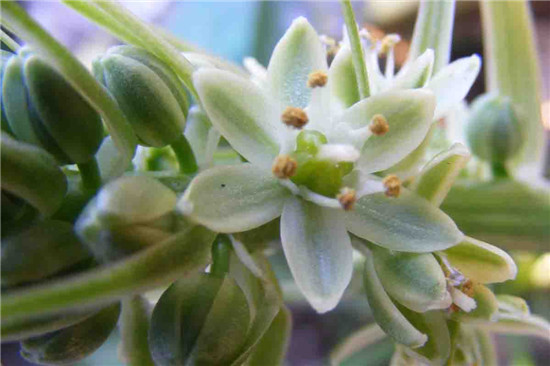
Ornithogalum caudatum is native to southern Africa. It likes sunlight and also tolerates partial shade, is cold-tolerant, fears direct sunlight in summer, prefers a humid environment, and its leaf clusters remain verdant green after heavy frost in winter. It prefers deep, humus-rich, loose, well-drained soil and an environment with partial shade in summer and ample light in winter. It is not cold-tolerant, and the greenhouse in winter needs to be above 8°C. The bulb has a summer dormancy habit, the bulb has strong splitting ability, and the propagation coefficient is high.
Garden uses of Ornithogalum caudatum:
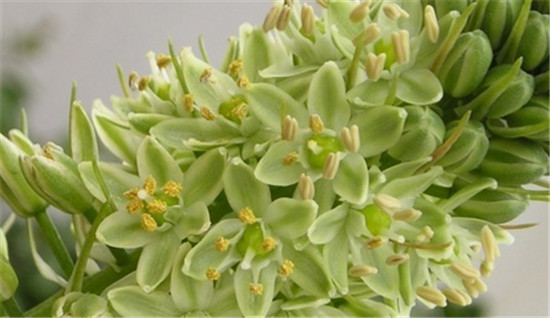
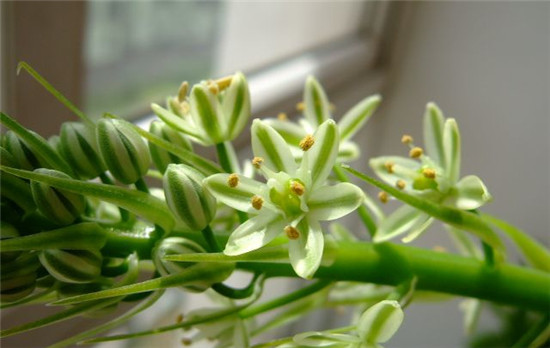
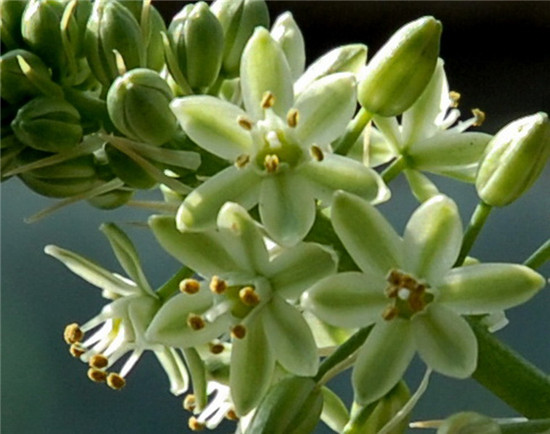
Ornithogalum caudatum: each time it grows a leaf, several small bulbils will grow on the bulb tunic, resembling a tiger's eye, hence the name "tiger's eye Ornithogalum caudatum". Because its spherical bulb resembles a gourd, it is also commonly called "gourd orchid". Ornithogalum caudatum is tender green all year round, with a texture like agate, having a transparent quality, and placed indoors for viewing, it is refreshing and pleasing to the eye. Its leaves are quite distinctive, suddenly tapering from the base to the tip like a needle, bending and drooping, draping around the edge of the pot, swaying with the wind, with a unique charm. Ornithogalum caudatum blooms from mid-April to early May, with white, orange and double-flowered varieties. In spring, the star-shaped white flowers flicker, elegant and simple, making it an excellent material for natural-style gardens and rock gardens, and also suitable for cut flowers and potted viewing.
As a foliage plant for indoors and shaded balconies, appreciating the large leaves and gray-green bulbs, it is mostly used as a potted plant for viewing.
Is Ornithogalum caudatum toxic:
The sap of Ornithogalum caudatum is toxic, generally the stem tissue fluid is more toxic. If the mucus sticks to the hands or skin, it will cause an allergic reaction, producing patches or a very itchy sensation, and if you do not pay attention, the more you scratch, the itchier it becomes.
Because the liquid in the branches and leaves of Ornithogalum caudatum contains toxic alkaloids, touching the skin will cause severe itching and dermatitis. If ingested by mistake, it will cause swelling and pain in the mouth, throat, esophagus, and gastrointestinal tract, and even damage the vocal cords, making a person mute; the leaves and bulbs contain toxic sap.
Effects of Ornithogalum caudatum:
1. Medicinal value: Ornithogalum caudatum has the function of clearing heat and detoxifying, softening hardness and dissipating nodules. Folk use its fresh sap to apply to affected areas to treat sores, and internal use can treat nameless swellings and toxins, hepatitis, cirrhosis, liver cancer, etc., all with good therapeutic effects. It has anti-cancer effects, immune-enhancing effects, and anti-inflammatory effects.
2. Ornamental value: Ornithogalum caudatum is tender green all year round, elegant and simple, with a texture like agate, having a transparent quality, resembling a flying bird in the clouds. It blooms from mid-April to early May, with white, orange and double-flowered varieties. It can be used as a foundation planting or ground cover in landscaping, and is an excellent material for arranging courtyards and rock gardens, and is also suitable as a potted foliage plant for indoors and north-facing balconies, refreshing and pleasing to the eye.
Efficacy of Ornithogalum caudatum:
Folk medicine often uses Ornithogalum caudatum for anti-inflammatory and disinfection purposes, and for treating liver disease, liver cancer, and gallbladder inflammation. From plants of this genus, cholestane glycosides and 22-homo-23-norcholestane glycosides with lymphocyte proliferation inhibitory effects have been isolated, as well as baicalin and emodin ether, and it is rich in steroidal saponins.
1. Ornithogalum caudatum contains a variety of active ingredients, among which polysaccharide compounds have a strong regulatory effect on immune function, and have certain anti-aging, antiviral and anti-tumor effects.
2. Besides having certain anti-inflammatory and disinfection effects, the ethanol extract of Ornithogalum caudatum can inhibit the inflammatory reaction caused by xylene.
3. In domestic and foreign literature, the anti-tumor effect of Ornithogalum caudatum has long been recorded, and Ornithogalum caudatum polysaccharides have very high anti-tumor activity.
The above is all the content I have summarized for everyone on whether Ornithogalum caudatum is suitable for placing indoors. I hope this article can help everyone. Please also continue to follow us.