How do you care for a Portulacaria afra plant, and will it bloom?
In today's constantly evolving world, people's enthusiasm for growing plants keeps growing stronger, the number of plants they grow keeps increasing, and their requirements for the plants they grow keep rising. Choosing a good plant to grow is fairly important for people. Although there are many kinds of plants, people find it fairly difficult to choose. Portulacaria afra is one of the many plants and is fairly commonly grown. Next, let's take a look at how to care for Portulacaria afra and whether Portulacaria afra will bloom.
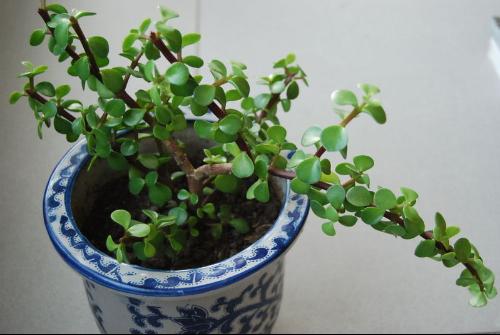
Portulacaria afra is also known as the purslane tree (Portulacaria afra). It is a perennial evergreen plant. The color of its leaves is affected by sunlight. When there is plenty of sunlight, its leaf color is purplish red; when there is not enough sunlight, its leaf color is different and appears green. Its ornamental value is fairly strong.
How to care for Portulacaria afra
1. Temperature: 15-30°C. It likes a warm, dry environment with plenty of sunlight and tolerates partial shade. In summer, provide shade to prevent exposure to the scorching sun, spray the plant with water 2-3 times a day, and pay attention to ventilation. It is afraid of cold, so protect it from freezing in winter; the overwintering temperature should be above 10°C, and below 5°C it is prone to cold damage. Although it can also grow in shady places, the distance between stem nodes becomes longer, and the leaves are large, thin, and lack luster.
2. Water: It tolerates drought and not waterlogging, so do not water too much. Pay attention to ventilation and drainage. In spring and autumn, wait until the soil dries out completely before watering thoroughly. The roots must not be allowed to stand in water, otherwise they rot easily. During the growing season, water according to the rule "do not water until dry, and when you water, water thoroughly." When the summer temperature rises above 30°C, the plant is in a dormant or semi-dormant state, so control watering and you can spray water on the leaves. In winter, water less and keep the potting soil slightly dry.
4. Fertilizer: During the growing season, apply a dilute, fully rotted cake liquid fertilizer once every half month, or a dilute fertilizer solution mainly based on nitrogen fertilizer. If growth is too weak, add a liquid fertilizer containing potassium. It should be light and dilute, not thick. Stop fertilizing in winter. New buds sprout strongly, so prune and remove buds regularly to keep the tree shape attractive.
5. Propagation: Cuttings can be taken in all four seasons, but spring and autumn are best, as rooting is fast and the survival rate is high. The cuttings should be 8-12 cm long. Place them in a cool, ventilated place to dry for 1-2 days so the cut ends dry slightly, then insert them into a propagation sand bed.
6. Pests and diseases: If anthracnose occurs, spray the leaves with 50% thiophanate-methyl wettable powder at 1500 times dilution. Pests include whiteflies and scale insects; spray with 50% fenitrothion emulsifiable concentrate at 1000 times dilution to kill them.
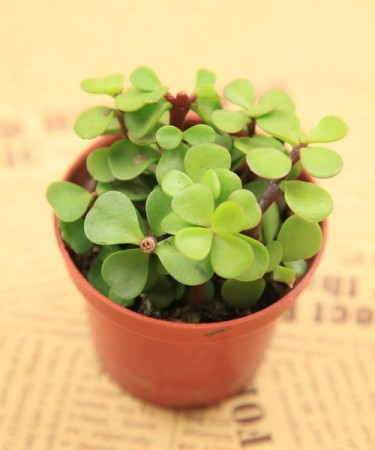
1. Scatter a few soybeans into the growing soil; this can improve the soil and also release nitrogen fertilizer.
2. Remember not to place it indoors for a long time. The soil is best mixed with sawdust, rotted charcoal, and similar materials.
3. Pay attention to observing and recording watering. The root system is fleshy, and too much water makes it rot easily.
4. In winter, keep the room temperature no lower than 10 degrees, and it can overwinter safely.
5. Give it more sun, but the sunlight must not be too intense; about three hours a day is enough.
Will Portulacaria afra bloom?
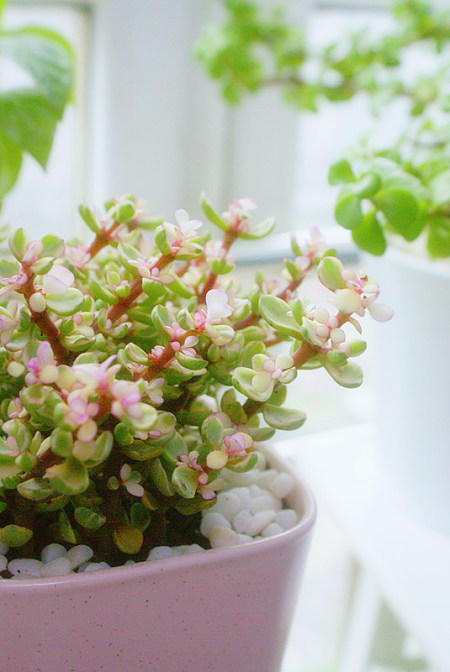
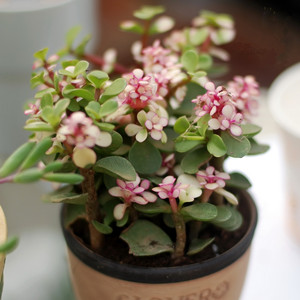
Many flower lovers are very curious about whether Portulacaria afra actually blooms. This is because at flower markets we can always see small red flowers growing on Portulacaria afra, truly "a touch of red in the green forest," which really makes people very happy. According to general growing experience, this plant does not bloom; flower vendors simply insert a special small paper flower (fake) into the branches. When watered, the petals open; ordinarily they are closed. Its relative the jade plant (Crassula ovata, also called the money plant) does bloom occasionally, but even that is extremely rare!
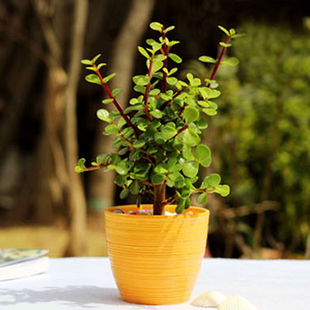
Propagation of Portulacaria afra
Cuttings are commonly used for propagation. Cutting propagation can be done in all four seasons, but spring and autumn are best, with fast rooting and a high survival rate. Generally, select a leafy side branch from a plant with good growth vigor and many side branches. The cutting should be 8-12 cm long. Place it in a cool, ventilated place to dry for 1-2 days so the cut end dries slightly, then insert it into a propagation sand bed. You can also pick off a leaf from the main stem, let the cut end dry slightly, insert it into a sand bed, and keep it at 20-25°C with suitable humidity; it will root in about half a month.
Only after investigating can one speak with authority, fill in this gap about Portulacaria afra, or resolve the doubt.
Propagation of Portulacaria afra
Cuttings are commonly used for propagation. Cutting propagation can be done in all four seasons, but spring and autumn are best, with fast rooting and a high survival rate. Generally, select a leafy side branch from a plant with good growth vigor and many side branches. The cutting should be 8-12 cm long. Place it in a cool, ventilated place to dry for 1-2 days so the cut end dries slightly, then insert it into a propagation sand bed. You can also pick off a leaf from the main stem, let the cut end dry slightly, insert it into a sand bed, and keep it at 20-25°C with suitable humidity; it will root in about half a month.