What Is the Giant Pitcher Plant? A Comprehensive Guide to This Plant
The giant pitcher plant is a new species of pitcher plant, enormous in size, and can even devour prey as large as a rat. Let us now take a look at the introduction to the giant pitcher plant.
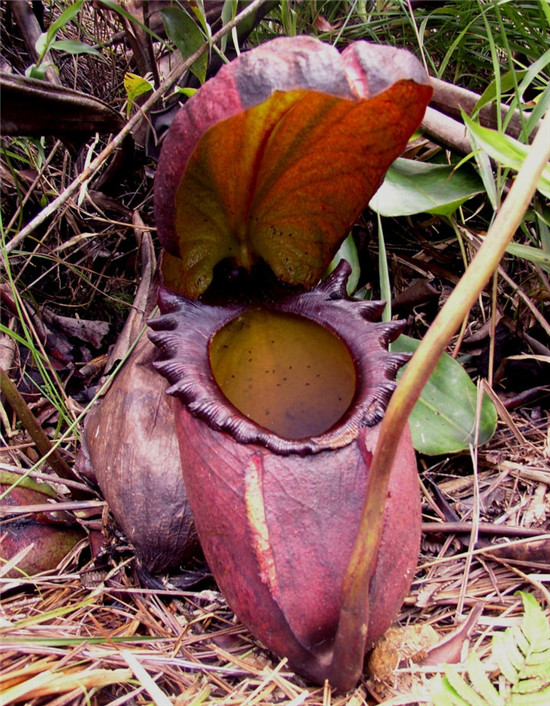
Rumors of this new pitcher plant species first came from two Christian missionaries. As early as 2000, these two missionaries attempted to explore the summit of Mount Victoria in central Palawan, Philippines, and later claimed to have discovered a new species of pitcher plant.
The missionaries' words caught the interest of nature explorer Stewart McPherson, British botanist Alastair Robinson, and Philippine botanist Volker Heinrich. All three are experts in pitcher plant research and had visited many remote places in search of pitcher plant species. Led by three local guides, the three set off in 2007 and began a two-month expedition to Mount Victoria aimed at finding new and unusual plant species. In the lowland forests of Victoria, the three discovered large areas of pitcher plant species previously found by scientists.
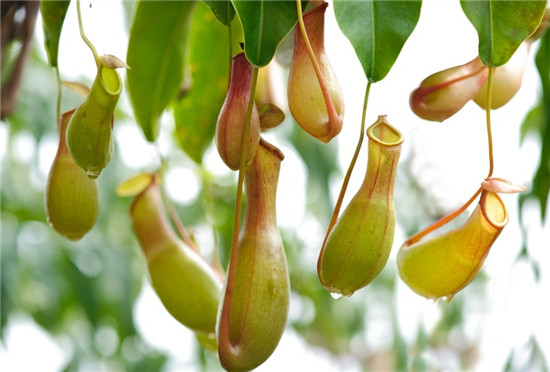
Leaves grow regularly from the stem. The structure connecting the leaf to the stem is called the petiole. At the end of each long, narrow leaf is a tendril. At the tip of the tendril is a small bud that can develop into a pitcher. The pitcher is hugely different from the leaves of ordinary plants, so the pitcher is regarded as a kind of modified leaf. What we see as the part that looks like an ordinary plant leaf is actually the petiole of the pitcher plant.
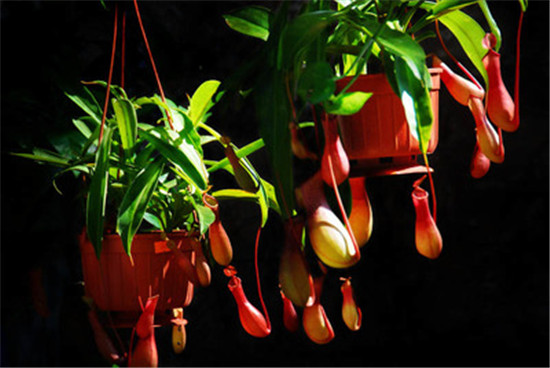
Once the leaves of the giant pitcher plant reach a certain size, they are very distinctive. The leaf texture is tough and the edges are wavy. When set off by tendrils and petioles, the leaf takes on a typical peltate shape. Apart from N. clipeata, this feature of the giant pitcher plant is more pronounced than in other pitcher plants. The tendril emerges from the lower surface of the leaf at about 5cm from the leaf tip and is about 50cm long. Each leaf has 3-5 longitudinal veins, which branch out in several directions to the outer edge of the leaf. The leaves are elliptical to lanceolate, up to 80cm long and up to 15cm wide.
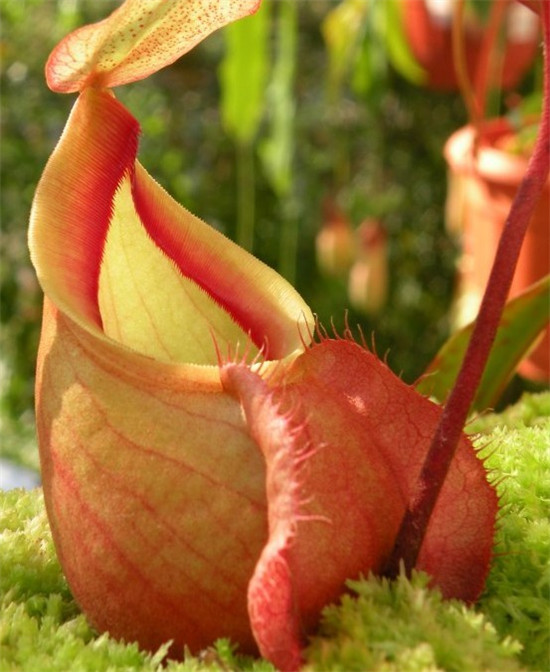
Another notable feature of the giant pitcher plant is that it has the largest arched lid in the genus Nepenthes. The lid is ovate to elliptical, and behind the base of the lid there is an unbranched tendril tail no more than 20mm long.
The pitchers of the giant pitcher plant bear large numbers of nectar glands. This is what distinguishes it from other pitcher plants and makes it easy to identify. The inner surface of the pitcher is almost entirely covered in nectar glands, at a density of 300-800 per square centimeter.
The giant pitcher plant has no fixed flowering season and can bloom at any time of the year. Its flowers emerge from the top of the stem and form a raceme made up of many small flowers, though two-flowered bifurcate pedicels also appear in the inflorescence. The huge inflorescence of the giant pitcher plant can reach 80-120cm in length. It is said that its brownish-yellow inflorescence releases a strong sugary scent. The sepals of the flowers are elliptical and can reach 8mm in length. Like other pitcher plants, the giant pitcher plant is dioecious, meaning that pollination can only occur between different plants to produce the next generation. The seed pods are orange-brown and 1-2cm long.
The above is the full content of the introduction to the giant pitcher plant that I have summarized for you. I hope this article can help you. Please also continue to follow us.