How to propagate Calathea makoyana? Detailed introduction to propagation methods
Calathea makoyana is a common household potted plant, and many families place it indoors as an ornamental. Next, let us take a look at how to grow Calathea makoyana.
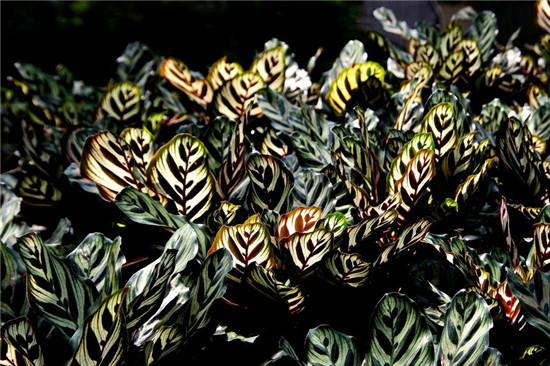
Calathea makoyana is also called blue-flower arrowroot. It is a rather beautiful and delicate herbaceous plant. It is very suitable for placing in offices, while larger ones are suitable for placing in corridors as ornamental bonsai. It is a perennial evergreen herb. It grows 30-60 cm tall, with leaves 15-20 cm long and 5-10 cm wide, ovate-elliptical, thin, leathery, and with purplish-red petioles.
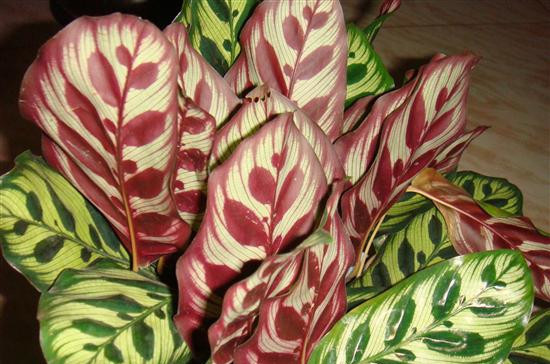
The green leaf surface faintly shows a metallic luster and is bright and gorgeous. Along both sides of the midrib are feather-like, dark green, long elliptical velvety patches arranged alternately left and right. The leaf underside is purplish-red.
It has tubers at the base, and the plant height is 30-50 cm. The leaves are ovate-elliptical, basal, entire, 20-30 cm long and about 10 cm wide, deep purple, with white fine hairs; because the dense filamentous markings on both sides of the main vein on the leaf surface extend from the central vein to the leaf margin and are arranged in a feather-like pattern, and there are obvious small veins between the lateral veins resembling peacock tail feathers, it is named Calathea makoyana; the ornamental markings on the leaf underside are light purple, and the petioles are deep purple.
Cultivation and growing: In spring and autumn, Calathea makoyana can be placed indoors in a spot suitable for full-day light, while in summer it is recommended to provide semi-shade, and in winter if there is little light, fluorescent lamp illumination can be used. The general temperature is best kept above 20°C, but not higher than 35°C, because otherwise it will be scorched. Leaves curl because of high temperatures. In winter it must not go below 5°C. Calathea makoyana likes a humid environment, so it is generally recommended to keep the humidity for the arrowroot at around 70%. During growth, water thoroughly to maintain soil moisture, but be careful not to let water accumulate.
Daily care: If you find that the Calathea makoyana plant is relatively small and the markings are dull, then it indicates a lack of fertilizer. It is generally recommended to fertilize once every 20 days during the growing season, and it is recommended to apply thin fertilizer. When growth stops in winter and summer, it is recommended to stop fertilizing. Watering is the most important part. During the growing season, water enough, but do not let water accumulate. After flowering, pay attention to controlling watering, and it is generally recommended to water after the soil dries.
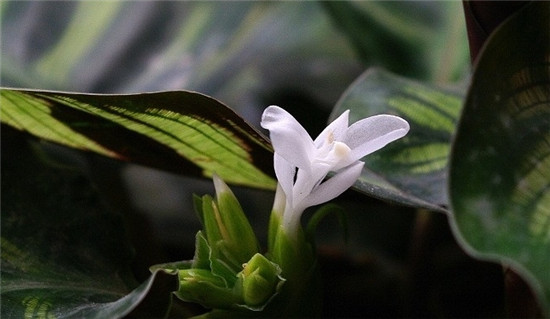
Cultivation precautions: Calathea makoyana is a shallow-rooted plant. Before planting or transplanting, you can choose a wide-mouthed shallow pot as the container. For the soil, it is recommended to mix sandy soil with garden soil, preferably containing some humus. Repotting is generally done once every 2 years. In winter, special attention must be paid to care, because too much watering or low temperatures in winter can both cause death.
How to grow the leaves of Calathea makoyana well: When growing Calathea makoyana at home, humidity must be controlled. Apart from summer and winter, it is recommended to spray and wash once every 3-5 days. Those with a greenhouse can also raise the greenhouse temperature to increase humidity. To make the leaf color full and gorgeous, it is recommended to apply a thin liquid fertilizer once every 3-4 weeks during the growing season, along with watering with nutrient solution 1-2 times per month. The most important thing is to provide more sunlight, because if it is placed in a dim place for a long time, the leaves will lose their unique gorgeous luster. In daily care, often gently wipe the leaves with clean water. Only by doing the above aspects can the leaf color of Calathea makoyana remain beautiful.
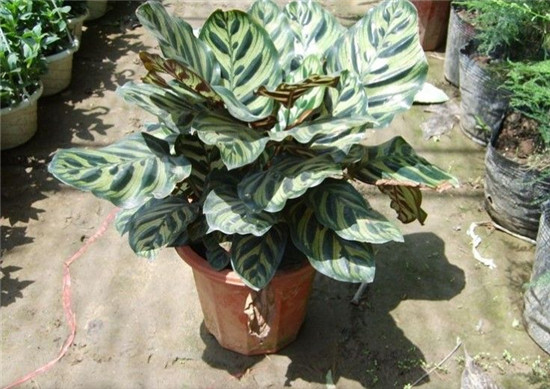
Uses of Calathea makoyana: The most important value of Calathea makoyana is ornamental. Its leaves are not only beautiful, but it is also relatively good at tolerating shade or light. Its growing leaves cluster together, making it a rather ideal green plant for home planting. Whether in a large group or as a single Calathea makoyana, it looks very good. Many people like small potted plants and place them beside the computer.
The formaldehyde-removal effect of Calathea makoyana is half that of spider plant, but it is also much higher than ordinary plants. In addition, it is also an expert at removing ammonia pollution from the air (within 10 sq m it can remove 0.86 mg of formaldehyde and 2.19 mg of ammonia).
The above is all the content I have summarized for everyone on the propagation methods of Calathea makoyana. I hope this article can help everyone. Please also continue to follow us.