How to Grow Snake Plants? A Detailed Guide to Care Methods and Planting Tips
The snake plant (Sansevieria) is native to western and southern Africa. Because of its high ornamental value, it is now grown as an ornamental potted plant and can be seen all over the world. Next, I will introduce snake plant cultivation for you.
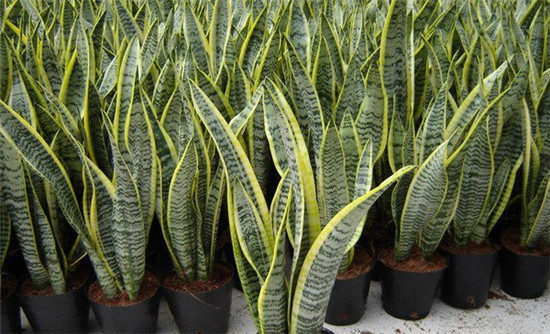
The snake plant, also known as mother-in-law's tongue or bowstring hemp, is a plant in the Asparagaceae family, genus Sansevieria. Varieties include the golden-edged snake plant and the silver-veined snake plant. The underground stem is branchless, and the leaves grow in clusters, tubular at the lower part and flat in the middle and upper parts, with stiff, upright sword-shaped leaves. The plant grows 50 cm to 70 cm tall, with leaves 3 cm to 5 cm wide and entire margins. The surface is mottled with milky white, pale yellow and dark green in horizontal bands. The golden-edged snake plant has golden-yellow leaf margins 1 cm to 1.6 cm wide. The silver-veined snake plant has longitudinal silvery-white stripes on the surface. With good care as a household potted plant, the whole plant's leaves can reach more than 1.2 m tall. The flower stalk emerges singly from the rhizome, bearing a raceme with pale white to light green flowers, in clusters of 3 to 5 borne on the flowering stalk.
Golden-edged snake plant: also known as the yellow-edged snake plant. It is a cultivated variety of the snake plant. The leaf margins have thin yellow band-like stripes, the middle is light green, and there are dark green horizontal stripes. It has higher ornamental value than the snake plant.
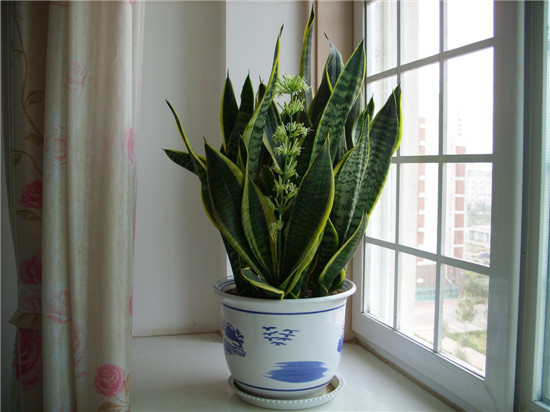
Short-leaved snake plant: the short-leaved snake plant is a cultivated variety of the snake plant. The plant is low-growing, no more than 20 cm tall. The leaves spiral outward from the center, overlapping each other to form a bird's nest shape. The leaves are short and wide, long ovate, with tapering tips and a distinct short tail-like point. The leaves are 10-15 cm long and 12-20 cm wide, deep green in color, with relatively wide yellow bands along both sides of the leaf margins and irregular silvery-gray streaks on the leaf surface. The leaves grow in clusters and are lush.
Silver short-leaved snake plant: also known as the silver-edged short-leaved snake plant. It is a cultivated variety of the snake plant. Its plant shape and leaf shape are similar to the short-leaved snake plant. The leaves are short, silvery-white, with indistinct horizontal stripes.
Golden-edged short-leaved snake plant: also known as the yellow short-leaved snake plant. It is a variety of the short-leaved snake plant. Apart from the yellow band along the leaf margin being wider and accounting for about half of the leaf, its other characteristics are similar to the short-leaved snake plant. The leaves are short, broadly oblong, and arranged in a rosette. Its ornamental value is higher.
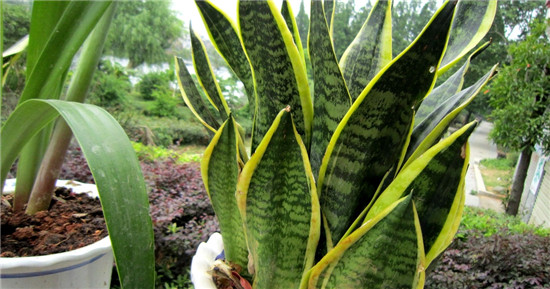
Stone pencil snake plant: the stone pencil snake plant is a common species in the same genus. The leaves are cylindrical, roughly the same thickness from top to bottom, with slender pointed tips and longitudinal shallow grooves on the surface. The leaves are 1-1.5 m long and about 3 cm in diameter. The leaf bases overlap left and right, and the leaves rise in the same plane, spreading out like a fan. Its form is unusual and its ornamental value is relatively high.
Snake Plant Care Methods
First, choosing the soil. Snake plants need loose soil with good air permeability, so when mixing soil for them, be sure to use 2/3 leaf mold plus 1/3 garden soil. Remember that the soil must be loose and breathable, otherwise water will not evaporate easily, causing the rhizome to rot.
Second, sunlight requirements. Snake plants love light, so make sure they get regular exposure to sunlight. Ideally, place them somewhere they can be directly hit by sunlight. If conditions do not allow this, then place them somewhere close to the sunlight. Being kept in a dark place for a long time will cause the leaves to turn yellow.
Third, temperature. Snake plants have fairly high temperature requirements. Their suitable growing temperature is 20-30°C, and in winter it should not drop below 10°C, so be sure to pay attention, especially in northern regions.
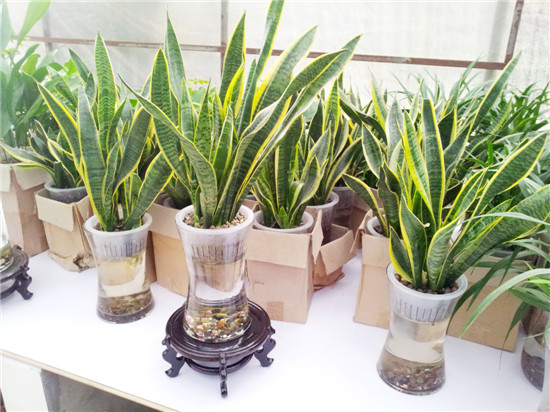
Fourth, watering. Snake plants also have fairly high water requirements. Generally speaking, if the soil is relatively loose, they need watering twice a week, while in winter, due to climatic factors, only once is enough.
Fifth, pruning. Compared with other household green plants, snake plants grow relatively fast, so once the pot is full, manual pruning is needed, mainly by cutting away old leaves and overly dense areas to ensure they get sunlight and growing space.
Sixth, repotting. Snake plants are perennial plants. Generally speaking, they need to be repotted once every two years. When repotting, be sure to add nutrients to the new soil so as to ensure their nutrient supply.
Precautions for Snake Plants
In general, for snake plant care precautions, you just need to follow your usual care habits, but note that the soil should be replaced about every 2 years, which is what is called repotting. Pay special attention to handling the soil around the root system.
The snake plant is also called the tiger skin plant. It can be grown indoors all year round, though in spring and autumn it is recommended to grow it outdoors, as this is good for its growth. In winter and summer, it is recommended to place it in a bedroom or living room, taking care to keep it warm and protect it from heat.
When watering, be careful not to water at low temperatures. If you water too much in winter, root rot and leaf rot will appear in summer.
Generally, snake plants are quite suitable for placement in the living room or rooms, because they can absorb ammonia, formaldehyde and other harmful substances from home decoration.
The above is the full content of the snake plant care methods and snake plant planting tips I have summarized for you. I hope this article can help you. Please also continue to follow us.
This is good for its growth. In winter and summer, it is recommended to place it in a bedroom or living room, taking care to keep it warm and protect it from heat.When watering, be careful not to water at low temperatures. If you water too much in winter, root rot and leaf rot will appear in summer.
Generally, snake plants are quite suitable for placement in the living room or rooms, because they can absorb ammonia, formaldehyde and other harmful substances from home decoration.
The above is the full content of the snake plant care methods and snake plant planting tips I have summarized for you. I hope this article can help you. Please also continue to follow us.