What is the flower language of cosmos? The flower language and symbolism of cosmos
Cosmos, also known as autumn cosmos, gesang flower, and Zhang Daren flower, is an annual herbaceous plant. Next, let's take a look at what the flower language of cosmos is.
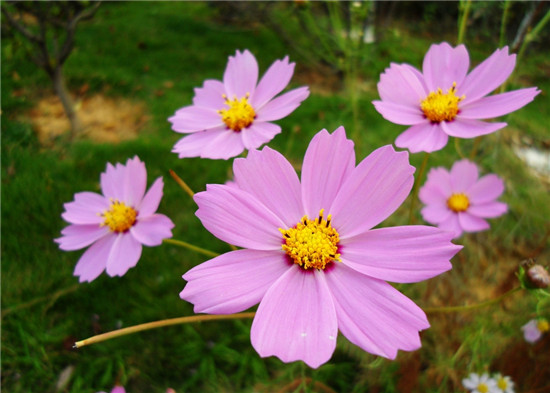
Cosmos is native to Mexico. It loves light, tolerates poor soil, dislikes fertilizer, and dislikes overly fertile soil, heat, and waterlogging. It is not suited to high summer temperatures and is not cold-hardy. It needs loose, fertile, and well-drained loam. It belongs to the Asteraceae family, Cosmos genus. It is a herbaceous plant with slender, upright stems and opposite simple leaves. The flower heads grow on slender pedicels, either terminal or axillary. The tubular flowers occupying the central part of the flower disk are all yellow. The achenes have ribs, the seeds remain viable for 3-4 years, and the thousand-grain weight is 69. The flowering period is summer and autumn.
Cosmos is vigorous, loves sunlight, tolerates drought, and is not demanding about soil, but it cannot tolerate waterlogging. If it is planted in fertile soil, it easily causes excessive vegetative growth of branches and leaves, affecting flowering quality.

When the seedlings are 5 cm tall, transplant them; when they have 7-8 leaves, plant them in their final position. They can also be sown directly and then thinned. If base fertilizer is applied to the planting site, no further fertilization is needed during the growing period. If the soil is too fertile, the branches and leaves tend to grow excessively and flowering decreases. Alternatively, during the growing period, apply diluted decomposed urine at 5 times the water ratio once every 10 days. In dry weather, water 2-3 times and they will grow and bloom well. Plants that bloom during the high-temperature period from July to August do not easily set seed. Seeds fall off easily after ripening, so they should be collected in the early morning. Cosmos is a short-day plant. Spring-sown seedlings often have lush leaves but few flowers, while summer-sown seedlings are short, neat, and bloom continuously. It grows quickly and can be pinched back multiple times to increase branching.
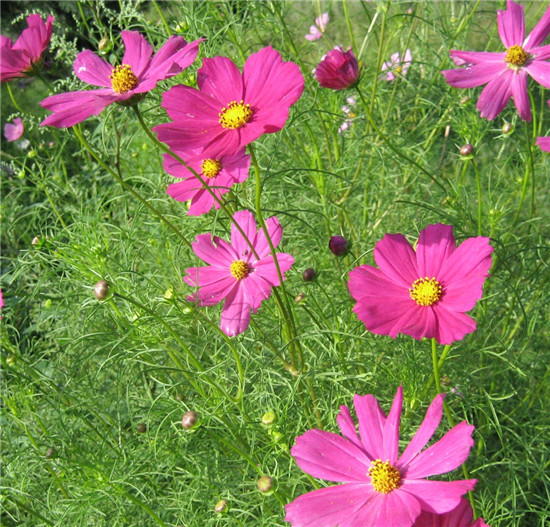
Cosmos is an annual herbaceous plant. The plant height is 120 to 150 cm. The stems are slender and upright, with a free and easy plant form. The leaves are opposite, bipinnately parted, with sparse, linear, entire lobes. The flower heads are single-layered, with truncate or slightly notched tips. The flower colors range from white and pink to purplish red. The tubular flowers in the center of the disk are yellow. The flowering period is from September to frost.
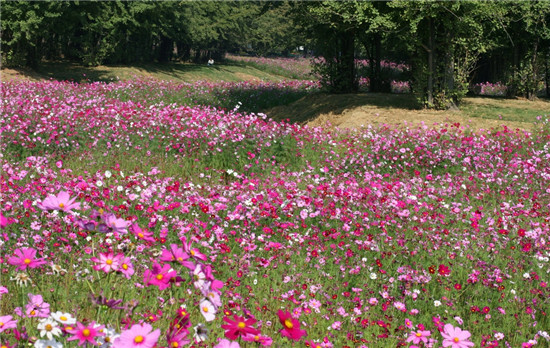
The flower language of cosmos is the true heart of a young girl, maidenly purity, representing pride, extraordinaryness, mystery, cleanliness, nobility, first love, freedom, cheerfulness, and eternal happiness. The flower language of cosmos also differs by color: the flower language of white cosmos is purity, while red cosmos symbolizes being amorous. Anyone born under the blessing of this flower is very rational; they have a strong curiosity for knowledge, can study tirelessly throughout their life, and thus achieve success.
Cosmos has a tall plant form, elegant leaf shape, and rich flower colors, including pink, white, and deep red. It is suitable for flower borders and for planting in masses along grassland edges, around tree clusters, and beside roads for beautification and greening, with a rather wild charm. Double-petaled varieties can be used as cut flower material. It is suitable as a background material for flower borders and can also be planted beside hedges, rocks, cliff slopes, tree beds, or homes.
The above is the complete content of my summary of what the flower language of cosmos is and the flower language and symbolism of cosmos. I hope this article can help everyone. Please also continue to follow us.